'One Year of Martial Law' Foreign Press Conference
"If It Helps U.S.-North Korea Dialogue, Joint Military Exercises Can Be Discussed"
Securing Nuclear-Powered Submarines Cited as the Greatest Achievement of Two South Korea-U.S. Summits
"Trump Also Proposed a 50-50 Partnership on Uranium Enrichment"
"No Nuclear Armament, Denuclearization Is the Fundamental Principle"
"No Taking Sides in China-Japan Conflict... Continued South Korea-China and South Korea-Japan Cooperation"
President Lee Jaemyung stated that he is willing to apologize to North Korea regarding the previous administration's secret anti-North Korean leaflet (psychological warfare) operations, but has refrained from doing so due to concerns over domestic political attacks accusing him of being pro-North. He also indicated that, if necessary to create conditions for dialogue between North Korea and the United States, discussions could be held about scaling back joint South Korea-U.S. military exercises.
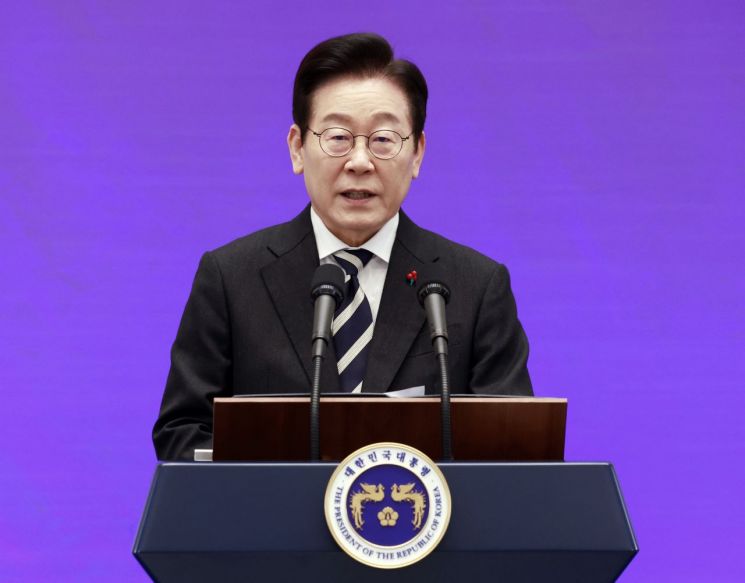
On the morning of December 3, at a press conference for foreign correspondents held at the State Guest House of the Blue House in Seoul to mark the first anniversary of martial law, President Lee responded to a foreign journalist's question: "You commented on social media that the former president's covert leaflet operations against North Korea brought the Korean Peninsula to the brink of war. Are you willing to offer a state-level apology to ease inter-Korean tensions?"
President Lee began by saying, "I don't know how you can read my mind to ask such a question. I simply cannot bring myself to say it." He continued, "Although I believe an apology may be necessary, I am concerned that this could become, in our terms, a tool for political ideological confrontation or accusations of being pro-North. That is why I have not been able to say it." This is the first time he has directly mentioned the need for an apology to North Korea in a public setting.
However, President Lee added, "I will leave it at that," and refrained from elaborating on the specific method, timing, or format of an apology. Although he did not use the phrase "state-level apology" directly, by acknowledging responsibility for the previous administration's operations in the context of inter-Korean relations, attention is now focused on his future actions.
Additionally, regarding his "Pace-Maker" initiative, President Lee explained, "Currently, inter-Korean dialogue is completely severed, with not even a needle's eye open. The only thing we can do is take unilateral conciliatory measures. North Korea perceives the United States as the key party capable of guaranteeing regime security." He added, "President Donald Trump has a strong will for peace and can play a significant practical role. We will do our utmost to cooperate on all conditions we can to facilitate U.S.-North Korea dialogue."
In particular, he indicated that if it would help facilitate U.S.-North Korea talks, discussions could be held about reducing joint South Korea-U.S. military exercises. President Lee said that even the willingness to discuss and consider the issue of joint exercises, if necessary and if it would aid U.S. strategic leverage, would help create favorable conditions for negotiations. "We must constantly play the role of an adjuster to foster the right environment, and that is the path to independently resolving issues on the Korean Peninsula," he said.
The Greatest Achievement of Two South Korea-U.S. Summits: Securing Nuclear-Powered Submarines..."Trump Also Proposed 50-50 Partnership on Uranium Enrichment"
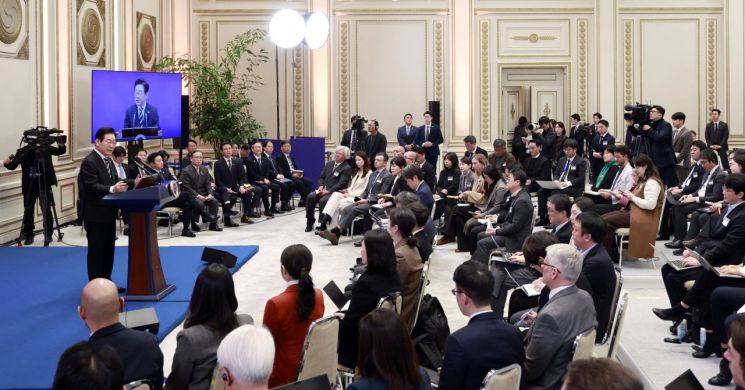
President Lee cited the securing of nuclear-powered submarines as the greatest achievement from the two summits held with U.S. President Donald Trump this year. "From the perspective of strategic flexibility and autonomy, this is an extremely beneficial outcome for us," he said. Regarding the construction site for the submarines, he noted, "President Trump suggested building them at the Philadelphia Naval Shipyard in the United States, but from our perspective, that is highly unrealistic. Producing them domestically is preferable both economically and for military security."
He also revealed that, in order to introduce nuclear-powered submarines, the South Korean and U.S. presidents agreed to expand South Korea's rights to enrich uranium and reprocess spent nuclear fuel. President Trump proposed that South Korea independently produce nuclear fuel and engage in a 50-50 partnership. President Lee explained, "President Trump made it clear that he approves the construction of nuclear-powered submarines. When I mentioned that about 30% of our nuclear reprocessing and uranium enrichment comes from Russia, President Trump said, 'If you produce it domestically, you'll have plenty left over. Let's do a 50-50 partnership.'" President Trump made this proposal himself and assigned the partnership role to U.S. Secretary of Commerce Howard Lutnick.
President Lee drew a clear line regarding the arguments about South Korea's nuclear armament raised in some quarters in the United States. When a foreign journalist raised concerns that cooperation on nuclear-powered submarines and the nuclear fuel cycle could undermine nonproliferation norms, President Lee responded, "We will not pursue nuclear armament. We are not seeking nuclear weapons."
He continued, "Nonproliferation is a fundamental international principle, and denuclearization of the Korean Peninsula is a basic principle agreed upon by both Koreas. If we pursue nuclear armament, we cannot tell North Korea to abandon or stop producing nuclear weapons." He added, "If South Korea goes nuclear, it could trigger a 'nuclear domino' effect in Japan, Taiwan, and elsewhere, and we would have to endure severe sanctions. That would be irrational behavior."
Regarding the controversy over nuclear-powered submarines and uranium enrichment and reprocessing, he emphasized that these do not violate nonproliferation norms, and, conscious of concerns in the United States, reiterated, "We have neither the intention nor the need to pursue nuclear armament."
"No Taking Sides in China-Japan Conflict... Continued South Korea-China and South Korea-Japan Cooperation"
Questions on diplomatic and security issues continued. When asked about his stance on supporting Japan in the event of a Taiwan contingency and how he views the Japan-China conflict, President Lee said, "There is a saying that you should mediate fights and encourage negotiations. Taking sides only exacerbates conflict." He continued, "Northeast Asia is economically vibrant but extremely dangerous in terms of military and security. It is desirable to find common ground for cooperation and, where possible, to play a role in minimizing conflict and acting as a mediator or coordinator."
On South Korea-Japan relations, he mentioned historical and territorial disputes such as Dokdo and the Sado mine, and said, "If we sever all ties because of problems, we will end up isolated. We must resolve historical issues as tasks in their own right, but continue cooperation in areas such as the economy, security, and culture." Regarding shuttle diplomacy between South Korea and Japan, he said, "It must continue. As it is my turn to visit, I have expressed my desire to hold a summit in Prime Minister Sanae Takaichi's hometown."
Regarding talks with Chinese President Xi Jinping, he said, "It was a good opportunity to reset and newly develop South Korea-China relations. I hope to visit China as soon as possible and have in-depth discussions across various fields." However, he added, "Although I had hoped to visit China this year, it seems it will take longer due to China's internal circumstances."
On Russia and North Korea-Russia relations, he said, "Due to Russia's illegal invasion of Ukraine, international sanctions continue and South Korea is also participating. Although North Korea-Russia relations are developing in a direction that is far from desirable for us, we cannot give up. We must work to prevent further deterioration and strive for improvement."
"K-Democracy: Peaceful Direct Action... Deserving of the Nobel Peace Prize"
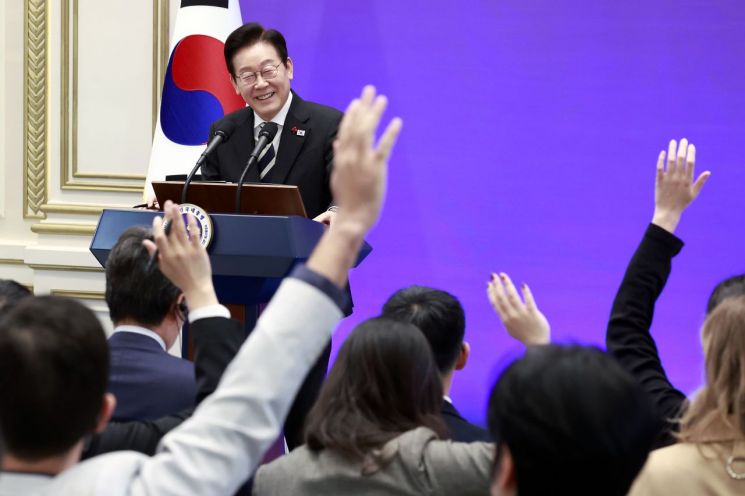
When asked about the characteristics of "K-Democracy," President Lee highlighted "peaceful direct democracy based on collective intelligence" as a key concept. He said, "Korean democracy is unique. The people do not simply delegate power but act directly, yet their actions are peaceful and beautiful, not violent. And they never give up."
He continued, "Even when hundreds of thousands or millions gather, not a single window is broken. There was no violence during the Candlelight Revolution. It may be the first case in world history where the power of reality was brought down through the bloodless, peaceful actions of the people." This reiterates his previous statement in a special address that "the Korean people deserve the Nobel Peace Prize."
President Lee said, "While Athenian democracy is an ideal of the distant past, Korean democracy is a living model in the present. The strength of Korea comes from democracy. Valuing people and a citizenry with a strong sense of sovereignty that does not tolerate undemocratic systems have been the driving forces behind national development."
Concluding the press conference, President Lee said, "During this recent rebellion, I was reminded of how the truth was concealed by media control and distorted reporting during the Gwangju Democratization Movement. It was the reporting of foreign photojournalists that revealed the reality in Gwangju. Once again, thanks to the active reporting of domestic and international media, the people were able to act directly as sovereign citizens." He added, "I hope you will continue to share the reality of K-Democracy with global citizens," expressing his gratitude to the foreign correspondents.
© The Asia Business Daily(www.asiae.co.kr). All rights reserved.