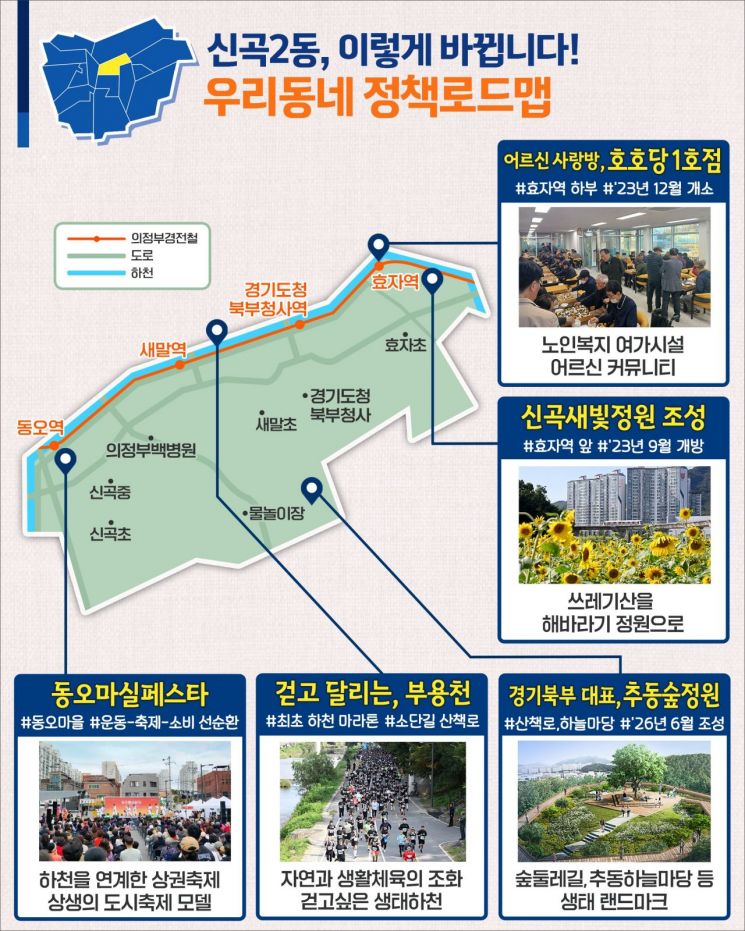
[Feature] Uijeongbu City Unveils "Our Neighborhood Policy Roadmap: Singok 2-dong Edition"
Major Upgrades to Ecological and Living Infrastructure Centered on Buyongcheon Stream
Creating a Safe and High-Quality Living Environment for Children
From the Barefoot Path to Hoho-dang and the Forest Garden: Accelerating Citizen-Focused Change
Uijeongbu City in Gyeonggi Province (Mayor Kim Dongkeun) announced the "Our Neighborhood Policy Roadmap" for Singok 2-dong on December 3, signaling an upcoming transformation of the local living environment. The roadmap systematically organizes information on administration, infrastructure, welfare, and culture at the neighborhood level, focusing on establishing a green living zone centered around Buyongcheon Stream that integrates ecology, commercial districts, and leisure, as well as expanding customized infrastructure for all age groups from children to seniors.
Buyongcheon Ecological and Commercial Space: A Place for Walking, Staying, and Consumption
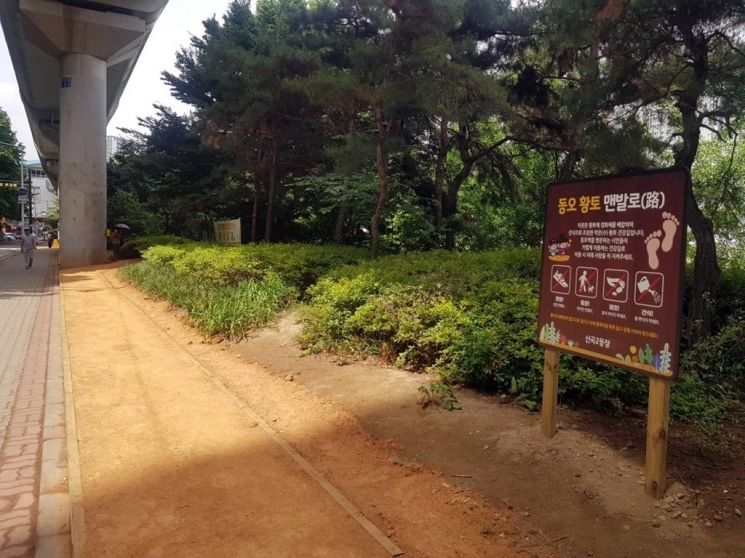
In Singok 2-dong, leisure spaces for walking and resting are rapidly expanding around Buyongcheon Stream. In 2024, a 120-meter-long "Dong-o Hwangto Barefoot Path" was created under the Dong-o Station of the light rail, adjacent to Buyongcheon, and has become a popular health walking course for people of all ages.
This section is particularly important for providing a safe walking environment, as it is located near Dong-o Elementary School, Singok Elementary School, Singok Middle School, and the Uijeongbu Senior Club, serving both children and seniors. Thanks to the unique features of the space under the light rail, it can be used even in rain or snow, making it a natural resting area for seniors on morning walks, students on their way home from school, and office workers during lunchtime.
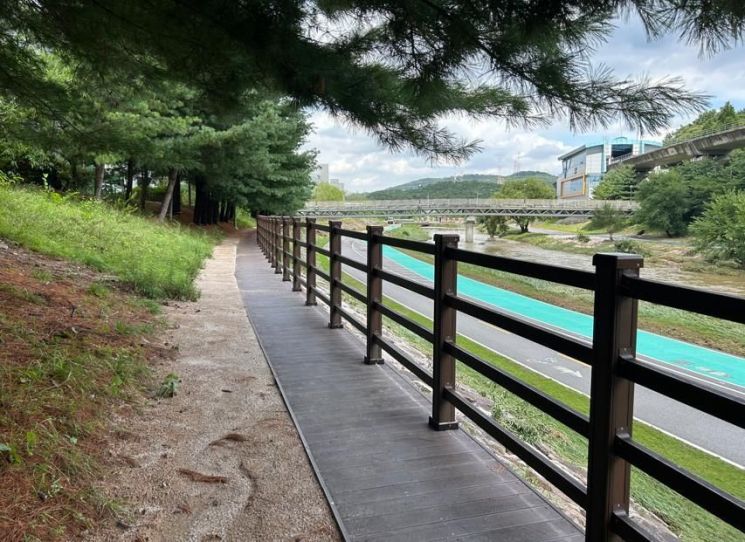
The barefoot path is being extended beyond Dong-o Station, with expansions this year including Saemal Station to Northern Government Complex Station (300 meters), and Northern Government Complex Station to Hyoja Station (280 meters), covering the entire buffer green space under the light rail and forming a continuous walking corridor connected to Buyongcheon Stream.
Additionally, the section from Hyoja Station to Uisun 1 Bridge (480 meters) has seen its previously narrow walkway widened into a deck road, greatly improving both width and pedestrian flow. The previously crowded dirt and concrete path has been redeveloped into a decked walking trail, making it much easier for people to pass each other.
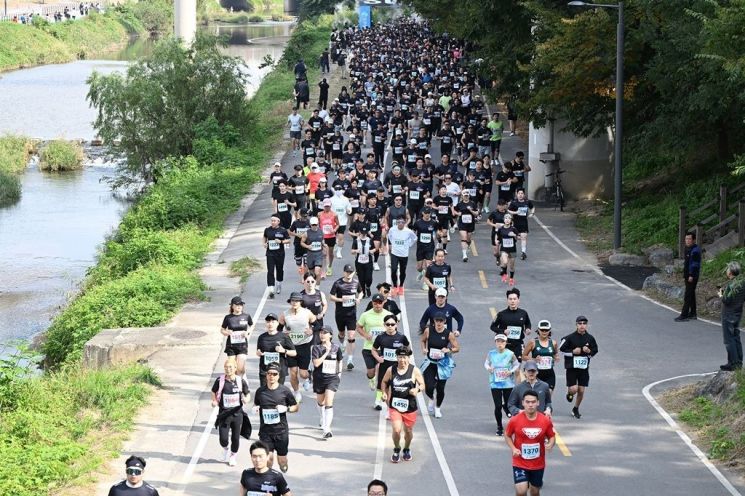
Last year, the first marathon event was held along the Buyongcheon riverside trail, and this year it expanded to a national scale with about 2,000 participants. The sight of runners along Buyongcheon and Jungnangcheon Streams clearly demonstrated the rivers’ appeal and potential.
The excitement of the marathon continued into the afternoon with the "Dong-o Masil Festa." Completion coupons and local currency paybacks encouraged participants to visit Dong-o Village, creating a flow from exercise to visitation to consumption.
The festival featured a variety of food and experience booths, allowing residents and participants to mingle, while performances and activities added vibrancy to the entire street. Both visitor numbers and local consumption saw a significant increase on the day of the event.
Based on this virtuous cycle, Singok 2-dong is establishing a unique living zone structure where the Buyongcheon ecological corridor and the Dong-o Village commercial district are closely intertwined.
Improving Children’s Living Spaces for Safe Play and Growth
Children’s living spaces in Singok 2-dong have been systematically renovated, greatly enhancing both safety and the quality of play.
In 2023, Sangnok Children’s Park underwent a complete remodeling as part of the Gyeonggi Ainuri Playground Project, with new integrated play facilities such as a zipline and combination play equipment installed. The addition of shade structures, benches, and new plantings improved the park’s comfort and safety. Given its proximity to Hyoja Elementary and Middle Schools, as well as nearby apartments and daycare centers, the park’s function as a daily playground for both children and guardians has been significantly strengthened.
Following this, Hyoja Children’s Park was also redeveloped into a complex play space with swings, net play equipment, and a large communal slide, allowing children to choose their own routes and activities. Rest facilities were also expanded, making it more convenient for guardians. The renovation, considering its location near Hyoja Elementary and Eoryong Elementary Schools, has established it as a daily playground meeting high local demand.
In 2024, a "Child Safety Green Forest" was created in the child protection zone near Hyoja Elementary School. Old elastic paving was replaced with sidewalk blocks, and a variety of trees were planted to create a green buffer belt that naturally separates the roadway from the pedestrian path. This space not only secures a safe distance for children but also serves as an ecological learning area for seasonal plant observation, significantly improving the walking environment around the school.
Enhancing Quality of Life: Parking, Senior, and Garden Infrastructure
The living environment in Singok 2-dong is rapidly improving through better parking facilities, expanded senior welfare spaces, and the creation of garden infrastructure.
Among these, Singok-dong Public Parking Lot No. 1, which opened in May 2023, has become a key facility alleviating chronic parking shortages near the Northern Government Complex and Homeplus.
This underground parking lot, with one basement level, a total floor area of 4,559 square meters, and 116 parking spaces, has greatly improved access to commercial areas, making it more convenient for citizens to use urban amenities, and has naturally improved the flow of customers to nearby shops and facilities.
Hoho-dang, a senior leisure space, is also an important part of the local infrastructure. Established under the light rail at Hyoja Station in December 2023, this facility includes a mind sports room for activities like Go and Janggi, as well as a community space, and has become a beloved gathering place for over 150 visitors daily. It functions not only as a leisure space but also as a welfare hub where seniors can feel a sense of belonging and stay connected to society in their daily lives.
Adjacent to Hoho-dang is Singok Saebit Garden, forming a natural daily leisure route that any resident can use as they move about the neighborhood.
Singok Saebit Garden was created by redeveloping a site that had accumulated construction waste for over 20 years, and in September 2023, it was reborn as a 30,000-square-meter, four-season garden. It has established itself as a participatory garden culture model, with citizens directly planting and maintaining flowers together.
Thanks to its excellent accessibility in front of Hyoja Station and the changing floral scenery each season, the garden has grown into a popular ecological and leisure destination visited by about 5,000 people annually, and regularly hosts various programs such as busking and garden concerts.
The garden infrastructure in Singok 2-dong will be further expanded with the upcoming Chudong Forest Garden. Chudong Park, a key green space in central Uijeongbu with high ecological potential, is the focus of a long-term city project to transform it into Chudong Forest Garden.
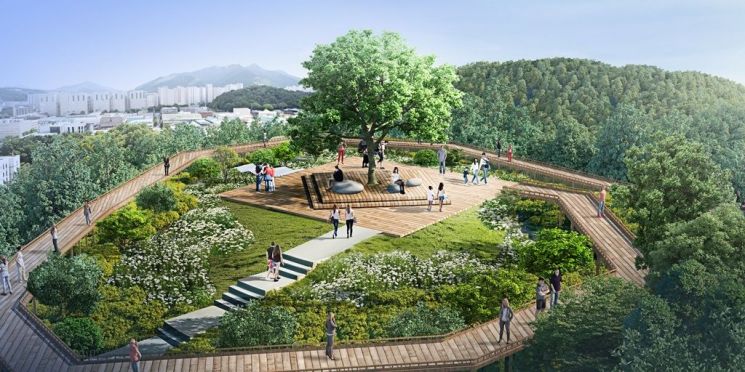
The first phase, including the forest trail, entrance garden, and flower garden, has already been completed and opened to the public, with 41 citizen participants involved in the design, planting, and maintenance, marking the beginning of a "citizen-created garden culture."
The renovated forest trail and flower garden are already seeing active use by citizens, and the park is shifting from a walk-through area to an ecological garden where people can stay and enjoy the environment.
By 2030, when the symbolic space, themed gardens, and forest perimeter trail are all connected, Singok 2-dong will become a green living zone where gardens, walking, and leisure naturally expand together.
Meanwhile, the "Our Neighborhood Policy Roadmap" is an initiative that systematically organizes policies and current issues for each of the city’s 15 neighborhoods to share changes in citizens’ daily lives and strengthen communication with residents. The next edition will feature Songsan 1-dong.
© The Asia Business Daily(www.asiae.co.kr). All rights reserved.