Tourism, Agriculture, Welfare, and AI Strategies Outlined in Policy Address
Strengthening East-West and North-South Axes with Namhae Line and Gangjin-Gwangju Expressway
Main Budget Surpasses 500 Billion Won... Expanded Housing, Jobs, Care, and SOC Initiatives
"I will make Gangjin the center of South Jeolla Province and a key city on the southern coast."
Kang Jinwon, Mayor of Gangjin County, presented the "cross-shaped tourism development strategy" as the central pillar of next year's county administration during his recent policy address at the 317th regular session of the Gangjin County Council. His plan is to usher in an era of 7 million annual visitors by 2026, based on the completion of a transportation network that connects the Namhae Line railway (east-west axis) and the Gangjin-Gwangju Expressway (north-south axis). He is preparing for Gangjin's resurgence by building on the achievements of tourism, housing, childcare, and youth policies, which have earned the county the Presidential Award for three consecutive years.
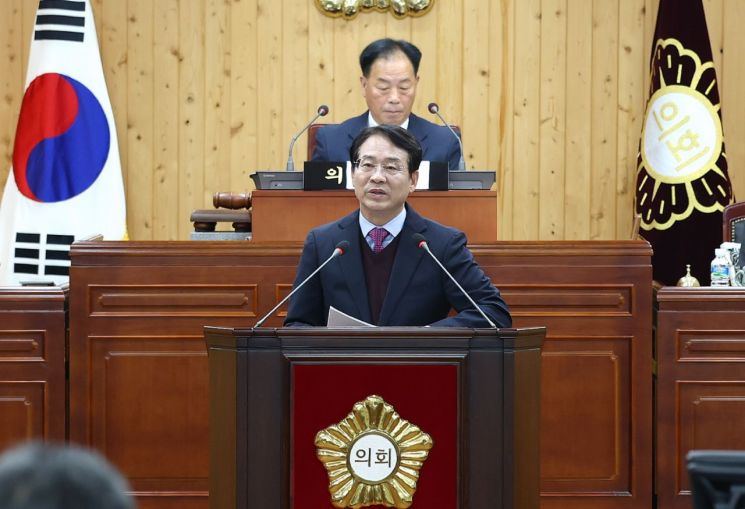
According to Gangjin County on the 27th, the county's 2026 budget has been set at 535.5 billion won, surpassing the 500 billion won mark for the first time based on the main budget. Nearly half of the total budget will be allocated to areas directly related to residents' lives, including 146.1 billion won for agriculture, forestry, livestock, and fisheries, and 103.7 billion won for social welfare.
In the agricultural sector, the primary industry budget has been increased by 13.6 billion won compared to last year to strengthen farm management stability and income foundations. Mayor Kang stated, "We will reduce the burden on farmers by injecting an additional 1 billion won from the county budget into the rice management stabilization fund, which provides the highest level of support in South Jeolla Province." He added, "We will also significantly expand budgets for fisheries and forestry to ensure fairness." The plan also includes strengthening local food distribution, starting construction of a cold storage auction facility at Maryang Port, fostering young farmers, expanding seasonal labor, and developing ICT smart farms-collectively referred to as the "Gangjin-style 10th industry."
The core of the tourism sector is the "cross-shaped tourism strategy." Gangjin County has designated next year as the "first year of attracting railway tourists to Gangjin" and will work to attract tourists from railway-connected regions such as Mokpo, Suncheon, and Busan. The county will also strengthen its economic community partnership with Gwangju to counteract the siphoning effect. Efforts will be made to revitalize local business districts by linking festivals, half-price travel promotions, and local gift certificates, while simultaneously expanding tourism infrastructure and human services through projects such as the Gaudo Forest of Light Gallery, nighttime reed field landscapes, and hosting sports competitions.
In the population sector, the county will continue its housing, job, and childcare initiatives. Mayor Kang emphasized the significance of a population increase of 73 people in October compared to the previous month, despite the overall trend of natural decline. The plan includes supplying 50 units of Jeonnam-style "10,000-won housing," building 140 households in the New Village project, starting construction of a new village in the Imcheon district, operating a training center for foreign workers, attracting international students to Jeonnam Life Science High School and Jeonnam Future International High School, and developing Gangjin's second general industrial complex.
The senior welfare budget will be expanded to 56.6 billion won. The county will strengthen its overall care services, including the "Our Neighborhood Meat Table Day," bathing and laundry services, expansion of senior dining halls, renovation of senior centers and welfare halls, and improvement of welfare workers' treatment. Integrated care, companion services, and support measures for solitary seniors, people with disabilities, and single-parent families will also be implemented.
Other initiatives include the introduction of a 500,000 won grant for high school graduates preparing for further education or career paths, support for residential solar power, expansion of city gas and LPG supply, and closing gaps in safety insurance coverage.
Major SOC (social overhead capital) projects will also accelerate. These include speeding up the Namhae Line railway upgrade, expanding and paving National Route 23 between Gangjin and Maryang, expanding Local Route 55, and completing the Kkachinaejae Tunnel. The Gangjin Bay bridge will be upgraded from a provincial to a local road, minimizing the county's financial burden by securing national and provincial funding.
The foundation for the AI industry was also mentioned. The county plans to attract an AI data center by utilizing the Shingangjin Substation, the largest power supply base in South Jeolla Province. Other plans include discovering new revenue sources, introducing a basic income for residents, and considering the implementation of a "solar pension." Mayor Kang stated, "Gangjin has a favorable AI infrastructure location in South Jeolla Province," adding, "A new future for Gangjin will open when the council, administration, and residents work together."
© The Asia Business Daily(www.asiae.co.kr). All rights reserved.