Takaichi Responds to Former Prime Minister Noda During Party Leaders' Debate
"If I Had Repeated Previous Answers, Budget Committee Proceedings Could Have Halted"
"A Situation Threatening Japan's Survival Will Be Determined Based on All Circumstances"
Japanese Prime Minister Sanae Takaichi, whose remarks about potential intervention in the event of a Taiwan contingency have sparked tensions between China and Japan, responded to opposition lawmakers questioning the authenticity of her comments by saying, "I answered sincerely within the scope of the examples provided by the questioner." According to Yonhap News Agency, during a ruling and opposition party leaders' debate held at the National Diet that day, Prime Minister Takaichi stated, "If I had merely repeated the government's previous answers, there was a possibility that the proceedings of the Budget Committee at the time would have come to a halt."
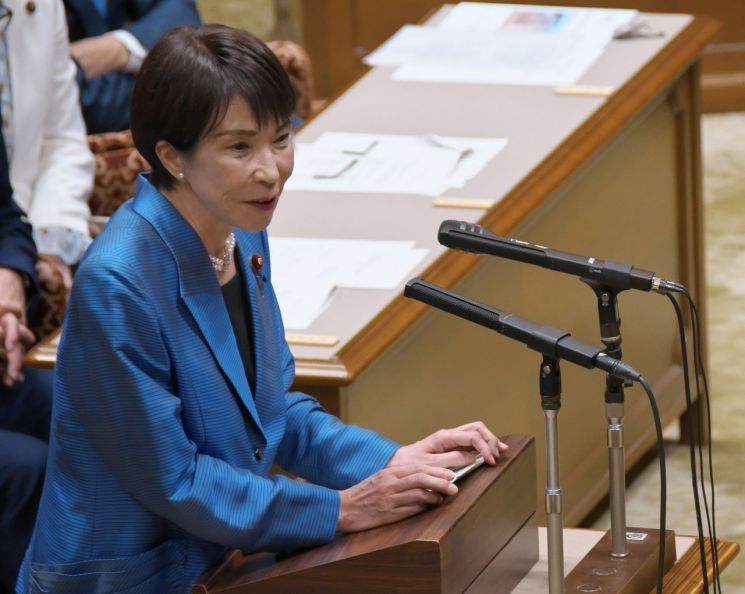 Sanae Takaichi, the Prime Minister of Japan, is responding to a question from Yoshihiko Noda, leader of the Constitutional Democratic Party, the main opposition party, during a ruling and opposition party leaders' debate held at the National Diet. Photo by UPI News Agency
On the same day, Yoshihiko Noda, leader of the Constitutional Democratic Party, the main opposition party, said, "I believe the Prime Minister has held such views since her days as a lawmaker, and I am not trying to deny that itself." He continued, "However, expressing views as Prime Minister that one held as a lawmaker is a different matter." He further pointed out, "Carelessly voicing one's convictions is a reckless act," adding, "I believe this may be an example of such a case."
Noda referenced the nationalization of the Senkaku Islands (known as Diaoyu Dao in China) in September 2012 during his own tenure as Prime Minister, which sparked China-Japan tensions, but explained that it was a "strategic decision" at the time, and questioned the true intent behind Takaichi's recent remarks. In response, Prime Minister Takaichi cited the fact that the questioner had raised specific examples and said, "I also answered that the government makes comprehensive judgments based on all circumstances." She added, "Japan is not in a position to recognize Taiwan's legal status," and stated, "Yesterday, the Japanese government's unified position was also decided at the Cabinet meeting."
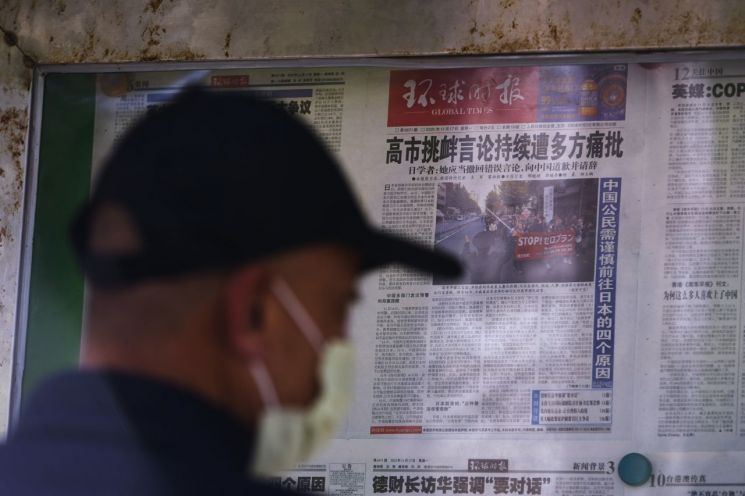 On the 17th, a man in Beijing, China, was reading a report on Japanese Prime Minister Sanae Takaichi's remarks regarding Taiwan, displayed at a newspaper stand. Photo by AP Yonhap News
On the 7th, during a Budget Committee session at the House of Representatives, Katsuya Okada, a lawmaker from the Constitutional Democratic Party, questioned Takaichi about her previous statement during the Liberal Democratic Party leadership election, in which she said that if China were to impose a maritime blockade on Taiwan, it could constitute a situation threatening Japan's survival. In response, Prime Minister Takaichi said, "If the U.S. military comes to break the blockade, one could imagine a scenario in which China uses some form of military force to stop them," and added, "If warships are used and military force is exercised, I believe it could be considered a situation threatening Japan's survival." A situation threatening Japan's survival refers to circumstances under which Japan can exercise the right of collective self-defense.
Regarding this, the Japanese government stated at a Cabinet meeting the previous day, "The government's previous position has not changed," and added, "Whether a situation threatening Japan's survival exists will be determined by the government after comprehensively considering all information based on individual and specific circumstances."
China has responded by demanding a retraction of the remarks and is exerting all-around pressure, including issuing travel advisories and banning seafood imports. According to Chinese media outlet Diyi Caijing on the 24th, after the travel advisory was issued, 12 air routes between China and Japan were canceled. On the same day, the Yomiuri Shimbun reported that due to China's suspension of imports of Japanese seafood, 172 Japanese companies are expected to be affected.
© The Asia Business Daily(www.asiae.co.kr). All rights reserved.