The CubeSat developed by KAIST will be loaded onto the Nuri rocket to have its performance verified in space.
On November 26, KAIST announced that the CubeSat 'K-HERO (KAIST Hall Thruster Experimental Satellite)', developed by Professor Wonho Choi's research team from the Department of Nuclear and Quantum Engineering, will be loaded onto the fourth Nuri rocket, which is scheduled to launch from the Naro Space Center in Goheung, Jeollanam-do, in the early morning of November 27.
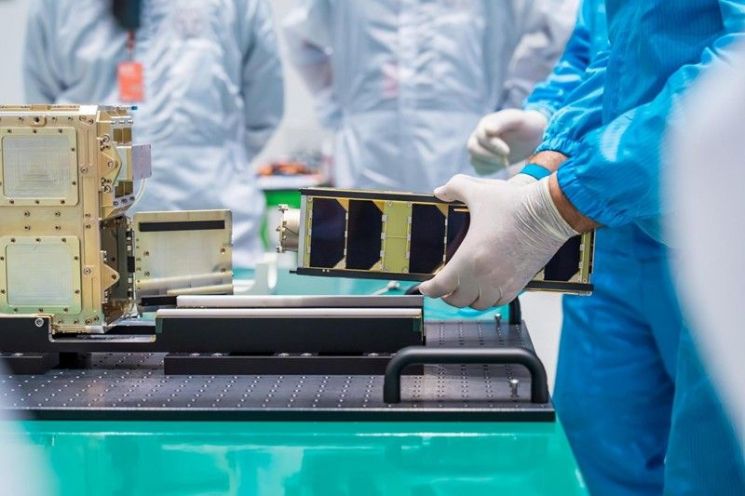 Cube satellite 'K-HERO' loaded in the Nuri rocket's cube satellite launch vehicle. Photo by Korea Aerospace Research Institute
The fourth launch of the Nuri rocket is drawing attention as a turning point for the domestic space industry, as it is the first launch to be led by the private company Hanwha Aerospace, following a technology transfer from the Korea Aerospace Research Institute (KARI).
The Nuri rocket will carry the third next-generation medium-sized satellite, as well as 12 CubeSats developed by industry-academia-research collaborations. K-HERO is one of these 12 CubeSats.
K-HERO was developed after Professor Choi's research team was selected as the basic satellite development team in the '2022 CubeSat Competition' organized by KARI.
A basic satellite is a technology demonstration satellite designed to verify whether its design and core components operate properly in the space environment before the full-scale production of the flight model (FM).
K-HERO, a 3U standard CubeSat measuring 10 cm in width and length, 30 cm in height, and weighing 3.9 kg, was designed to meet all requirements for stability, electrical specifications, and interface conditions with the launch vehicle.
The core mission of K-HERO is to verify whether the 150W-class miniature Hall thruster for satellites, developed by the research team, operates successfully in space.
The Hall thruster is essentially an "electric-powered engine for space." It serves as an electric propulsion engine that allows satellites to move slowly but efficiently using electricity.
Unlike rockets, which generate a large burst of force by burning a significant amount of fuel at once, the Hall thruster works by using electricity to turn gas (xenon) into plasma and then expelling it rapidly to propel the satellite. Thanks to its high fuel efficiency, the Hall thruster is emerging as a key technology in the era of small and constellation satellites.
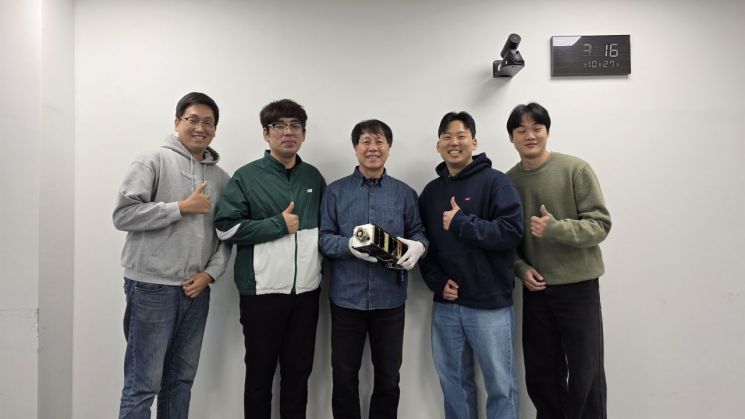 Members of the research team involved in the development of the CubeSat 'K-HERO' are posing for a commemorative photo. (From left) Jaehong Park, PhD candidate at KAIST; Yoonsu Kim, researcher at CosmoBee; Wonho Choi, professor; Dongha Park, PhD candidate; Seungbeom Heo, master's candidate. Provided by KAIST
The Hall thruster is a proven technology that has already been used for more than 20 to 30 years in large satellites and deep space probes. However, due to its size and high power requirements, it was previously used mainly in large geostationary (GEO) communication and broadcasting satellites. Hall thrusters have also been used in NASA and ESA deep space probes for long-distance flights.
Recently, with the advent of SpaceX's Starlink satellite constellation, demand for small and ultra-small electric propulsion systems has surged. As the global space industry shifts toward satellite constellations, "small and efficient thrusters" have become essential technology.
K-HERO is expected to become an important milestone in enhancing domestic technological competitiveness, as it is the first case of directly demonstrating a miniature Hall thruster developed with domestic technology in space.
Previously, Professor Choi's research team began Hall thruster research in Korea for the first time in 2003, securing fundamental technology based on plasma physics. In 2013, the team successfully mounted a 200W-class Hall thruster on the "KAIST Science and Technology Satellite 3," proving the practical utility of the technology.
Notably, the fourth Nuri rocket will carry a next-generation model aimed at ultra-small satellites, with improved performance that allows operation at a lower power level (30W) compared to previous versions.
CosmoBee Co., Ltd., a laboratory startup founded by Professor Choi's research team, also participated in the development of K-HERO, strengthening the foundation for technology commercialization.
Professor Choi said, "Starting with K-HERO, we expect a significant increase in the number of small satellites equipped with electric propulsion systems in Korea. The Hall thruster to be verified in the fourth Nuri launch can be used for a variety of missions, including low Earth orbit constellation surveillance and reconnaissance satellites, 6G communication satellites, ultra-low orbit high-resolution satellites, and asteroid probes."
© The Asia Business Daily(www.asiae.co.kr). All rights reserved.