China Expands Subsidies for Newlyweds
Amid Growing Aversion to Marriage and Childbirth
As China faces the dual challenges of a declining population and sluggish domestic demand, local governments are consecutively introducing policies that provide cash and consumption coupons to newlywed couples.
According to Zhejiang Daily, Economic Daily, and Hubei Daily on November 18, Zhejiang Province is currently implementing a "marriage consumption coupon" policy for newlyweds. In Ningbo, newlywed couples who register their marriage within the city between October 28 and December 31 this year are temporarily receiving consumption coupons worth 1,000 yuan (approximately 200,000 KRW). These coupons can be used for wedding-related expenses such as ceremonies, photography, and tourism, providing a discount of 125 yuan for every 500 yuan spent. Each couple receives eight coupons, totaling 1,000 yuan in support.
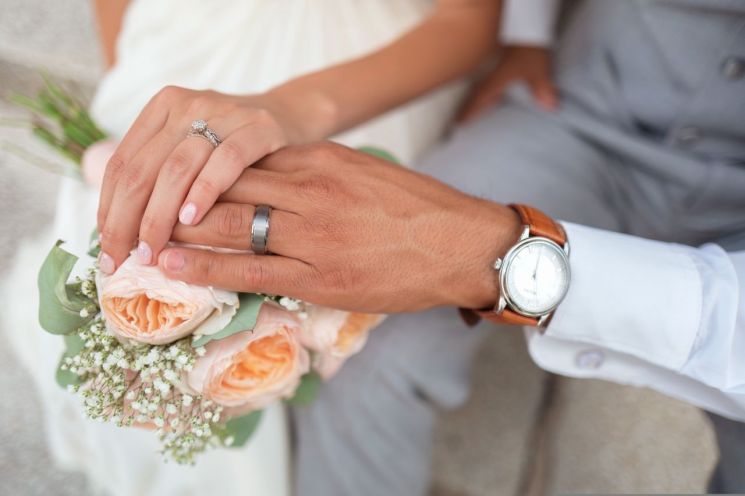 Local governments in China are consecutively introducing policies that provide cash and consumption coupons to newlywed couples. Pixabay
Similarly, Hangzhou is also providing consumption coupons worth 1,000 yuan to couples who register their marriage between August 28 and December 31. Like Ningbo, the city is issuing ten consumption coupons, each offering a 100-yuan discount on purchases over 2,000 yuan at local wedding-related businesses. Other areas in Zhejiang Province, such as Keqiao District in Shaoxing and Pujiang County in Jinhua, also began issuing marriage consumption coupons between September and October.
Some regions are providing direct cash incentives for marriage. In L?liang, Shanxi Province, newlywed couples who register their marriage in the city after January 1 this year, with the bride aged 35 or younger, receive 1,500 yuan (approximately 300,000 KRW) in cash. In addition, since March this year, Tianmen in Hubei Province has been offering a housing purchase subsidy of 60,000 yuan (1.24 million KRW) to help newlyweds with housing costs.
In Nanlingchun, Baiyun District, Guangzhou, if both partners in a first marriage hold Nanlingchun household registration, they can receive up to 80,000 yuan (1.65 million KRW). If they have a child, they can receive an additional 120,000 yuan (2.47 million KRW), bringing the total support to 200,000 yuan (4.12 million KRW). This is currently the highest amount of marriage and childbirth-related support provided by any local government in China.
Meanwhile, in China, the trend of avoiding marriage and childbirth continues due to the high costs associated with child-rearing and education, as well as youth unemployment. Over the past three years, China’s birth rate has fallen to less than half of the 2.1 children per woman needed to maintain the population. The annual number of births in China has remained below 10 million for three consecutive years since 2022, resulting in a three-year decline in the overall population. Last year, the number of marriage registrations in China was 6,106,000, a decrease of over 20% from the previous year. This is the lowest figure in 44 years since marriage law statistics were established following the 1980 amendment.
© The Asia Business Daily(www.asiae.co.kr). All rights reserved.