National Tax Service Improves Related Systems Based on Field Feedback
Tasting Limit Raised from 9,000 to 11,000 Liters; Tastings Now Allowed at Festivals
"Intended to Strengthen Promotion of Traditional Liquor"
The government has decided to ease restrictions on the tasting limits and eligible recipients for traditional liquor. This move aims to expand opportunities for consumers to directly experience traditional liquor, thereby supporting the growth of K-alcohol.
The National Tax Service announced on November 18 that a revised notification and amendments to the regulations on liquor tax administration, reflecting these changes, will take effect on January 1 next year.
An official from the National Tax Service explained, "To support the growth of the liquor industry, the National Tax Service has comprehensively reviewed various challenges collected from the field and is pursuing institutional improvements that the industry can feel. We have improved the system to expand the tasting limits, reflecting changes in promotional and consumption environments, as well as the revitalization of traditional liquor."
When liquor manufacturers or importers provide tasting samples for promotional purposes, they may only do so within the annual limit for each type of liquor and must go through a prior approval process by the National Tax Service. The current annual limits are as follows: 12,960 liters for diluted soju, 18,000 liters for beer, and 9,000 liters for other types of liquor.
For lesser-known liquors, tasting opportunities at events and festivals are virtually the only means of promotion. To enhance consumer accessibility and awareness, the number of tasting approval applications has been steadily increasing. According to the National Tax Service, the number of tasting approval applications rose from 1,018 in 2021 to 5,190 in 2024. During the same period, the number of products for which tasting was requested surged from 1,753 to 10,463.
Accordingly, the National Tax Service has decided to increase the tasting limit for liquors other than diluted soju and beer-such as takju (unrefined rice wine) and fruit wine-from 9,000 liters to 10,000 liters. In particular, for traditional liquors under the Liquor Tax Act, such as folk liquors and regional specialty liquors, the tasting limit will be raised to 11,000 liters.
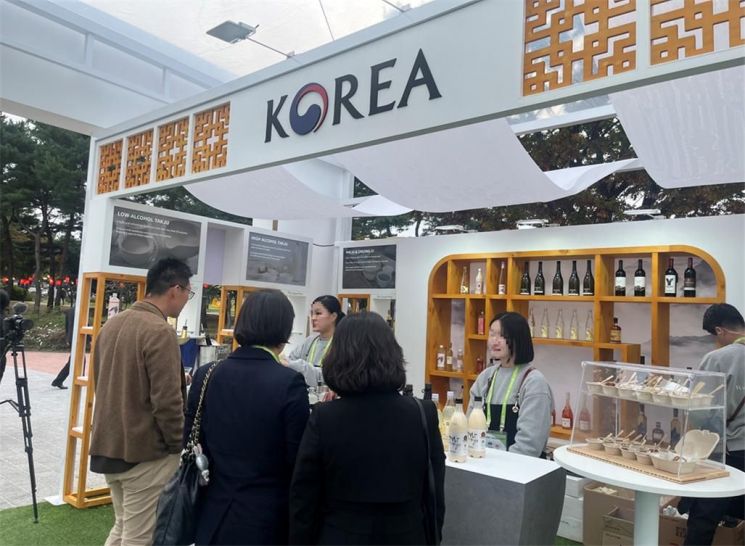
The locations where traditional liquor tastings are permitted will also be expanded. Until now, retailers could only provide tasting samples at permanent promotional centers operated by the national or local governments. Going forward, they will also be able to offer tasting samples at non-permanent festivals and events organized by the government or public entities.
The obligation to attach tax payment certification labels to traditional liquor will also be relaxed. When manufacturing and distributing liquor, a visible tax payment certification label must be attached to the container to prevent illegal processing or tax evasion. However, for traditional liquor, to support small-scale manufacturers, the obligation to attach the label is waived up to the quantity eligible for liquor tax reduction. Following a revision of the law earlier this year, the quantity eligible for tax reduction was increased, and accordingly, the exemption criteria were relaxed to 1,000 kiloliters for fermented liquors (up from 500 kiloliters) and 500 kiloliters for distilled liquors (up from 250 kiloliters). In particular, to support the initial establishment of small-scale licensed liquor manufacturers, the obligation to attach tax payment certification labels will be exempted for products manufactured until the quarter following the date of their first license.
The licensing standards for comprehensive liquor wholesale businesses will also be improved. Previously, a quota system by region was used to prevent excessive competition and maintain an appropriate number of licenses according to distribution conditions. However, recently, new licenses have been restricted, leading to criticism that the system does not sufficiently reflect changes in the market environment. To address this, the method for calculating new licenses will be improved to use the greater value between the average of "liquor consumption" and "population" as the basis, thereby better reflecting actual distribution demand in each region.
An official from the National Tax Service stated, "Through these institutional improvements, we expect to reduce tax compliance costs for traditional liquor and small-scale businesses, and to provide systematic support for distribution infrastructure that reflects regional market conditions, thereby strengthening the foundation for K-alcohol's overseas expansion. The National Tax Service will continue to listen to voices from the field and boldly improve regulations that do not fit reality."
© The Asia Business Daily(www.asiae.co.kr). All rights reserved.