Demonstration to Be Installed on HMM Container Ship
Expected to Reduce Fuel Consumption by 230 Tons and CO₂ Emissions by 700 Tons
Samsung Heavy Industries is set to conduct offshore demonstration of its independently developed Organic Rankine Cycle (ORC)-based waste heat recovery power generation system. This is the first such demonstration in South Korea, and the technology is designed to convert medium- and low-temperature waste heat, which is discarded during ship operation, into electricity, thereby reducing fuel consumption and carbon emissions.
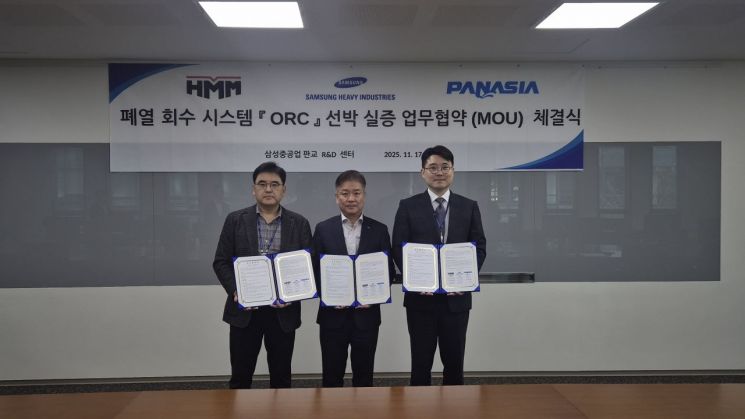 (From left) Lee Hogi, Head of Eco-friendly Research Center at Samsung Heavy Industries; Kim Minkang, Head of Safety and Health Division at HMM; Mingeol Lee, CEO of Panasia. Provided by Samsung Heavy Industries
On November 18, Samsung Heavy Industries announced that it had signed a business agreement with HMM and Panasia for the offshore demonstration of the ORC waste heat recovery system. The three companies will form a joint working group and plan to install a 250kW-class ORC generator on a 16,000 TEU-class container ship operated by HMM, with full-scale offshore demonstration scheduled to begin in the second half of 2026.
The ORC waste heat recovery system utilizes an organic heat medium with a lower boiling point than water to convert medium- and low-temperature waste heat (70 to 300 degrees Celsius) into electricity. This overcomes the limitations of conventional steam-based waste heat recovery systems, which could only utilize high-temperature waste heat (300 to 600 degrees Celsius), thus restricting their application range.
The "variable pressure ORC" developed by Samsung Heavy Industries maximizes waste heat utilization efficiency under various operating conditions. Having already completed onshore demonstration, the technology was certified by the American Bureau of Shipping (ABS) in May of this year.
The three companies plan to verify, through the nation's first offshore demonstration, the effectiveness of waste heat recovery, operational data at sea, and both technical and economic feasibility. The system is expected to reduce fuel consumption by approximately 230 tons and CO₂ emissions by 700 tons annually.
Lee Hogi, Head of the Eco-friendly Research Center at Samsung Heavy Industries (Executive Director), stated, "This demonstration will significantly enhance the commercial viability of waste heat recovery power generation technology," adding, "We will accelerate the advancement of eco-friendly technologies that improve energy efficiency and reduce carbon emissions."
© The Asia Business Daily(www.asiae.co.kr). All rights reserved.