Hanshin, Dongbu, and HS Hwaseong Go All-In on
Street Housing and Small-Scale Reconstruction
Successes in Daejo and Gocheok-dong Moa Town Projects
Low Risk of Unsold Inventory and Project Costs
Small and mid-sized construction companies are securing new opportunities by winning a large number of small-scale maintenance projects in the Seoul metropolitan area. Although these projects are less profitable compared to large-scale reconstruction projects worth over 1 trillion won, they are proceeding at a faster pace and can help boost brand recognition, according to industry analysis.
According to the maintenance industry on November 18, Hanshin Engineering & Construction was selected as the contractor for the street housing maintenance project at Moa Town (A-1 and A-2 districts) in Sihung 1-dong, Geumcheon-gu, on November 3. The total construction cost is 226.2 billion won, which is about 15% of last year's revenue. This follows the company's achievement in September, when it won the contract for the Daecho A3 district in Eunpyeong, worth 150.5 billion won. Hanshin Engineering & Construction's order backlog in the third quarter of this year reached 6.6435 trillion won. With the addition of the Sihung 1-dong street housing maintenance project, the backlog is expected to easily surpass 7 trillion won by the end of the year.
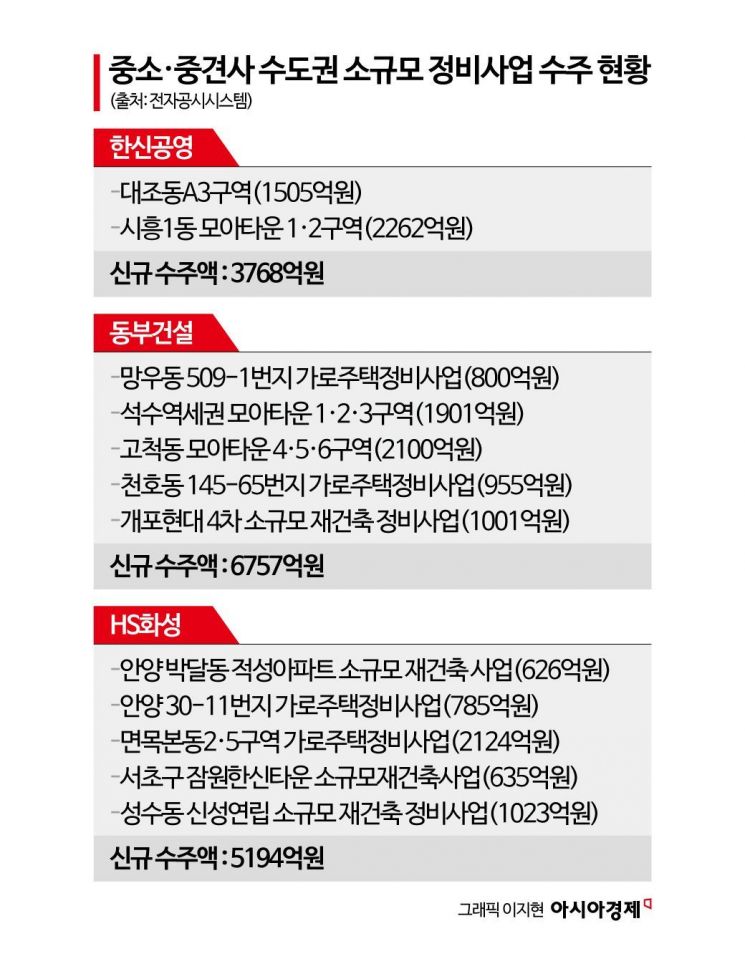
Dongbu Construction has also strengthened its order book by winning small-scale maintenance projects in Seoul. From June to July, the company secured construction rights for Moa Town districts 1, 2, and 3 in the Seoksu Station area of Sihung-dong, Geumcheon-gu (576 units), 145-66 Cheonho-dong (242 units), and Gaepo Hyundai 4th Complex in Ilwon-dong, Gangnam-gu (178 units). Including Moa Town districts 4, 5, and 6 in Gocheok-dong (647 units), and the street housing maintenance project in Mangwoo-dong, Jungnang-gu, both awarded in the first half of the year, Dongbu Construction recorded a total of 675.7 billion won in orders by the third quarter. This accounts for about 20% of the company's cumulative new orders in the third quarter, which total approximately 3.4 trillion won.
HS Hwaseong, a regional construction company based in Daegu, has also entered the small-scale reconstruction market in the Seoul metropolitan area. In July, HS Hwaseong established an urban maintenance business team and expanded its existing Seoul branch into a housing business headquarters, launching a major organizational restructuring. The aim is to focus the company's full capabilities on metropolitan area maintenance projects.
As a result of these efforts, in September, the company won its first-ever project in Gangnam by securing the small-scale reconstruction of 'Jamwon Hanshin Town' in Jamwon-dong, Seocho-gu. In October, it also won the construction rights for the 'Shinseong Yeonrip' small-scale reconstruction project in Seongsu-dong 1-ga, Seongdong-gu, establishing a presence in the Hangang Belt. The company also secured contracts for Moa Town districts 2 and 5 in Myeonmok-dong, Jungnang-gu, worth 212.4 billion won. The total value of new orders HS Hwaseong has secured this year for urban maintenance projects in Seoul stands at 378.2 billion won. Including the street housing maintenance and small-scale reconstruction projects won in Anyang, Gyeonggi Province, the company has secured a total of 519.4 billion won worth of work in the metropolitan area this year alone.
Small and mid-sized companies are eyeing small-scale redevelopment and reconstruction projects that carry less of a financial burden for funding. Since street housing projects are carried out in street blocks of less than 13,000 square meters and small-scale reconstruction projects are limited to sites with fewer than 200 units, the required project investment is much smaller compared to large-scale reconstruction sites in areas like Seongsu or Apgujeong. Additionally, expanding sales projects in local areas where unsold inventory remains unresolved is riskier than focusing on the metropolitan area. Another advantage is that even companies with low brand recognition can enter the market more easily.
An industry official explained, "In large-scale reconstruction bidding, the symbolic value of high-end brands held by major construction companies has a significant impact. In contrast, small-scale maintenance projects involve less competition and provide a foothold in key locations in Seoul."
© The Asia Business Daily(www.asiae.co.kr). All rights reserved.