New Start Fund Introduced to Ease Loan Burden on the Self-Employed
Bond Purchases Fall Far Short of Initial Targets
Possibility That Debt Scale Was Overestimated from the Outset
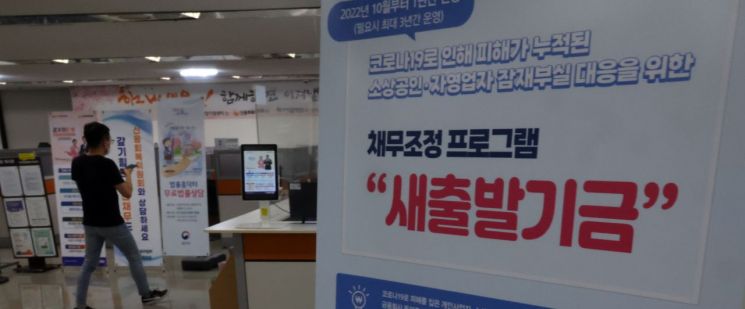 In September 2024, a New Start Fund information leaflet for small business owners and self-employed individuals was placed at the Seoul Integrated Support Center for Low-Income Finance. Photo by Yonhap News Agency
There have been criticisms that the execution performance of the New Start Fund, which was introduced to ease the loan burden on small business owners and self-employed individuals, has been lower than initially planned. Analysts suggest that it is necessary to reconsider the debt adjustment support plan in order to improve these underwhelming results.
Bond Purchases by the New Start Fund Fall Short of Initial Plans
According to the National Assembly Budget Office’s report, “Fiscal Project Evaluation for Small Business Support,” released on the 17th, the government announced in July last year that it would expand the New Start Fund from the original 30 trillion won to over 40 trillion won and increase the number of beneficiaries as part of the “Comprehensive Measures for Small Business Owners and the Self-Employed.”
The New Start Fund is a debt adjustment program established by the Financial Services Commission and Korea Asset Management Corporation (KAMCO) in 2022 to alleviate the loan repayment burden of small business owners and self-employed individuals affected by COVID-19. Depending on the level of delinquency, beneficiaries receive various forms of support, including principal reduction, interest relief, and extension of repayment periods.
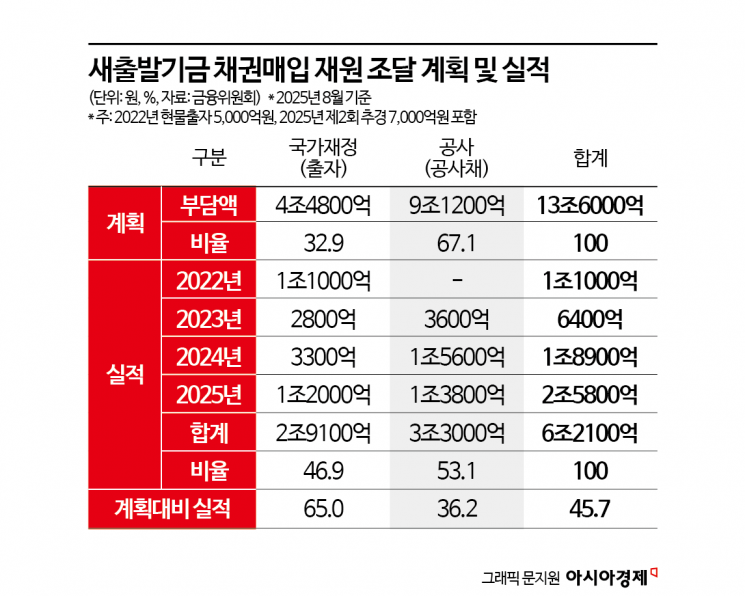
At the time, the Financial Services Commission set a target of adjusting over 40 trillion won in debt for small business owners and self-employed individuals by 2026, with a plan to purchase a total of 33.4 trillion won in bonds. However, the actual performance has been lackluster compared to these plans. In 2024, the bond purchase target was 7.5603 trillion won, but the actual amount purchased was only 4.2303 trillion won, representing just 56% of the target. For this year, the bond purchase target is 11.585 trillion won, but as of August, only 4.2838 trillion won had been purchased, which is just 37% of the target.
Since the program’s introduction, up to August this year, a total of 11.4238 trillion won in bonds from 134,388 debtors has been purchased, which amounts to 34.2% of the total bond purchase target of 33.4 trillion won set for 2026.
The actual funding raised for bond purchases by the New Start Fund has also fallen short of plans. As of August, a total of 6.2100 trillion won had been secured, including 2.9100 trillion won from the national budget and 3.3000 trillion won from KAMCO bonds, which is only 45.7% of the total planned funding.
Possibility That the Scale of Self-Employed Debt Was Overestimated from the Outset
The report points out that although the government expanded debt adjustment support for financially vulnerable small business owners through the New Start Fund and plans to continue support through 2026, actual bond purchases by August 2025 remain insufficient compared to the planned scale. It analyzes that the amount of debt requiring adjustment may have been overestimated relative to the total debt of the self-employed when the New Start Fund was launched. It also notes that expanding the eligibility for support, in consideration of the difficulties faced by small business owners, is another reason for the low performance.
Lee Byungcheol, Budget Analyst for Economic and Industrial Project Evaluation at the National Assembly Budget Office, stated, “The government needs to closely examine the amount of debt held by self-employed individuals with long-term delinquencies and, considering the remaining project period and bond purchase performance so far, review whether a more realistic debt adjustment support plan is necessary going forward.”
Concerns were also raised about the psychological sense of deprivation among diligent payers and the potential for moral hazard among self-employed individuals who benefit from debt relief. While the government’s debt support measures for the self-employed have positive effects, such as helping vulnerable groups recover and improving the soundness of the financial sector, they may only serve as short-term solutions and not address fundamental problems. The report particularly notes that repeated debt adjustments could lower repayment rates among debtors, increasing the risk of insolvency.
The budget analyst emphasized, “The government should continue to exercise meticulous management and monitoring in the design and operation of debt adjustment programs for small business owners with long-term delinquent debt.”
© The Asia Business Daily(www.asiae.co.kr). All rights reserved.