US Deputy Secretary of State: "A New Chapter for the Alliance"
Former Ambassador to South Korea: "Alliance May Loosen in the Long Term"
Yoo Myunghee: "Only the Beginning of an Uncertain Process"
On November 15, the day after South Korea and the United States jointly announced their "Joint Fact Sheet" on tariffs and security negotiations, reactions in the United States have been mixed. While some have offered positive assessments, suggesting that a new chapter in the South Korea-US alliance has begun, others have expressed negative views, pointing out a lack of detail and long-term perspective.

Christopher Landau, US Deputy Secretary of State, delivered a keynote speech at the "Van Fleet Policy Forum" co-hosted by the Atlantic Council and the Korea Society in Washington, D.C. on November 14 (local time). He stated, "The two countries have announced a historic Joint Fact Sheet in connection with President Donald Trump's state visit to South Korea at the end of October," adding, "This has opened a new chapter in the South Korea-US alliance."
Deputy Secretary Landau went on to say, "I hope everyone will read this fact sheet carefully, as it presents the joint priorities for the future of the bilateral relationship." He particularly emphasized that the fact sheet includes the rebuilding and expansion of key industries, maintaining stability in the foreign exchange market, strengthening commercial cooperation, promoting reciprocal trade, protecting economic prosperity, modernizing the South Korea-US alliance, cooperating on issues on the Korean Peninsula and in the region, and enhancing maritime and nuclear partnerships. He added, "The fact sheet confirms that South Korea is one of the major investors in the United States, which will support American jobs, expand US energy exports, foster trusted technologies, and strengthen the maritime partnership between the two countries."
In contrast, former US Ambassador to South Korea Philip Goldberg focused on the "modernization of the South Korea-US alliance" included in the fact sheet, expressing the view that, in the long term, this could lead to a loosening of the alliance and may not produce the intended results. He suggested that while modernization may bring the two countries' security ties closer in the short term, over time, as their priorities diverge and South Korea's capabilities grow, the two nations may drift apart.
Former Ambassador Goldberg, speaking at the same forum attended by Deputy Secretary Landau, noted that if South Korea's purchases of US weapons, the transfer of wartime operational control, uranium enrichment, and spent nuclear fuel reprocessing all proceed, "all of this means integration between the two countries in the short term." He continued, "In the longer run, I think there could be more separation. This is because the United States will shift its focus elsewhere, and South Korea, thanks to all these measures, will be able to deal with North Korea more easily and with greater confidence." He added, "The focus is changing. In the past, North Korea was more important than anything else, but now the scope is much broader and the relationship is of a different kind."
Until now, the South Korea-US alliance has prioritized deterring North Korea, but now the United States is seeking greater strategic flexibility to focus on the larger threat of China, while strengthening South Korea's defense capabilities so that it can take greater responsibility for deterring North Korea. As a result, the alliance is said to be undergoing a "transformation."
He also commented on the reaffirmation of the goal of North Korea's complete denuclearization in the fact sheet, saying, "I think this actually makes it harder to bring Kim Jong Un back to the negotiating table." Regarding the South Korea-US trade agreement, he said, "In many ways, it is one-sided, but on the other hand, South Korea has also gained something," referring to nuclear-powered submarines and nuclear fuel. "These are two issues that South Korea pressed very strongly for, both under President Yoon Suk-yeol and now under President Lee Jae-myung, for several years," he said.
However, he pointed out that, unlike the European Union, South Korea sought to finalize the details of the trade agreement with the United States and include them in the document, believing that the agreement would actually be implemented, which may have put South Korea at a disadvantage. "The EU maintains the attitude of 'We will sign (a trade agreement with the US), but this will either disappear or never happen,'" he said. "South Korea, on the other hand, tries to document everything in its own way and takes it literally, which I think has cost them." He argued that while the EU drafted a vague agreement, believing that it would not have to implement the unfair deal struck under tariff pressure from President Trump once his term ended, South Korea may have tied its own hands with clear agreement language.
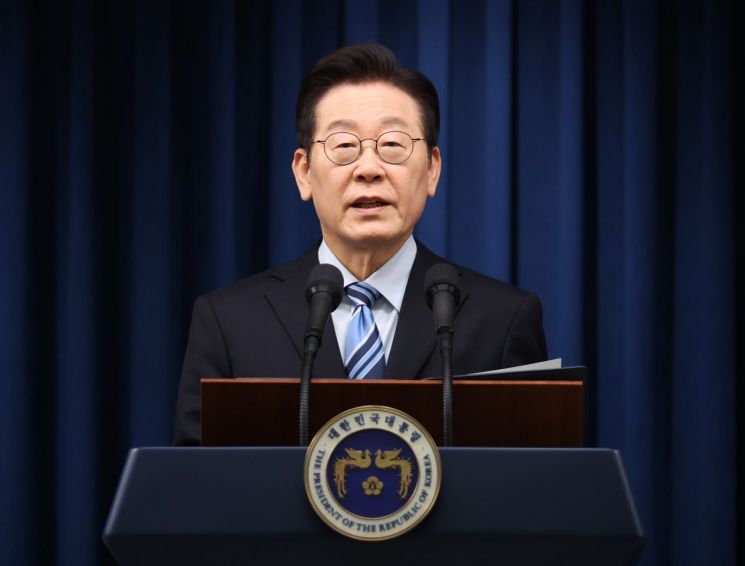 President Lee Jae-myung is making an announcement on June 14 at the Yongsan Presidential Office press conference room in Seoul regarding the final agreement on the South Korea-US fact sheet. Photo by Yonhap News
Yoo Myunghee, former Director-General for Trade Negotiations, who oversaw South Korea-US trade talks during the first Trump administration, commented at the same forum, "The joint fact sheet may be just the beginning of a long and uncertain process, rather than a final outcome."
The fact sheet specifies details of US tariff reductions and South Korea's planned $350 billion investment in the United States. There are concerns about the unexpectedly large scale of cash investment. Former Director-General Yoo appears to have pointed this out as well. She said, "Much depends on how the two governments select and manage specific investment projects that can benefit both countries. For this agreement to be robust and sustainable, it must not only support the development of US manufacturing, but also foster growth and innovation in strategic sectors for both countries."
She added, "The real test lies ahead, and this is truly uncharted territory," explaining that "there are concerns in Korea that investing such a massive amount of resources in the United States could lead to the hollowing out of our own domestic manufacturing sector." She continued, "If Korean companies can expand their presence in the US market as a result of these investments, such investments could actually strengthen, rather than weaken, Korea's manufacturing base." She further emphasized, "Korea is a truly excellent, valuable, and reliable partner for the United States in rebuilding the manufacturing sector, especially in strategic high-tech industries. Instead of creating trade friction with such an outstanding ally and manufacturing partner as Korea, we should channel our efforts into strengthening the industrial and technological competitiveness of both countries."
© The Asia Business Daily(www.asiae.co.kr). All rights reserved.