Industrial Production Rises 4.9% in October, Missing Expectations
Retail Sales Up 2.9% as Growth Slows
China's industrial production increased by 4.9% last month, falling short of market expectations and marking the lowest level in 14 months. Retail sales rose by 2.9%, slightly surpassing market forecasts, but the growth rate has been slowing for five consecutive months.
On November 14, the National Bureau of Statistics of China announced that industrial production in October grew by 4.9% compared to the same month last year.
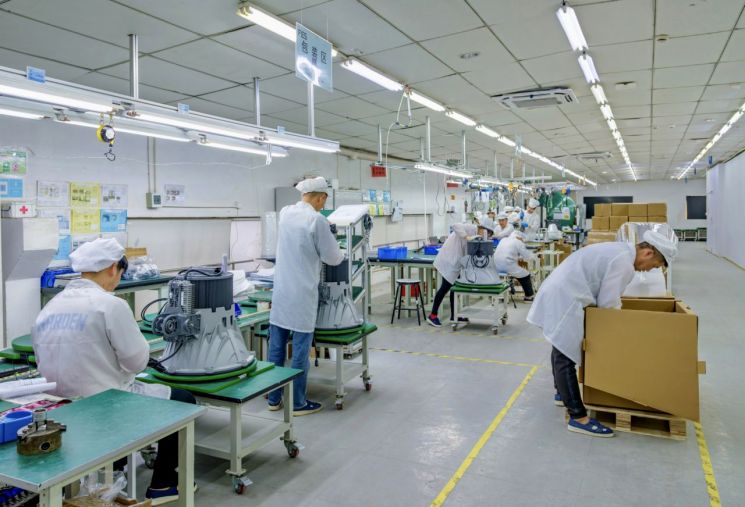
This increase was significantly lower than in September (6.5% growth) and fell short of the median economist forecasts compiled by both Bloomberg and Reuters, which stood at 5.5%.
Last month's industrial production growth rate was the lowest since August of the previous year (4.5%).
Retail sales in October, a key indicator of domestic demand, rose by 2.9% year-on-year.
This figure was higher than the Reuters forecast of 2.8%, but the growth rate has declined for five consecutive months since May of last year (6.4%). Bloomberg explained that this marks the longest period of retail sales growth slowdown since 2021.
Fixed asset investment, which reflects changes in capital investment in factories, roads, power grids, and real estate excluding rural areas, decreased by 1.7% year-on-year from January to October. Economists had expected a decline of 0.8%, but the drop was steeper and expanded significantly from the 0.5% decrease recorded from January to September. During the same period, real estate development investment fell by 14.7%.
According to calculations by Reuters based on data from the National Bureau of Statistics, new home prices in October fell by 0.5% compared to the previous month and by 2.2% year-on-year. Reuters noted that home prices continued to decline even during the traditional peak season for real estate in September and October.
Zhang Zhiwei, Chief Economist at Pinpoint Asset Management, stated, "The pace of decline in fixed asset investment is very rapid," adding, "This reflects sluggish investment in both the real estate sector and infrastructure."
The average nationwide urban unemployment rate in October was 5.1%, down by 0.1 percentage points from the previous month. The average urban unemployment rate for January to October was 5.2%.
The National Bureau of Statistics assessed, "The economy operated in a generally stable manner in October," but also noted, "There are relatively many unstable and uncertain external factors, significant domestic restructuring pressures, and many challenges to maintaining stable economic operations." The bureau also stated that it would actively support the implementation of existing policies.
Bloomberg commented that this suggests the Chinese government is not rushing to introduce additional support measures.
Xutianchen, Chief Economist at the Economist Intelligence Unit, said, "Structural issues are hindering growth," adding, "There is still room for stimulus, but the preference is to defer this until 2026. Since China only needs a 4.5-4.6% growth rate in the fourth quarter to achieve its 5% growth target, there is little willingness to introduce further stimulus measures."
© The Asia Business Daily(www.asiae.co.kr). All rights reserved.