Ministry of Food and Drug Safety and Ministry of Health and Welfare Hold First Tobacco Harmful Substance Management Policy Committee Meeting
With the mandatory inspection and disclosure of harmful substances in tobacco products now in effect, the Tobacco Harmful Substance Management Policy Committee, which deliberates and decides on the scope and methods of such disclosure, has been launched.
The Ministry of Food and Drug Safety and the Ministry of Health and Welfare announced on November 13 that they convened the first session of the 2025 Tobacco Harmful Substance Management Policy Committee and reviewed the "Operating Regulations for the Tobacco Harmful Substance Management Policy Committee" as well as the "List of Harmful Substances Subject to Inspection and Testing Methods by Tobacco Product."
With the enforcement of the Tobacco Harmful Substance Management Act on November 1, information on harmful substances contained in tobacco products and their effects on the human body will be disclosed starting from the second half of next year. To facilitate this, tobacco manufacturers or importers and distributors are required to undergo mandatory inspections for harmful substances every two years.
During the committee meeting, procedures for the inspection and disclosure of information on harmful substances in tobacco, the establishment of basic and implementation plans, the tobacco harmful substance management system, and the committee's future operational plans were reported. The committee also approved detailed operating regulations, which specifically enumerate the areas of expertise for private sector members-such as analysis, toxicology, medicine and pharmacy, public health, and communication. The regulations also define grounds for exclusion, challenge, and recusal of members in cases where impartiality in deliberation cannot be expected, and set out detailed procedures for the committee's decision-making process.
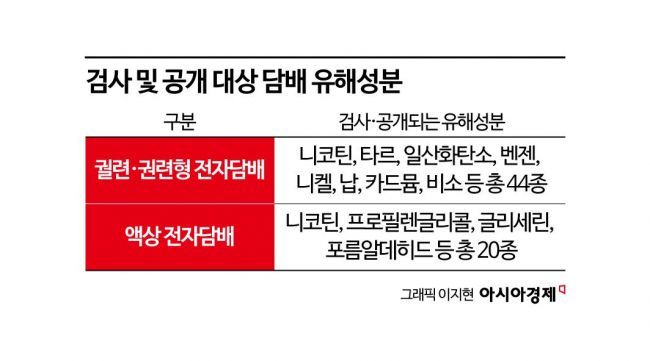
The committee also approved the list of harmful substances in tobacco products subject to inspection and the respective testing methods. For harmful substances, 44 types-including tar and nicotine-were designated for cigarettes and heated tobacco products, and 20 types-including nicotine, propylene glycol, and glycerin-were designated for liquid-type electronic cigarettes, making a total of 46 substances. The testing methods were established with reference to standard methods developed by the World Health Organization (WHO) and the International Organization for Standardization (ISO). These substances and testing methods, subject to regulatory review, are expected to be finalized within this year.
The Ministry of Food and Drug Safety and the Ministry of Health and Welfare plan to provide more information on harmful substances in tobacco to protect public health and will continue to expand the list of harmful substances subject to inspection as new testing methods become available.
Kim Yongjae, Deputy Commissioner of the Ministry of Food and Drug Safety, stated, "Through the committee, we will establish a more scientific and objective institutional foundation for tobacco harmful substance management policies," adding, "We will make efforts to ensure that the government systematically manages harmful substances in tobacco and transparently provides this information to the public."
© The Asia Business Daily(www.asiae.co.kr). All rights reserved.