Constructed for Capital Defense in the 5th Century
Evidence of Division of Labor and Group Responsibility Found
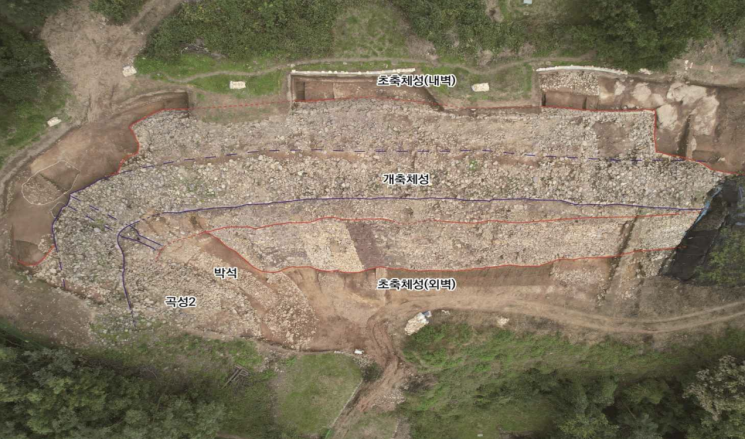
The National Heritage Administration announced on November 13 that it has identified the earliest stone wall construction style of a Silla mountain fortress during the excavation of Daegu Palgeosan Fortress.
Palgeosan Fortress is located at the summit of Hamji Mountain in Buk-gu, Daegu. It was constructed after the 5th century as Silla sought to build a defensive line west of Seorabeol, its capital, amid fierce struggles with Goguryeo and Baekje. The fortress was designated as a Historic Site in 2023.
This excavation has revealed the main fortress wall and curved wall structures. The main wall was built at least twice, with a Goryeo-era wall overlapping the original Silla-era wall.
The original main wall was constructed using a composite technique: the lower section was built with a single-sided method, while the upper section was built with a double-sided method. The double-sided construction, where the outer and inner walls are stacked to similar heights but facing away from each other, represents the early form of Silla stone fortress walls.
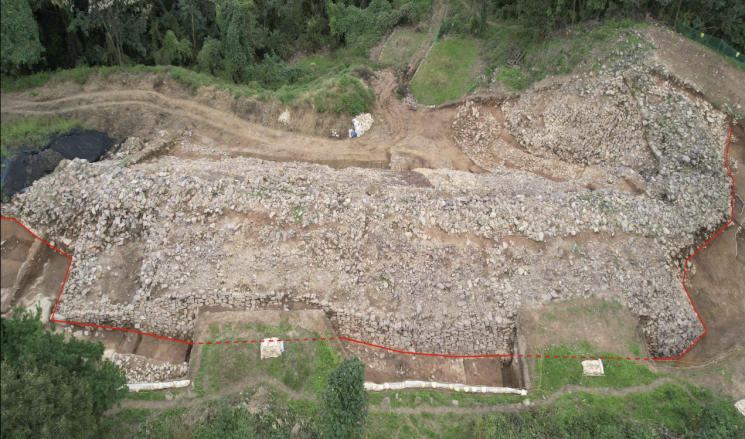
The lower section of the outer wall measures 46 meters in length and up to 6.3 meters in height. The inner wall remains at 55 meters in length and a maximum height of 2.4 meters. The central part of the inner wall is 14 meters thick, tapering to 7 meters at both ends. It is believed that the central section was built twice as thick to ensure the stability of the wall, which is located in a valley.
Fourteen vertical partition lines, spaced 2.3 to 2.7 meters apart, were discovered on both the outer and inner walls. These are traces of the wall having been divided into sections and constructed through group-based division of labor. Some sections, built exclusively with purple mudstone of the same color, remain clearly visible, suggesting that a single group was responsible for the entire process from quarrying to construction.
The National Heritage Administration will hold a briefing session at the excavation site at 2 p.m. on the same day. Anyone can participate without prior registration.
© The Asia Business Daily(www.asiae.co.kr). All rights reserved.