Choo Mi-ae: "A Comprehensive Government Response Is Needed"
The amendment to the Tobacco Business Act, which seeks to define synthetic nicotine products as tobacco and regulate them accordingly, failed to pass the Legislation and Judiciary Committee at the National Assembly.
The government had called for the swift passage of the amendment, emphasizing the urgent need to regulate synthetic nicotine, which has long been considered a legal blind spot. However, both ruling and opposition parties determined that further discussion was necessary.
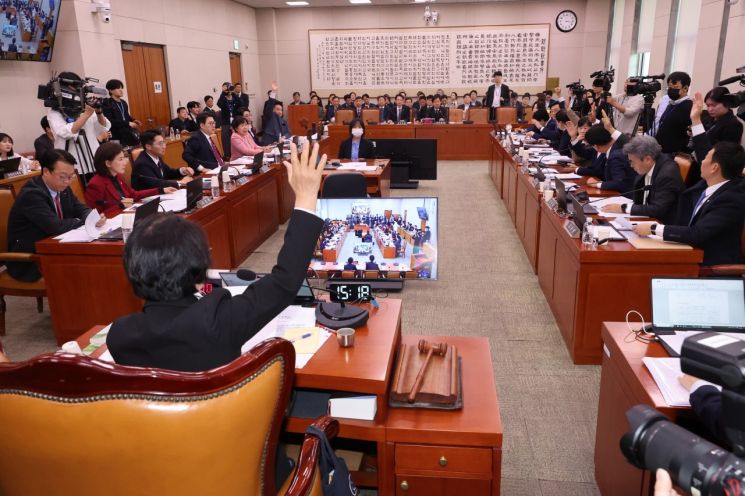 On the 12th, at the plenary meeting of the Legislation and Judiciary Committee held at the National Assembly in Yeouido, Seoul, members from both ruling and opposition parties voted to conclude the alternative debate on the partial amendment bill of the Tobacco Business Act. Photo by Yonhap News Agency
At the plenary session held that afternoon, the Legislation and Judiciary Committee decided to table the amendment to the Tobacco Business Act, which would include synthetic nicotine in the definition of tobacco, and to continue further deliberations. Committee Chair Choo Mi-ae stated, "The alternative bill for the partial amendment to the Tobacco Business Act will continue to be reviewed at the plenary meeting."
Chair Choo added, "There are significant concerns within the committee regarding the spread of similar nicotine products. However, before regulating nicotine sales through the Tobacco Business Act, there is a consensus that a comprehensive, government-wide response to similar nicotine products is needed. We ask that the bill be addressed after such measures are established."
The amendment seeks to expand the definition of tobacco from the current "leaf of the tobacco plant," which is the raw material for natural nicotine, to "tobacco or nicotine." If the bill is passed, synthetic nicotine would also be categorized as tobacco and thus be subject to the same regulations.
Currently, synthetic nicotine is used in e-cigarette liquids but is not classified as tobacco, meaning it is not taxed and can be sold online or through vending machines. This has led to widespread criticism that it creates a loophole for youth smoking.
Nevertheless, lawmakers from both parties agreed that further discussion is required.
Kim Gipyo, a member of the Democratic Party of Korea, stated, "The bill is set to take effect six months after promulgation, which creates a gap. There are reports that vendors are stockpiling products. We need to consider whether the tax standard should be based on the point of sale, among other issues."
Na Kyungwon, a member of the People Power Party, also pointed out, "The definition of nicotine in the amendment is ambiguous, so it cannot effectively regulate e-cigarettes. Additionally, the supplementary provisions are problematic, and vendors are importing large quantities before the law takes effect."
In response, Deputy Prime Minister and Minister of Economy and Finance Koo Yooncheol said, "After extensive discussions in the Strategy and Finance Committee, we decided to set the tax standard at the point of manufacture. Regulation of synthetic nicotine is necessary, and in my opinion, implementation should proceed as soon as possible." However, this was not reflected in the outcome.
© The Asia Business Daily(www.asiae.co.kr). All rights reserved.