After Steady Decline Since August, Dollar Deposits Surge in November
Balance Drops 38% in Just One Business Day After the Weekend
Investors Appear to Be Realizing Profits
There is analysis suggesting that investors are realizing profits as the balance of dollar deposits, which had surged earlier this month, plummeted in just one business day. The won-dollar exchange rate has shown significant volatility, with some forecasts predicting it could surpass the 1,500 won mark. While experts expect the surge in the won-dollar exchange rate to be short-lived, there are also observations that the preference for the dollar will become more pronounced due to ongoing global trade uncertainties.
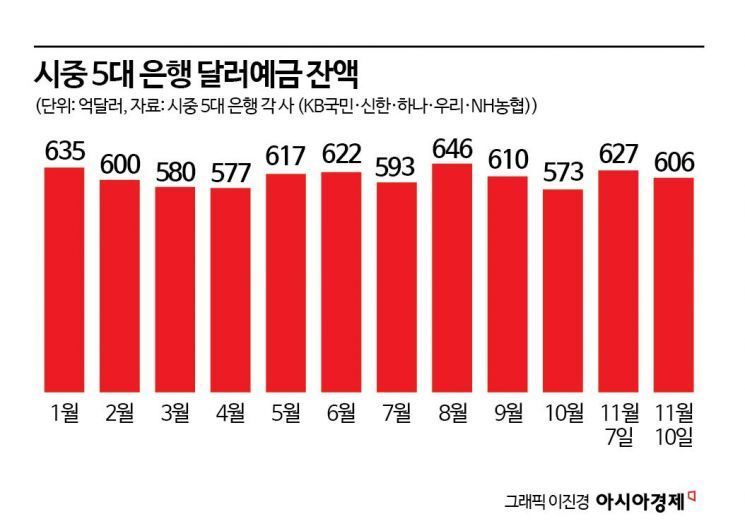
According to the five major commercial banks (KB Kookmin, Shinhan, Hana, Woori, and NH Nonghyup) on November 12, the balance of dollar deposits stood at $60.63621 billion (approximately 88.735 trillion won) as of November 10. At the end of October, the dollar deposit balance at the five major banks was $57.3 billion, which increased to $62.7 billion as of November 7. This represents an increase of $5.4 billion (about 7.9034 trillion won) in just five business days. In fact, the increase in dollar deposit balances during the first week of November surpassed the previous largest increase of $5.3 billion recorded between July and August this year.
Dollar deposits had been steadily declining since August, but began to rise again in November. However, after soaring rapidly up to November 7, the balance of dollar deposits dropped by $2.1 billion (about 3 trillion won) in just one business day after the weekend.
Dollar deposits are financial products in which customers exchange won for dollars and deposit them, later withdrawing the funds or converting them back to won at maturity. In addition to deposit interest, if the won-dollar exchange rate rises compared to the time of deposit, customers can also realize foreign exchange gains. Typically, the balance of dollar deposits increases when the exchange rate falls and decreases when the rate rises, as more investors seek to realize profits.
The sharp decline in dollar deposits this month is interpreted as investors realizing foreign exchange gains due to the strong dollar. In fact, in the Seoul foreign exchange market the previous day, the won-dollar exchange rate closed at 1,463.3 won, up 11.9 won from the previous trading day. This is the first time since April 9 (1,484.10 won) that the rate closed above 1,460 won. It is also higher than the intraday peak of 1,462.40 won recorded in the night session on the 7th.
An official from the banking sector stated, "About 70% of dollar deposit customers are corporate clients. Usually, the balance of foreign currency deposits increases during periods of dollar strength, but it appears that companies have moved to realize profits as part of their risk management and currency hedging strategies."
Experts predict that the surge in the exchange rate will be short-lived, and that more investors will move to realize profits. However, there are also forecasts that the preference for a strong dollar will continue, due to factors such as the increasing number of Korean investors in the U.S. stock market and ongoing uncertainty in the global trade environment.

Lee Minhyeok, a researcher at KB Kookmin Bank, said, "The direction of the exchange rate is unclear as there are no distinct economic indicators. However, if psychological stability emerges due to the end of the U.S. federal government shutdown and strong stock market performance, the upside for the won-dollar exchange rate will likely be limited."
Park Sanghyun, a researcher at iM Securities, also stated, "The sharp rise in the won-dollar exchange rate is likely to be short-lived. In particular, there is a high possibility that the U.S. federal government shutdown will be resolved before Thanksgiving, and actions such as interest rate cuts by the U.S. Federal Reserve will either limit further dollar strength or exert downward pressure on the currency."
© The Asia Business Daily(www.asiae.co.kr). All rights reserved.