Attending 'Tokyo Forum 2025' Tomorrow
To Propose a New Economic Solidarity Paradigm
LS Executives Hold Seminars on Holidays
Samsung Supports Language Test Fees
Strengthening Cooperation to Overcome Crises Expected
Recently, LS Group has begun a systematic study of Japan. On recommended holidays, executives voluntarily come to work to analyze Japan's history and industrial structure and to explore possibilities for cooperation between Korean and Japanese companies through internal seminars. This is because, as the conflict between the United States and China intensifies and the restructuring of supply chains around strategic industries such as semiconductors and batteries accelerates, there are increasing practical reasons for Korea and Japan to divide their roles within the same bloc. Amidst geopolitical tensions, Korea is participating in a US-centered technology alliance, and Japan is establishing itself as a supplier of key equipment and materials. As a result, the two countries are being reorganized into a relationship where cooperation is inevitable, rather than competition. A senior company official said, "As we have more business to do with Japan, it has become necessary to take a closer look inside," adding, "There are new things we have learned, which are quite interesting."
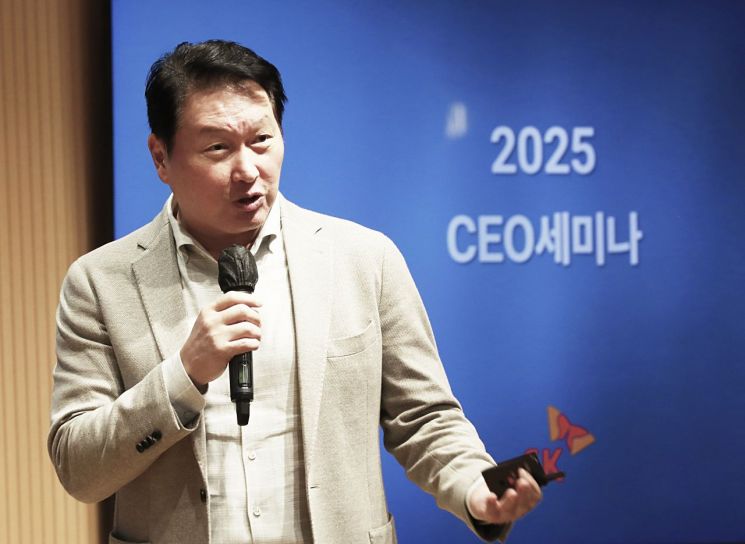 At the '2025 CEO Seminar,' Chey Tae-won, Chairman of SK Group, is revealing the future business direction and vision. SK Supex Council
Companies are eager to learn about Japan. This trend is spreading throughout the business community.
The person who first turned his attention to Japan was Chey Tae-won, Chairman of SK Group. Among business leaders, he has been the most consistent in emphasizing the need for Korea-Japan cooperation.
Chairman Chey will continue this trend by attending the 'Tokyo Forum 2025,' which will be held at Yasuda Auditorium at the University of Tokyo on November 12. In his opening remarks, he plans to address the structural problems facing capitalism, such as inequality and technological transition, and to propose a new economic paradigm centered on 'solidarity' between Korea and Japan.
He has previously stressed that Korea and Japan should create a joint market and cooperation system similar to the European Union (EU). He has repeatedly mentioned the need for solidarity with Japan, especially in technology fields such as AI and semiconductors. The forum will also be attended by prominent Japanese figures, including Fujii Teruo, President of the University of Tokyo, and Iwai Mutsuo, Senior Vice Chairman of the Japan Association of Corporate Executives. The session will be chaired by Park Cheolhee, Special Advisor at the Japan Foundation (former Ambassador to Japan).
Recently, other major companies have also been expanding their connections with Japan. The most prominent example is Samsung Electronics. There is a growing movement among employees to deepen their understanding of the Japanese market, technology, and language, and the company is expanding its support accordingly. Samsung Electronics has strengthened its foreign language courses, including Japanese, through its in-house education program 'Samsung Edu.' Since June, it has also implemented a policy to support the exam fees for seven foreign language conversation tests, including the Japanese SJPT, twice a year for employees in the Device eXperience (DX) division. An industry insider commented, "Twenty years ago, we studied Japan to catch up with them, but now, with our technology levels almost equal, we are revisiting Japan with the aim of strengthening cooperation to overcome geopolitical crises together."
In May, Samsung Electronics held a summit event in Tokyo to discuss building a sustainable supply chain with local partners and to strengthen relationships. Last month, it also signed a major agreement with Japan's SoftBank to jointly research next-generation communication technologies such as 6G mobile networks and AI-based network technology.
Shin Kaksoo, Vice Chairman of the NEAR Foundation (former Ambassador to Japan), noted, "There is a growing atmosphere of cooperation in areas where competition between Korea and Japan does not exist," adding, "Going forward, there is a high possibility that the two countries will create cooperation mechanisms in fields such as data centers, which require vast amounts of data for artificial intelligence (AI). We may also see the creation of Korea-Japan platforms to solve common social problems, with companies collaborating within them."
© The Asia Business Daily(www.asiae.co.kr). All rights reserved.