KDCA Conducts In-Depth Analysis Based on 2024 Community Health Survey
Regional Obesity Rates Highest in Jeollanam-do and Jeju, Lowest in Sejong
Obesity as a Cancer Risk Factor... Dietary Control and Lifestyle Management Essential
One out of every three adults in South Korea is obese, with Jeonnam and Jeju recording the highest obesity rates by region, and Sejong the lowest.
On November 10, the Korea Disease Control and Prevention Agency (KDCA) announced these findings, based on the results of the annual “Community Health Survey,” which covers approximately 230,000 adults aged 19 and older across 17 metropolitan and provincial governments. Obesity was defined as having a body mass index (BMI) of 25 or higher, calculated from self-reported weight and height.
The adult obesity rate in South Korea has been steadily rising, reaching 34.4% last year-meaning about one in three adults is obese. Compared to ten years ago, when one in four adults (26.3%) was obese, the self-reported obesity rate has increased by approximately 30.8%.

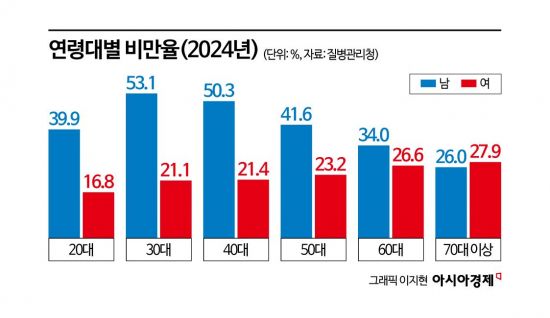
The obesity rate among men was 41.4%, about 1.8 times higher than the 23.0% observed in women. Among men, those in their 30s (53.1%) and 40s (50.3%)-typically more active in social and professional life-had the highest rates, with about one in two men in these age groups being obese. In contrast, women in their 60s (26.6%) and 70s (27.9%) showed relatively higher obesity rates compared to other age groups.
Additionally, about one in two adults (54.9%) in South Korea subjectively considered themselves obese. Among those classified as obese, 77.8% of men and 89.8% of women recognized themselves as obese, indicating that most are aware of their condition. Even among those who were not obese, 13.0% of men and 28.2% of women perceived themselves as obese, highlighting a gap between actual body type and self-perception.
Notably, about three out of five adults (65%) in South Korea have tried to lose or maintain their weight. Among obese individuals, 74.7% of men and 78.4% of women reported attempting weight control. Even among those who were not obese, 42.0% of men and 64.6% of women said they had tried to control their weight.
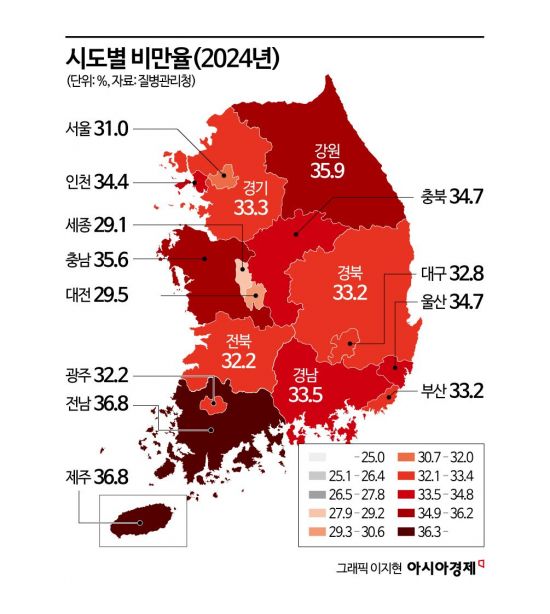
By region, Jeonnam (36.8%) and Jeju (36.8%) had the highest obesity rates, while Sejong (29.1%) had the lowest. An analysis of regional obesity trends over the past ten years showed that obesity rates increased in all 17 metropolitan and provincial areas nationwide. Jeonnam saw the largest increase, from 25.4% in 2015 to 36.8% in 2024, followed by Ulsan and Chungnam. In contrast, Sejong experienced the slowest rise, from 26.2% to 29.1% over the same period, with Daejeon and Gangwon also recording relatively modest increases.
Obesity is known to cause cardiovascular disease, type 2 diabetes, and musculoskeletal disorders, and also affects metabolism, hormones, and immune function, thereby influencing cancer development and prognosis. Professor Yoon Youngsook of Inje University’s Department of Family Medicine explained, “Even a sustained weight loss of about 5-10% leads to significant improvements in metabolic and hormonal environments in the body. Blood sugar and insulin resistance improve, chronic inflammatory responses decrease, and in women, hormonal balance such as estrogen is restored, playing a critical role in preventing an environment conducive to cancer cell growth.”
Although many highly effective obesity treatments have recently been developed, the KDCA warned that if obese patients rely solely on medication for weight loss without also managing their diet and exercising, they may experience nutritional deficiencies, loss of muscle mass, decreased bone density, and metabolic abnormalities. In such cases, stopping the medication can result in rapid weight regain and even worse metabolic conditions than before weight loss.
Lim Seungkwan, Commissioner of the KDCA, stated, “The recent surge in the use of obesity treatments has heightened public interest in weight control and dieting. Since obesity is a precursor to many chronic diseases, we will continue to produce evidence for prevention and management of chronic diseases through the Community Health Survey and the National Health and Nutrition Examination Survey, and provide accurate and reliable statistics on obesity awareness.”
© The Asia Business Daily(www.asiae.co.kr). All rights reserved.