Professor Nam Seungyoon's Team at National Pukyong University Presents Biomimetic Artificial Esophagus Technology
Next-Generation Technology Integrating Electrospinning, Embedded DLP, and Extrusion Bioprinting
The research team led by Professor Nam Seungyoon from the Department of Biomedical Engineering at National Pukyong University (President Bae Sanghoon) has developed a fusion bio-manufacturing technology for artificial esophagus fabrication in collaboration with Professor Jung Eunjae's team at Seoul National University Hospital.
Currently, when esophageal defects occur due to disease or injury, reconstruction is mainly performed through transplantation using the stomach or colon. However, this method has limitations, including mismatched mechanical properties, inflammatory responses, and decreased peristalsis, resulting in various complications.
To address these issues, Professor Nam Seungyoon's research team developed a next-generation artificial esophageal scaffold that simultaneously ensures biocompatibility and mechanical stability similar to that of an actual esophagus.
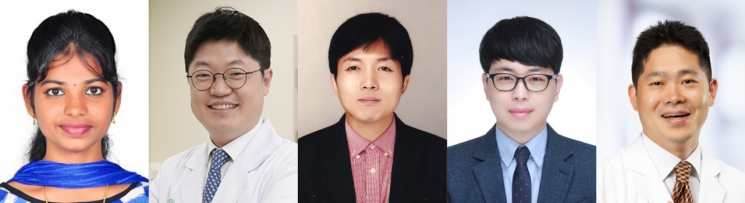 Research team (from left: Priya Ranganathan, Seunghoon Han, Ingeol Kim, Seungyoon Nam, Eunjae Jung). Courtesy of National Pukyong University
The research team produced highly elastic and durable nanofibers using electrospinning, then patterned the natural protein silk fibroin within the microstructure through a photopolymerization process to enhance structural strength and hydrophilicity. They further created a microenvironment similar to esophageal tissue by precisely extruding and stacking decellularized extracellular matrix derived from the esophagus.
The resulting composite artificial esophageal scaffold demonstrated significantly improved tensile strength and elastic modulus, as well as enhanced stem cell adhesion and proliferation, and markedly improved regeneration of smooth muscle and epithelial cells. In animal experiments using a rat esophageal defect model, the scaffold integrated smoothly with host tissue, reduced inflammatory responses, and promoted nerve and blood vessel regeneration and recovery of peristalsis, thereby proving its potential for actual esophageal function restoration.
This study is noteworthy for presenting an integrated platform that combines electrospinning, embedded DLP, and extrusion bioprinting into a single process, enabling the simultaneous realization of the structural and mechanical properties of biological tissues.
Professor Nam Seungyoon stated, "This research is the first case of sequentially integrating electrospinning, photopolymerization, and extrusion-based bioprinting to simultaneously realize the complex structure and mechanical properties of the esophagus. Its significance lies in proposing a new bio-manufacturing strategy that allows precise control of mechanical strength, hydrophilicity, and tissue regeneration within a single process."
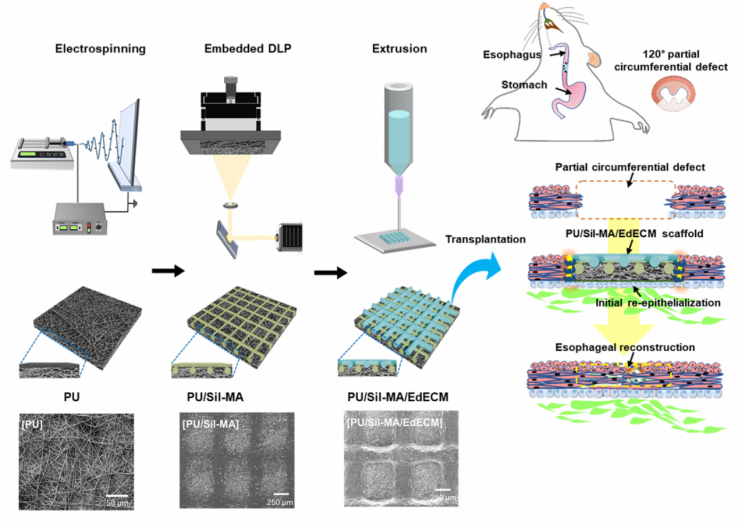
The research findings were published online in the top international journal in the field of biomaterials (IF 10.2, JCR top 7.2%) under the title 'Integrated Biofabrication of Artificial Esophageal Scaffolds using Electrospinning, Embedded DLP, and Extrusion Techniques.'
This study was supported by the Health and Medical Technology R&D Project (HI22C1323) of the Korea Health Industry Development Institute, with collaborative participation from research teams at Seoul National University College of Medicine, Ulsan University College of Medicine, Catholic University College of Medicine, Inje University, and ATEMs.
© The Asia Business Daily(www.asiae.co.kr). All rights reserved.