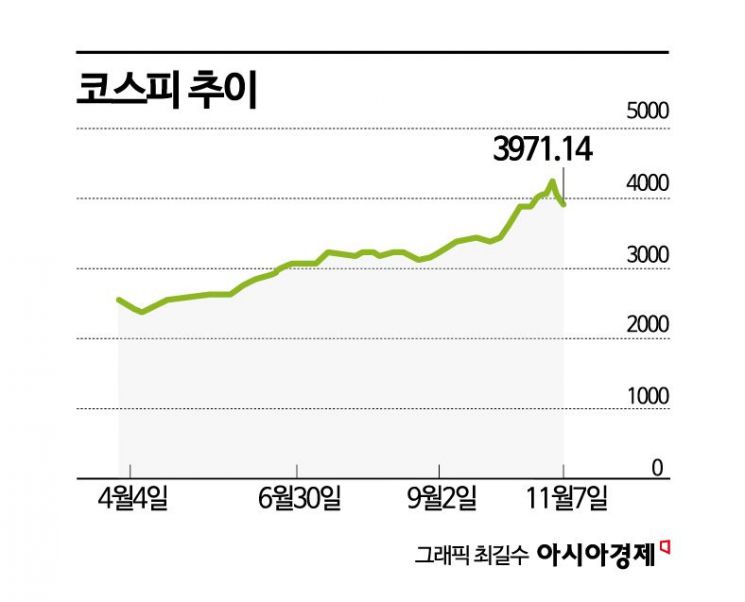
The KOSPI has once again fallen below the 4,000 mark. This is seen as a result of the previous day's decline in the US stock market, where technology stocks dropped amid concerns over an artificial intelligence (AI) bubble.
As of 10:51 a.m. on November 7, the KOSPI was trading at 3,971.71, down 54.74 points (1.36%) from the previous day. The KOSPI, which opened in the 3,960 range, fluctuated throughout the session as institutions engaged in net selling while foreigners and individual investors showed net buying.
After closing at a historic high of 4,221.87 on November 3, the KOSPI has been undergoing a correction as foreign investors sold approximately 6 trillion won worth of shares. During this period, individual investors defended the index with net purchases of a similar amount, but on this day, trading was conducted without a clear direction.
The previous day, the New York stock market declined as concerns over an AI bubble persisted, with a sharp increase in layoffs reported in the US Challenger Report for October and issues related to government guarantees involving OpenAI further dampening investor sentiment. Major AI-related stocks such as Nvidia (-3.65%), Palantir (-6.84%), and AMD (-7.27%) all plunged.
At the same time, by investor type, institutions recorded net selling of 92.1 billion won on the KOSPI, while foreigners and individuals showed net buying of 21.6 billion won and 55.1 billion won, respectively. In the futures market, institutions and individuals each recorded net selling of 159.6 billion won and 185.4 billion won, while foreigners recorded net buying of 365 billion won. In program trading, there was a net selling of 400 million won in arbitrage trading and a net buying of 2 billion won in non-arbitrage trading.
Most sectors declined. The construction sector dropped by 3.42%, while electricity and gas fell by 1.59%, manufacturing by 1.56%, distribution by 1.21%, finance by 1.12%, chemicals by 1.06%, textiles and apparel by 0.85%, transportation and storage by 0.97%, and non-metallic minerals by 0.77%. On the other hand, the food, beverage, and tobacco sector, classified as a defensive stock, remained relatively firm.
Most of the top market capitalization stocks also declined. Samsung Electronics and SK Hynix fell by 0.86% and 1.69%, respectively. LG Energy Solution dropped by 1.28%, Hyundai Motor by 1.67%, Doosan Enerbility by 1.89%, Hanwha Aerospace by 4.33%, HD Hyundai Heavy Industries by 3.24%, and Kia by 1.7%. In contrast, KB Financial Group remained relatively firm.
At the same time, the KOSDAQ index was also weak. The KOSDAQ was trading at 882.49, down 15.68 points (1.75%) from the previous day. By investor type, institutions and foreigners recorded net selling of 8.4 billion won and 21.1 billion won, respectively, while individuals recorded net buying of 53.1 billion won.
Most of the top market capitalization stocks also declined. Alteogen fell by 1.1%, Ecopro BM by 3.16%, Ecopro by 2.79%, Rainbow Robotics by 2.75%, HLB by 4.55%, ABL Bio by 1.05%, LIG Chem Bio by 1.7%, and Samchundang Pharm by 2.19%. On the other hand, Peptron rose by 2.98%.
Lee Sunghoon, a researcher at Kiwoom Securities, commented, "The AI-driven momentum that led the domestic stock market's rise has entered a lull, leading major semiconductor stocks into a short-term consolidation phase. Going forward, new government policy momentum, such as the discussed separate taxation of dividend income, may come into focus."
Meanwhile, in the Seoul foreign exchange market, the won/dollar exchange rate was trading at 1,453.6 won, up 4.3 won from the previous day.
© The Asia Business Daily(www.asiae.co.kr). All rights reserved.