Expanding Eco-Friendly Management Across Major Affiliates
Operating Green Factories with CCUS and Waste Recycling
Strengthening Accident Prevention Systems with Enhanced Safety Facilities
Kumho Petrochemical Group has established and strengthened a system to enhance the substance of its environmental management, taking action to address climate change and improve industrial competitiveness. The company plans to lay the foundation for sustainable growth by introducing greenhouse gas reduction measures, such as applying carbon capture, utilization, and storage (CCUS) technology in its energy generation business and achieving resource circulation through waste recycling.
Major affiliates, including Kumho Petrochemical, Kumho P&B Chemicals, Kumho Mitsui Chemicals, and Kumho Polychem, are strengthening their eco-friendly management with the goal of achieving 'carbon neutrality by 2050.' Kumho Petrochemical has made minimizing environmental pollution and enhancing resource utilization its key priorities. As part of its response to the national circular economy policy, the company is gradually expanding the international resource circulation certification system known as 'Zero Waste to Landfill Certification.' Yeosu 2nd Energy renewed its gold-level certification for its achievements in recycling power plant boiler ash, and Yeosu 1st Energy is also pursuing new certification.
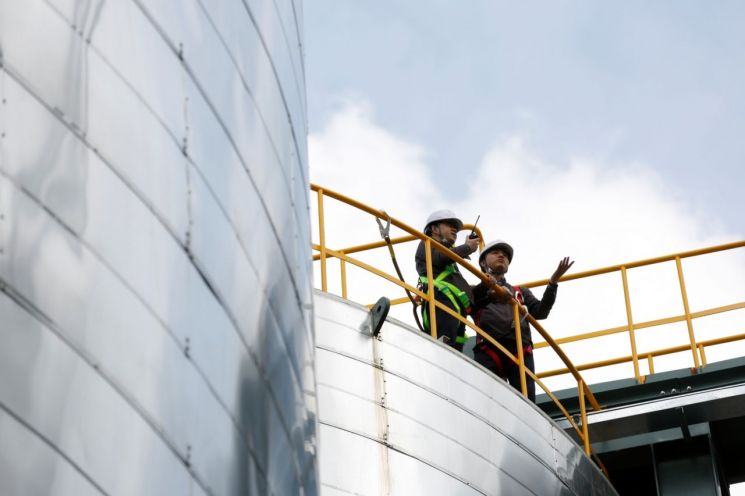 Employees of Kumho Petrochemical are conducting an internal safety inspection at the factory. Kumho Petrochemical Group
In addition, the company received the Minister of Trade, Industry and Energy Award for its contributions to improving the European Union's (EU) Registration, Evaluation, Authorisation and Restriction of Chemicals (REACH) policy regarding carbon nanotubes (CNTs). The company was highly praised for leading improvements to the previously unclear nanomaterial assessment system and for helping to alleviate concerns about carcinogenicity.
In July, the company established CCUS facilities that selectively capture carbon dioxide from power plant exhaust gases and convert it into useful chemicals through the processes of K&H Special Gas. The converted materials are expected to be used in a variety of fields, including dry ice, food and beverage carbon dioxide, welding and cutting, and wastewater treatment. This is expected to not only reduce greenhouse gas emissions, but also create added value and reduce costs.
Kumho P&B Chemicals is investing in equipment and strengthening monitoring systems to advance its environmental management. The company has installed a calorific value monitoring system on the flare stacks (gas incineration facilities) at its Yeosu Plants 1 and 2 to improve emergency response capabilities. At the Gwangyang Logistics Center, it introduced a real-time monitoring system based on the Internet of Things (IoT) for air pollution prevention facilities, improving management efficiency. In addition, the company conducted consulting on hazardous chemical handling facilities in accordance with revisions to the Chemical Control Act, and installed additional combustible gas detectors on the cumene hydroperoxide (CHP) facilities to comply with regulations and strengthen accident prevention systems.

Kumho Mitsui Chemicals introduced eco-friendly recycling processes and began operating a new plant in the first half of the year. By reducing and recycling wastewater generated during the production of methylene diphenyl diisocyanate (MDI) into chlorine and caustic soda, the company increased its self-sufficiency in raw materials and reduced the amount of wastewater produced. The company also maintained its ISCC PLUS international certification by demonstrating the feasibility of producing MDI products using recycled methanol and bio-naphtha as raw materials. This has enabled the company to establish a supply system that meets the sustainability requirements of global customers. Its low-emission volatile organic compound (VOC) MDI solutions are reducing the emission of hazardous substances in various industries, including building interior materials and automotive sound-absorbing materials.
Kumho Polychem expanded its air pollution and wastewater treatment facilities in line with the expansion of its fifth synthetic rubber 'EPDM (Ethylene Propylene Diene Monomer)' production line. The company increased its air pollutant treatment capacity by installing additional regenerative thermal oxidizers (RTOs) and vapor combustion units (VCUs). A new wastewater pipeline was built to allow for flexible adjustment of discharge volumes. The company has established a foundation for emergency response and strengthened its safe management system by relocating and expanding its waste storage facilities.
© The Asia Business Daily(www.asiae.co.kr). All rights reserved.