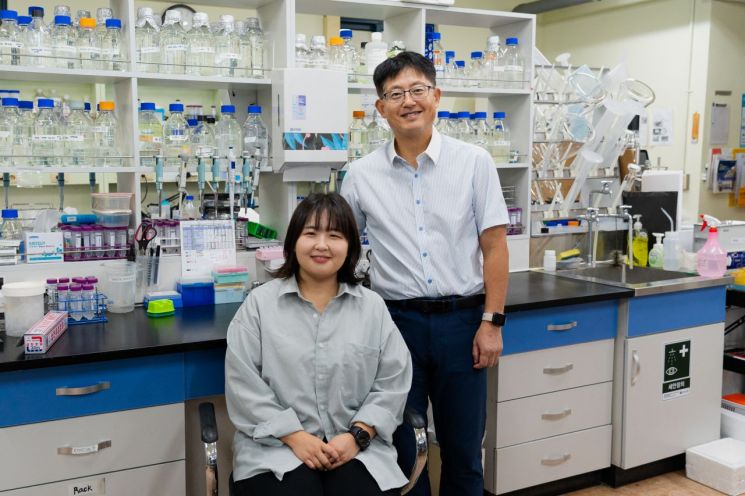
 (From left) Hyunseon Park, Integrated Program Student, Department of New Materials Engineering, GIST; Inchang Kwon, Professor.
On October 22, the Gwangju Institute of Science and Technology (GIST) announced that a research team led by Professor Inchang Kwon from the Department of New Materials Engineering has developed an eco-friendly bioconversion technology that converts 'molasses,' a byproduct generated during the sugarcane refining process, into the high-value-added substance 'D-mannitol' using only enzymatic reactions.
D-mannitol is a type of natural sugar alcohol and is a high-value-added functional compound used as a sweetener, stabilizer, and therapeutic agent in various industries such as food, pharmaceuticals, and cosmetics. The results of this research are expected to contribute to realizing a circular economy and strengthening industrial competitiveness by upcycling discarded agricultural byproducts into new resources.
The sugar industry generates massive amounts of byproducts every year. 'Molasses,' produced when processing sugarcane or sugar beets, is a viscous byproduct containing not only sugar but also glucose, fructose, and minerals. However, most of it has only been utilized as livestock feed or low-cost ethanol feedstock, and has not been used for high-value-added applications.
Technologies that convert such byproducts into new resources are attracting attention as key strategies to simultaneously address environmental issues and enhance industrial competitiveness. Molasses has a high sugar content, giving it great potential as a bio-chemical feedstock, and the production of D-mannitol from molasses is a representative example of turning discarded byproducts into industrial resources.
Previously, research on producing D-mannitol from molasses mainly relied on microbial fermentation. However, a portion of the fructose is consumed for microbial growth and maintenance, resulting in lower conversion rates, and unnecessary byproducts such as lactic acid and ethanol are also generated. In fact, the efficiency of conventional fermentation methods has remained at 60-90% of the theoretical maximum (100%).
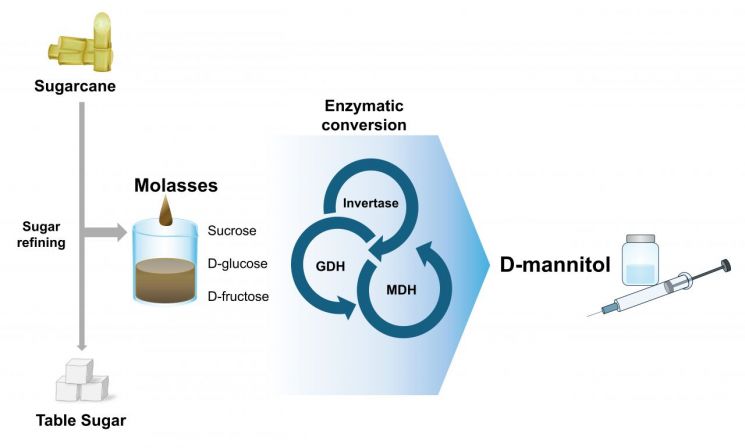
To address this, the research team newly designed a 'three-step enzymatic reaction system' that converts molasses to D-mannitol using only enzymatic reactions, without chemical treatment. This system utilizes three enzymes-invertase, mannitol dehydrogenase (MDH), and glucose dehydrogenase (GDH)-which act as natural catalysts in a sequential manner, inducing a chain reaction from sucrose to glucose and fructose, and finally to D-mannitol.
The research team designed the system so that glucose dehydrogenase (GDH) regenerates the cofactor (NADH) consumed during the reaction in real time by oxidizing glucose, thereby creating a self-sufficient system that does not require additional external cofactor supply. First, invertase breaks down sucrose, which is abundant in molasses, into glucose and fructose. These monosaccharides, once broken down, become suitable substrates for subsequent enzymatic reactions.
Next, mannitol dehydrogenase (MDH) carries out the key reaction of directly converting fructose into D-mannitol. In order to sustain this reaction, the cofactor (NADH), which acts as the 'fuel' for the enzyme, is essential. Here, the third enzyme, glucose dehydrogenase (GDH), plays a crucial role. GDH oxidizes glucose in the molasses, naturally regenerating the cofactor (NADH), which allows mannitol dehydrogenase (MDH) to continuously convert fructose into mannitol.
Through this sequential chain reaction system involving the three enzymes, various sugar components in molasses can be efficiently utilized. As a result, eco-friendly and economical bioconversion is possible without the need for expensive chemicals or complex pre-treatment processes for the raw materials.
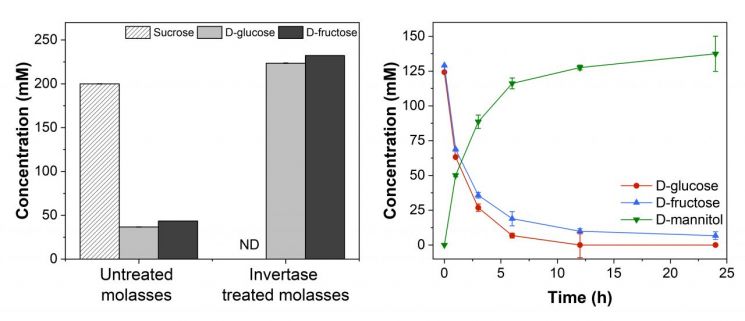
The research team established and compared the performance of two types of enzymatic reaction systems. First, in the two-step process, where each enzyme operates under its optimal conditions step by step, 137 mM of D-mannitol was produced, achieving a conversion efficiency of approximately 92%. In contrast, even in the one-pot process, where all enzymes are mixed and reacted simultaneously, 123 mM of D-mannitol was produced, recording a high efficiency of about 95%.
In particular, the enzymes functioned stably even in the presence of various components contained in molasses, and the reaction proceeded smoothly without the need for additional treatment processes such as impurity removal or dilution, demonstrating that the enzymatic system can convert molasses as-is into the desired product.
Additionally, the team confirmed that D-gluconolactone, generated by the oxidation of glucose during the reaction, can be utilized as another high-value-added compound. This presents a technological advantage of simultaneously producing two high-value-added compounds in a single process.
The enzyme-based technology developed by the research team is evaluated as a sustainable biomanufacturing technology that surpasses traditional microbial fermentation-based production methods in terms of reaction speed and selectivity, while generating almost no unnecessary byproducts, thereby achieving process simplification, cost-effectiveness, and environmental sustainability.
Professor Inchang Kwon stated, "This research is an upcycling technology that enables the production of high-value-added compounds from industrial byproducts that were previously discarded, ensuring both eco-friendliness and economic feasibility. We expect that this will be expanded as a sustainable bioproduction process in various industrial fields such as food, pharmaceuticals, and energy."
This research, supervised by Professor Inchang Kwon and conducted by integrated program student Hyunseon Park from the Department of New Materials Engineering at GIST, was supported by the Leading Research Center Program of the National Research Foundation of Korea and the Doctoral Student Research Encouragement Grant Program. The results were published online in the international journal 'Industrial Crops and Products' on September 30.
© The Asia Business Daily(www.asiae.co.kr). All rights reserved.