NongHyup Bank Analyzes 19.01 Million Transactions
More Visits and Merchandise Sales at the National Museum of Korea
Snack Consumption Rises with K-Pop Demon Hunters Collaboration
Beauty and K-pop Sectors Continue to See Growing Demand
Following the release of the Netflix animated film "K-Pop Demon Hunters" (K-Pop Demon Hunters), there has been a significant increase in consumption related to Korean culture. The "K-Pop Demon Hunters" effect has been observed not only in traditionally strong sectors such as snacks, cosmetics, and K-pop, but also in a variety of other categories, including merchandise from the National Museum of Korea.
According to an analysis by NongHyup Bank of 19.01 million transactions from NongHyup Card and Hanaro Mart between last year and September 21 of this year, visits to the National Museum of Korea increased after the release of "K-Pop Demon Hunters." Specifically, the number of passengers disembarking at Ichon Station, the subway station near the museum, rose significantly starting in mid-July, after the film’s release on June 24. If the number of visitors at the time of release is set at 100, the number of passengers disembarking at Ichon Station reached 190 for the week of July 21 to 27.
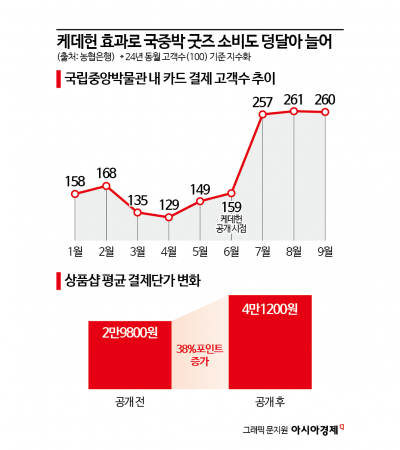
The number of customers making payments at the museum’s internal goods shops, cafes, and restaurants also grew substantially. In August of this year, the number of customers making payments increased by 1.6 times compared to August of last year. In July and September, the figures were 1.57 times and 1.6 times higher, respectively, compared to the same months last year. For the merchandise shop, the average transaction amount after the release of "K-Pop Demon Hunters" (41,200 won) increased by 38% compared to before the release (29,800 won). Looking at the sales share by age group at 10 a.m., right after opening when the crowd was largest, the proportion of customers in their 40s rose by 11 percentage points to 33% after the film’s release. NongHyup Bank explained, "We can see that the museum goods trend is spreading to middle-aged and older generations."
"K-Pop Demon Hunters" also impacted snack sales. After Nongshim announced the launch of a collaboration product with "K-Pop Demon Hunters" at the end of August, sales of Saewookkang at Hanaro Mart showed a slight increase compared to the previous month. When the sales data from August 25 to September 18 is indexed (with the minimum and maximum values set at 0 and 100), the index rose from 72 on August 30 to 75 on September 6, and then to 100 on September 13, demonstrating a clear upward trend. Notably, 46% of customers who purchased Saewookkang during this period were first-time buyers in 2024, indicating that "K-Pop Demon Hunters" attracted a new consumer base.
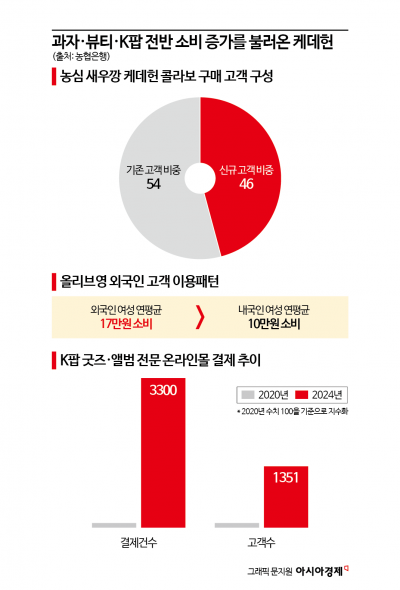
In addition, the "K-Pop Demon Hunters" effect was also observed in the beauty sector, which has traditionally been popular among foreigners. Analysis of Olive Young payment data showed that the monthly number of transactions by foreign customers in 2024 increased by more than 10 percentage points compared to the same months last year. Foreign female customers had higher annual spending and visit frequency than domestic customers. On average, foreigners spent 170,000 won per year and visited Olive Young 4.5 times, while domestic customers spent 100,000 won and visited 4.1 times.
Meanwhile, separate from "K-Pop Demon Hunters," K-pop-the core of Korean cultural consumption-continues to expand its influence through fandom-driven spending. According to NongHyup Bank’s analysis of payment data from major K-pop merchandise and album specialty online malls (such as Weverse Company and Ktown4u) over the past five years, the number of customers increased by 13.5 times and the number of transactions by 33 times compared to 2020. As of last year, women in their 20s accounted for 48% of customers, representing the largest share.
© The Asia Business Daily(www.asiae.co.kr). All rights reserved.