Clear Decline in Applicants to Seoul and Gyeongin Universities
Daegu and North Gyeongsang See Largest Increase in Applicants
It has been found that the number of applicants to regional universities has significantly increased in the early admission process for the 2026 academic year. This trend is analyzed as a result of students in non-metropolitan areas increasingly preferring universities close to home, rather than those in Seoul or the metropolitan area, due to the economic downturn and difficulties in finding employment.
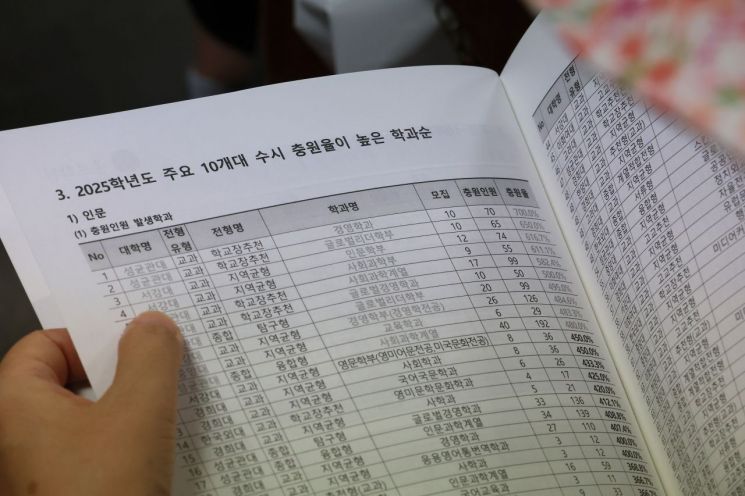 On the 27th, parents and students attending the "2026 Early and Regular Admission University Selection Strategy Special Briefing" held at Jongno Academy in Daechi-dong, Gangnam-gu, Seoul, are reviewing materials. Photo by Yonhap News Agency
On September 21, Jongno Academy analyzed the early admission application status of 192 universities nationwide and found that the number of applicants to regional universities increased by 104,272 (10.2%), reaching a total of 1,124,901. The growth rates by region were as follows: Daegu and Gyeongbuk (12.4%), Gangwon (11.7%), Chungcheong (10.6%), Jeolla (9.8%), Busan, Ulsan, and Gyeongnam (8.0%), and Jeju (7.8%). Out of 110 regional universities, only 16 saw a decrease in applicants.
In contrast, 20 out of 42 universities in Seoul and 17 out of 40 universities in Gyeongin experienced a decrease in applicants. The national average competition rate among universities was 9.77 to 1. By region, the competition rates were 18.83 to 1 in Seoul, 13.02 to 1 in Gyeongin, and 6.49 to 1 in regional areas. Notably, the number of regional universities with a competition rate below 6 to 1 decreased from 68 last year to 53 this year, indicating that the increase in applicants led to higher competition rates.
Lim Seongho, CEO of Jongno Academy, analyzed, "Due to the economic recession and increased uncertainty in the college entrance process, students in regional areas are more likely to apply to local universities for stability, rather than taking risks to enter metropolitan universities." In particular, variables such as the reduction in medical school quotas and intensified competition in the social studies section (commonly referred to as 'Satamrun') were also cited as factors encouraging students to seek more stable options.
The university with the highest competition rate in regional areas was Kyungpook National University, with 14.51 to 1. This was followed by Dankook University Cheonan Campus (11.11 to 1), Chungbuk National University (10.91 to 1), Konkuk University Glocal Campus (10.59 to 1), Yonsei University Mirae Campus (10.48 to 1), and Pusan National University (10.13 to 1), all recording competition rates above 10 to 1.
Nationally, Sungkyunkwan University recorded the highest average competition rate at 32.49 to 1. The highest competition rate in the natural sciences was 708.20 to 1 for the essay-based admissions track at Ajou University’s College of Pharmacy, while in the humanities, it was 321.6 to 1 for the essay-based admissions track in the Business Administration major at Kookmin University.
© The Asia Business Daily(www.asiae.co.kr). All rights reserved.