Economic Recovery Takes Back Seat to Financial Stability: Rate Frozen at 2.50%
Pressure for Stimulus Eases with Supplementary Budget and Expanded Fiscal Spending
Seoul Housing Prices Still Rising Despite Slower Gains
Real Estate, US Rates, Budget Impact, and Tariffs "Need to Be Monitored First"
On August 28, the Monetary Policy Committee of the Bank of Korea decided to keep the base interest rate unchanged at 2.50% per annum. This marks the second consecutive freeze following last month. Concerns that the overheating of housing prices has not yet subsided were a key factor in this month's decision to maintain the rate. Although the real estate market has shown signs of slowing after the government announced its June 27 measures, the committee judged that more time is needed to confirm whether the trend has stabilized.
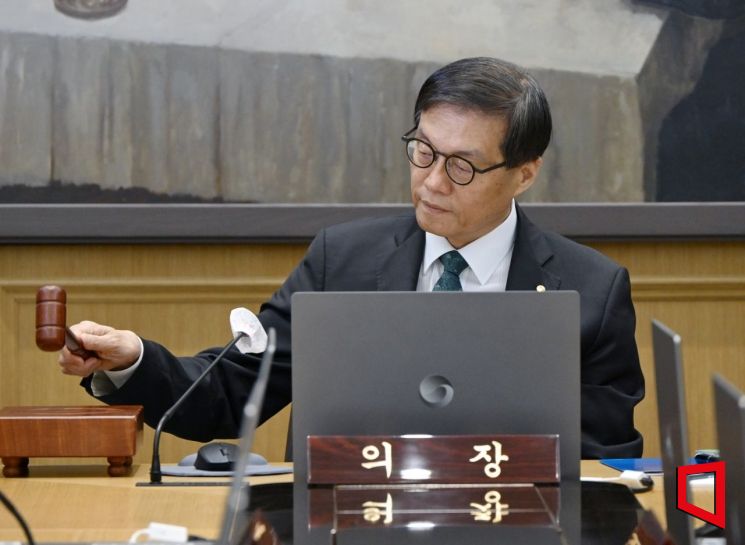 Lee Changyong, Governor of the Bank of Korea, is striking the gavel at the Monetary Policy Committee meeting held at the Bank of Korea in Jung-gu, Seoul on the 28th. Photo by Joint Press Corps
The Bank of Korea's Monetary Policy Committee announced at the monetary policy direction meeting held at the Bank of Korea in Jung-gu, Seoul, that it would maintain the base interest rate at 2.50% per annum. This outcome was in line with market expectations. In a prior survey of experts by Asia Economy, 10 out of 14 respondents (71.4%) predicted a rate freeze this month.
The continued rise in real estate prices in certain areas of Seoul, where the spark has not yet been extinguished, was a major reason for this month's rate freeze. According to the weekly apartment price trend released by the Korea Real Estate Board on August 21, apartment prices in Seoul rose by 0.09% in the third week of August (as of August 18). Although the pace of increase has slowed due to continued wait-and-see sentiment among buyers, localized price increases continued in some preferred complexes, such as newly built or redeveloped properties, with contracts being signed at higher prices. Lee Changyong, Governor of the Bank of Korea, previously emphasized, "The common view among committee members is that the speed and scale of the Bank of Korea's rate cuts should not stimulate market sentiment to the point of driving up real estate prices."
With the government supporting economic improvement through an additional supplementary budget and expanded fiscal spending, and as consumer sentiment recovers, the environment has become more favorable for the committee to focus on financial stability. The fact that major tariff negotiations with the United States concluded at a predictable level also supported the decision to freeze the rate.
The interest rate gap with the United States also posed a burden. If the Bank of Korea cuts rates before the US Federal Reserve, the Korea-US interest rate differential, already at a record high of 2.00 percentage points, would widen to 2.25 percentage points. This could trigger a rise in the won-dollar exchange rate and an outflow of foreign capital.
The Bank of Korea plans to continue its rate-cutting stance but will adjust the pace while monitoring the real estate market, household lending, the US Federal Open Market Committee's (FOMC) rate decision in September, the effects of supplementary budget execution, and the status of tariff negotiations with the United States. October is being considered the most likely timing for the next rate cut.
Ahn Jaekyun, a researcher at Korea Investment & Securities, commented, "If a rate cut accompanies the execution of the supplementary budget, it could boost growth through the first half of next year. Additional stabilization of real estate prices can also be expected if the government announces housing supply measures, so the environment for a base rate cut will likely be in place by October." Yoon Yeosam, a researcher at Meritz Securities, said, "Given the economic conditions, which are expected to remain below potential growth until next year, the monetary policy easing stance will likely continue. Assuming the US moves to cut rates in September, Korea is expected to lower its rate once around October."
The Monetary Policy Committee shifted to an easing cycle in October last year, cutting rates for the first time in three years and two months, and has since lowered rates a total of four times-in November last year, and February and May this year. In the market, the prevailing view is that the final rate for this year will be 2.25% per annum, which would be reached with one additional 0.25 percentage point cut from the current rate.
© The Asia Business Daily(www.asiae.co.kr). All rights reserved.