Sector-by-Sector Outlook Led by Office Recovery
Key Variables for the Real Estate Market in the Second Half of the Year
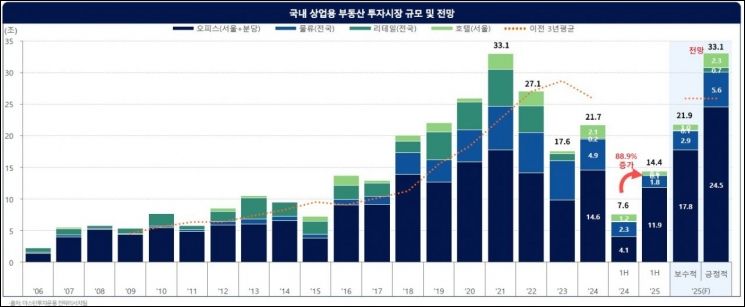
Alternative investment specialist asset management firm Mastern Investment Management announced on the 18th that it has published the report "Korea Real Estate Market Outlook for the Second Half of 2025." According to the report, the transaction share of the office sector continued to rise after 2022, reaching 67.1% at the end of 2024.
The report, prepared by Mastern Investment Management's Research & Strategy (R&S) Division, provides a comprehensive analysis of the outlook for major sectors such as offices and logistics in the second half of this year, as well as the domestic and global economic environments surrounding them.
According to the report, the transaction volume of office properties in Seoul and Bundang during the first half of this year reached approximately KRW 11.7 trillion, representing a 188.4% increase compared to the same period last year. The annual transaction volume is projected to range from at least KRW 17.8 trillion to as much as KRW 24.5 trillion. The upward trend in the sales price index, driven by falling interest rates, is also continuing. By region, the Gangnam Business District (GBD) is recovering at the fastest pace.
Positive factors for the leasing market included strong demand from large corporations, an increase in the number of office workers, and an expansion in per capita office space usage. However, the report also noted that if the economic slowdown persists for an extended period, the burden of vacancies could increase in some areas due to the expansion of new supply.
The report also presented outlooks for the retail and hotel sectors. In retail, transaction volumes have recently declined due to the economic slowdown and adjustments in the development market. This was attributed to a combination of factors, including a contraction in household consumption, population aging in certain regions, and a weakening of purchasing power. In contrast, the hotel sector has recovered its operational performance to pre-pandemic levels. As interest from overseas investors has increased, the transaction share in 2024 expanded to 9.5%. This level is expected to remain at around 5-7% this year as well.
Given that changes in the commercial real estate market are closely linked to domestic and global macroeconomic trends, the report also analyzed key related economic indicators.
The R&S Division projected that Korea's economic growth rate this year would remain at 0.8%, due to delayed domestic demand recovery and the impact of U.S. tariff increases. In the long term, the growth rate is expected to reach around 1.8%, slightly above the average for advanced economies. Both Korea and the United States are expected to continue their interest rate reduction policies, but the pace and magnitude of cuts will be limited, and market interest rates are projected to decline gradually.
Inflation was also addressed as a key topic. After construction costs surged significantly since 2020, they have recently stabilized due to the stabilization of major raw material prices. However, the report explained that high construction costs are likely to persist due to rising wages, which could continue to burden real estate development projects.
Yoo Myunghan, Head of the R&S Division (Managing Director) at Mastern Investment Management, stated, "The commercial real estate market, led by the office sector, is showing a gradual recovery. However, uncertainty remains due to the limited interest rate cut environment and imbalances between sectors." He added, "Whether sector fundamentals recover will be the key variable shaping the market trend in the second half of the year."
© The Asia Business Daily(www.asiae.co.kr). All rights reserved.