Letters to Be Sent Ahead of July 9 Deadline
Trump's Stance Contrasts with Besant's 'Conditional Extension'
If Korea Accepts 25% Tariff, Little Difference from China
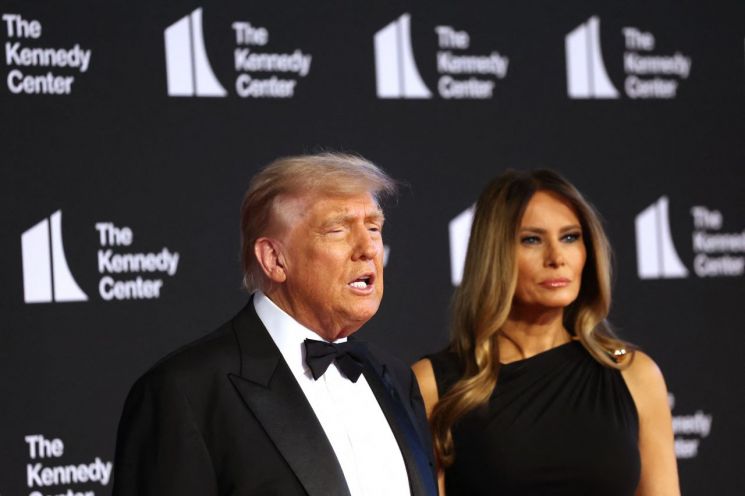 US President Donald Trump and First Lady Melania Trump are talking with the press on the 11th (local time) at the Kennedy Center in Washington before watching the movie "Les Mis?rables." / AFP·Yonhap News
US President Donald Trump announced on the 11th (local time) that he plans to send letters outlining tariff conditions to major trading partners within the next one to two weeks. This move is interpreted as a final ultimatum ahead of the trade negotiation deadline of July 9. In particular, President Trump took on the role of the "bad cop," stating that he does not see the need to extend the deadline, in contrast to US Treasury Secretary Scott Besant, who mentioned the possibility of a conditional extension.
According to Bloomberg and other sources, President Trump told reporters at the John F. Kennedy Center for the Performing Arts in Washington, D.C., before watching the performance of "Les Mis?rables," that "within the next one to two weeks, I will send letters to each country specifying the conditions." He added, "At some point, I will just send the letters. The content will be: these are the conditions, and you can choose to accept them or not."
When asked whether he was willing to extend the trade negotiation deadline, he replied, "It's possible," but added, "I don't think it's necessary." This statement runs counter to Secretary Besant's remarks made on the same day and reflects President Trump's characteristic "strategic ambiguity." It is also seen as an example of the "Good Cop-Bad Cop" negotiation strategy, in which two people apply both conciliatory and hardline stances to pressure the counterpart.
On this day, Secretary Besant appeared before the House Ways and Means Committee of the US Congress and stated his intention to extend the mutual tariff suspension period for countries that are negotiating in good faith. He emphasized, "For countries negotiating sincerely, or in the case of the European Union (EU), it is highly likely that we will make changes later in order to continue negotiations in good faith," and added, "If someone is not negotiating, we will not do so (extend the deadline)." This suggests that if the counterpart is negotiating sincerely, is willing to address US concerns, and requests an extension of the mutual tariff suspension due to the need for more discussion time, the suspension period could be extended beyond July 9.
Currently, the Trump administration is pursuing bilateral trade agreements with 18 countries, including India, Japan, Korea, and the EU. Korea is one of the primary target countries. Although President Trump initially intended to conduct one-on-one customized negotiations with each trading partner, he shifted focus to negotiations with major economic partners after acknowledging limitations in personnel and capacity. According to US Secretary of Commerce Howard Lutnick, the EU will be the last in line due to the negotiation difficulties arising from the interests of its 27 member states.
On April 2, the United States declared "Liberation Day" and notified Korea of a 25% mutual tariff rate. If Korea accepts this tariff as is, Korean products could face tariffs similar to those on Chinese goods (30%) and thus compete in the US market under nearly the same conditions. The US applied a basic tariff of 10% to all countries, then reviewed each country's tariff and non-tariff barriers, and imposed an additional "10%+α" tariff on so-called "worst offender" countries deemed to have high trade barriers.
The Korean government is also prioritizing the trade negotiation issue with the United States and is actively responding. In particular, after the US announced on the 4th at midnight that it would raise tariffs on Korean steel and aluminum from 25% to 50%, the response strategy and negotiation stance of the Lee Jaemyung administration are being put to the test. This is interpreted as the first measure to fully implement the protectionist stance of the Trump administration's second term, creating burdens for both the domestic industry and the government.
This week, President Lee Jaemyung appointed six new vice ministers from the Ministry of Economy and Finance, Ministry of Foreign Affairs, Ministry of Trade, Industry and Energy, and other ministries. This move is seen as preparation for the upcoming Group of Seven (G7) summit starting on the 15th. The chief negotiator for tariff talks with the United States will be Yeo Han-koo, a senior fellow at the Peterson Institute for International Economics in the US. Yeo previously served as Director-General for Trade Policy during the first Trump administration, overseeing trade policy as a whole.
© The Asia Business Daily(www.asiae.co.kr). All rights reserved.