Weekly Closing at 1,484.1 Won on the 9th
Highest Since March 12, 2009 (1,496.5 Won)
Focus on US-China Tariff War and Yuan Trends
The won-dollar exchange rate soared to levels seen during the 2009 financial crisis amid the escalation of the tariff war triggered by Trump. Experts believe that as the US-China conflict over tariff imposition intensifies, the won-dollar exchange rate is threatening the 1500-won level, and the volatile market with sharp fluctuations in response to related news is expected to continue for the time being.
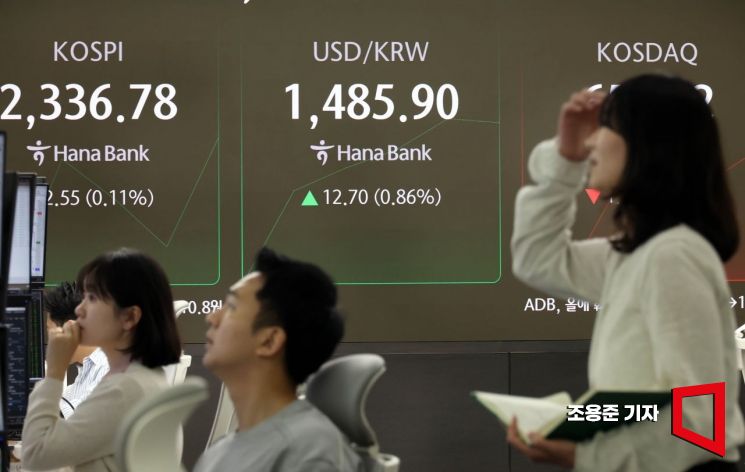 On the 9th, as the won/dollar exchange rate surged sharply to the highest level since the financial crisis during trading hours, the status board in the dealing room at the Hana Bank headquarters in Jung-gu, Seoul displayed the KOSPI and won/dollar exchange rate. On that day, the KOSPI opened at 2,329.99, down 4.24 points (0.18%) from the previous session, while the won/dollar exchange rate started at 1,484.0 won, up 10.8 won. 2025.4.9 Photo by Jo Yong-jun
On the 9th, in the Seoul foreign exchange market, the won-dollar exchange rate closed at 1484.1 won, up 10.9 won from the previous trading day as of 3:30 p.m. This is the highest weekly closing price in 16 years since March 12, 2009 (1496.5 won). It broke the won-dollar exchange rate record from the financial crisis again following the previous day.
On that morning, the won-dollar exchange rate opened at 1484.0 won, up 10.8 won from the previous week's closing price, and early in the session surged to 1487.5 won. It dipped to 1476.9 won during the morning session but then increased again, surpassing the 1480 won level. The won-dollar exchange rate jumped from the 1430 won level to the 1480 won level in just three trading days due to the US-China tariff war and the added effect of yuan weakness.
It is analyzed that the risk currency avoidance phenomenon was maximized as tariffs, retaliatory tariffs, and additional tariff responses continued between the US and China. The US began imposing cumulative tariffs of up to 104% on China that day. Initially, a mutual tariff of 34% was planned, but when China announced retaliatory tariffs, an additional 50% was imposed.
Expectations that China would devalue the yuan also contributed to the won’s weakness. Concerns arose that if China significantly devalues the yuan, signaling a currency war, the won-dollar exchange rate would inevitably rise further in tandem. Min Kyung-won, a researcher at Woori Bank, diagnosed, "As the risk of the US-China tariff war intensified, risk avoidance strengthened, and linked to the yuan’s weakness, the won-dollar exchange rate recorded its highest level since the financial crisis."
It is also analyzed that the delay in Korea’s inclusion in the World Government Bond Index (WGBI) from the originally scheduled November to April next year acted as a negative factor. Although the US has left open the possibility of tariff negotiations with Korea, the direction remains uncertain.Experts expect the volatile market to continue for the time being, keeping the upper limit open to the 1500 won level. However, the possibility of progress in tariff negotiations and the authorities’ caution regarding foreign exchange market intervention are expected to limit the upper bound.
© The Asia Business Daily(www.asiae.co.kr). All rights reserved.