Three Major Strategies: AI, Culture, and Sustainability
15 Key Initiatives and 40 Projects Including Mobility
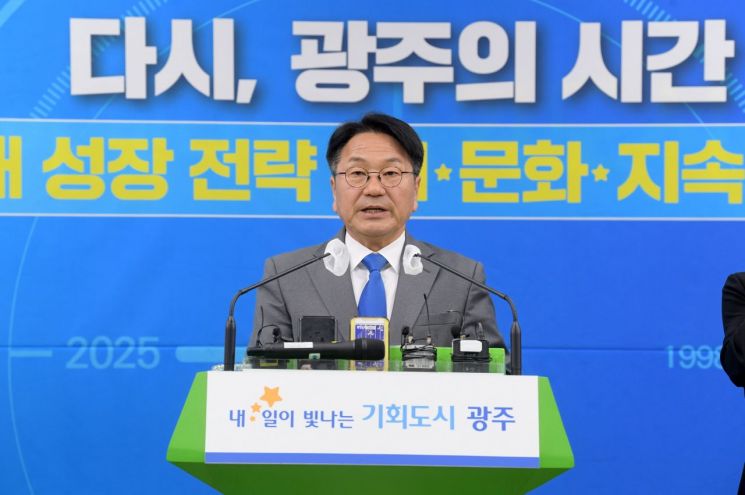 Kang Kijeong, Mayor of Gwangju, is announcing the proposal for the "21st Presidential Election Gwangju Pledge" at the City Hall briefing room on the afternoon of the 8th. Provided by Gwangju City
Gwangju City has proposed 15 key initiatives, 40 projects, and a total investment of 81 trillion won for the 21st presidential election pledges for the Gwangju region. These include the AI Model City - The BRAIN Gwangju, a future mobility new city, a distributed energy hub, ushering in the era of Asia Culture Centered City 2.0, and building transportation infrastructure to realize a Daejabo City.
On the 8th, Gwangju Mayor Kang Gijung held a press conference in the city hall briefing room and stated, "Now, through the presidential election, we must establish a competent democratic government, restore democracy, and reopen the growth plate of Korea that is closing." He presented 15 key initiatives and 40 projects as Gwangju’s pledges for the 21st presidential election.
Mayor Kang emphasized, "By enshrining the spirit of May 18 in the Constitution, we will restore democracy in Korea, and with the three major growth strategies of AI, culture, and sustainability, Gwangju will open the growth plate of Korea."
◇ AI-Led Growth = As an AI-centered city, Gwangju is pursuing 'AI-led growth' by creating the 'AI Model City - The BRAIN Gwangju,' where data becomes money and AI becomes the economy. The city has accumulated experience by establishing and operating the National AI Data Center, signed investment agreements with 274 AI companies, and produced 11,362 AI talents, thus completing an AI ecosystem of 'infrastructure, companies, and talent.'
To build the 'AI Model City,' the city will promote projects such as ▲Establishing a super-scale national AI computing infrastructure (10 trillion won) ▲Building an AI data bank and designating a mega sandbox (1 trillion won) ▲Creating a global AX demonstration valley (AI Phase 2 project, 900 billion won) ▲Establishing an AI semiconductor cluster (500 billion won) ▲Building a foundation for quantum and humanoid deck industries (1 trillion won).
Gwangju City will also promote the creation of Korea’s first future-oriented business new city, where autonomous driving and urban air mobility (UAM) become commonplace, through ▲Establishing a pilot new city for AI-mobility convergence mega sandbox (1.8 trillion won) ▲Building a new industrial line general railway connecting Gwangju Songjeong Station and Yeonggwang (1.9 trillion won) ▲Building an AI convergence autonomous driving testbed (PG), a future mobility testbed, and forming an AI-mobility core technology cluster (1.4 trillion won) ▲Creating a future vehicle RE100 smart industrial complex (2.3 trillion won).
Additionally, to build a 'Net-Zero Distributed Energy Hub,' the city will promote ▲Establishing a distributed energy demonstration complex (2 trillion won) ▲Creating a specialized battery module and system complex (500 billion won).
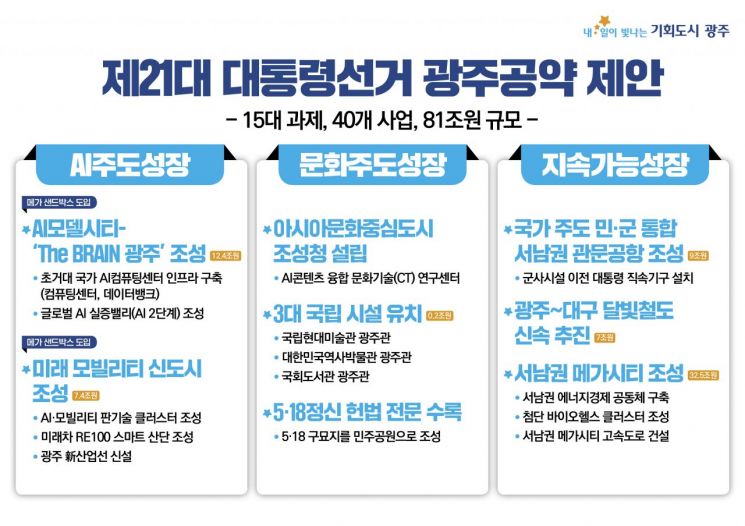
◇ Culture-Led Growth = The city has proposed establishing the Asia Culture Centered City Development Agency for Gwangju to become an Asia culture hub city, a biennale city, a Nobel Prize city, and a UNESCO Creative City of Media Arts. To secure citizens’ cultural rights, the city plans to build three major national cultural facilities: the National Museum of Modern and Contemporary Art, the National Museum of Korean History, and the National Assembly Library (200 billion won).
In addition, the Songam Industrial Complex area will be developed into a K-Culture Content Tech Town, the existing Gwangju Realistic Content Cube (GCC) Academy will be expanded into a specialized shared university for culture, and the 5.18 Old Cemetery, a symbolic site of May 18 widely introduced to the world by author Han Kang, will be developed into a Democracy Park.
◇ Sustainable Growth = To respond to regional extinction and the climate crisis, the city will realize Gwangju as a Daejabo City (public transportation, bicycle, and pedestrian-oriented). The city will build transportation infrastructure to realize the Daejabo City vision.
To solve transportation issues in the Gwangcheon area, where a complex shopping mall opening and large-scale redevelopment are planned, the city will actively request that the following be promoted as national projects: ▲Rapid construction of the Gwangcheon-Sangmu urban railway line (700 billion won) ▲Creation of a future-oriented transfer center at Gwangju Songjeong Station (200 billion won) ▲Expansion of the Honam Expressway Donggwangju-Gwangsan IC (800 billion won).
For the creation of a sustainable Yeongsangang and Gwangjucheon waterfront vibrant city, the city will promote ▲Establishing a water circulation system in the Yeongsangang basin (2 trillion won) ▲Ecological restoration of Gwangjucheon (1 trillion won).
◇ Mega-Regional National Projects = Gwangju City has also proposed national projects for integration with mega-regional national projects. These include the creation of a civil-military integrated airport, the creation of a Gwangju-Jeonnam-Jeonbuk southwest mega city, and fostering a global tourism hub that highlights the taste and style of Namdo.
The city will promote ▲Creation of a national-led southwest civil-military integrated gateway airport (9 trillion won) ▲Rapid promotion of the Dalbit Railway (7 trillion won) ▲Establishment of a southwest energy economic community (20.5 trillion won) ▲Creation of an advanced bio-health cluster (500 billion won) ▲Construction of a southwest mega city expressway (Goheung-Gwangju-Jeonju-Sejong, 10.4 trillion won) ▲Completion of the Gwangju outer ring road (1.1 trillion won) ▲Creation of a southwest cultural tourism belt (1 trillion won) ▲Creation of the Eodeungsan New Vitality Tourism Belt (1.4 trillion won).
In addition, the city requested ▲Inclusion of the May 18 spirit in the Constitution preamble ▲Establishment of the National Conflict Management and Social Integration Institute ▲Establishment of a presidential committee for the relocation of military facilities ▲Creation of the southwest civil-military integrated airport ▲Construction of an energy expressway ▲Establishment of a national integrated care standard model ▲Development of the new national balanced growth 3+5 model ▲Second phase relocation of public institutions.
Mayor Kang Gijung emphasized, "The 'Proposal of Gwangju' to the next government is 'Gwangju, an AI-led ultra-gap growth city.' The time has come again for Gwangju to speak of hope to Korea. Just as Gwangju of the past saved Korea of today, now Gwangju of today must move forward as new vitality for Korea's tomorrow. I will do my best to ensure that 'Gwangju's Proposal' is reflected in the pledges of each political party and the next government's national agenda."
Meanwhile, detailed information on the pledges can be found on the Gwangju City website.
© The Asia Business Daily(www.asiae.co.kr). All rights reserved.