"Falling Behind Chinese Companies in Every Aspect"
Tesla, a Frog in the Well Within the U.S.
China Also Holds a Clear Edge in Price Competitiveness
Analysis suggests that China is one step ahead of the United States in the development of humanoid robots resembling humans, drawing attention.
On the 28th (local time), CNBC, a U.S. economic news broadcaster, cited a recent report from SemiAnalysis, a research and analysis institution in the semiconductor and artificial intelligence (AI) fields, reporting that “China may replicate the influence it has achieved in the electric vehicle industry in the humanoid robot sector as well.”
In the United States, Tesla Optimus is the frontrunner in humanoid robot development. Tesla plans to produce about 5,000 units this year. Additionally, it plans to deploy more than 1,000 Optimus units in Tesla factories this year.
However, according to SemiAnalysis, while Tesla is ahead of U.S. competitors such as Aptronic and Boston Dynamics, the situation changes when compared to Chinese companies.
The report stated, “China is the only country that will gain economic benefits in intelligent robot systems, especially in the humanoid robot field,” adding, “The United States is lagging behind in every aspect.”
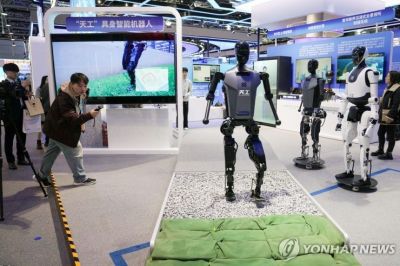
According to a Morgan Stanley research note from February, China overwhelmingly leads with 5,688 patent applications mentioning the word ‘humanoid’ over the past five years, compared to 1,483 from the United States.
Unitree Robotics, headquartered in Hangzhou, China, sold two humanoid robots on the e-commerce platform JD.com last month. Robot startup Agibot, located in Shanghai, aims to produce 5,000 units this year, similar to Optimus.
BYD and Geely have already deployed some of Unitree’s robots in their factories ahead of Tesla. Additionally, Unitree attracted attention by releasing a demonstration video in January showing 16 of its highest-performing robots dancing alongside human dancers.
Electric vehicle manufacturers such as Xiaomi, BYD, Chery, and Xiaopeng have also entered the humanoid robot development arena.
The United States is also losing out to China in price competitiveness. The selling price of Optimus is expected to reach $20,000, which requires conditions such as mass production, short research and development cycles, and inexpensive Chinese-made components to align.
However, Unitree launched a humanoid robot for consumers in May priced at $16,000.
Lake Knututsen, an analyst at SemiAnalysis, analyzed, “For U.S. companies to catch up with China, they must rapidly establish a strong manufacturing and industrial base domestically or through allies.”
© The Asia Business Daily(www.asiae.co.kr). All rights reserved.