"Cultural Exchange, an Attractive Aspect of Bilateral Relations"
Wang, Director of the Central Foreign Affairs Office of the Chinese Communist Party (also serving as Foreign Minister), emphasized cultural exchange between South Korea and China, raising the possibility of lifting China's 'Hanhanryeong' (Korean Wave restriction order).
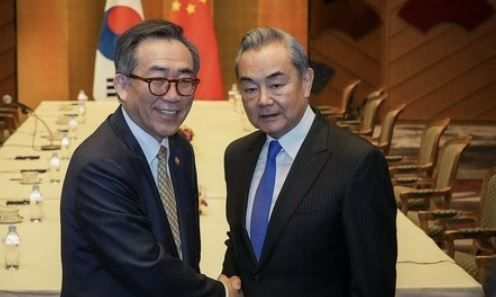 Cho Tae-yeol, Minister of Foreign Affairs, who is visiting Japan to attend a foreign ministers' meeting, is taking a commemorative photo with Wang Yi, Director of the Office of the Central Foreign Affairs Commission of the Chinese Communist Party (also serving as Foreign Minister), during their meeting on the 21st. Photo by Yonhap News
On the afternoon of the 21st, Foreign Minister Cho Tae-yeol and Director Wang agreed at a foreign ministers' meeting held in Tokyo, Japan, to work together to restore cultural exchanges between South Korea and China, aiming to enhance mutual understanding among their peoples and further develop practical cooperation between the two countries.
Earlier, President Xi Jinping met with National Assembly Speaker Woo Won-shik, who visited Harbin on the 7th of last month, and reportedly said he was seriously considering attending the APEC summit, adding, "Cultural exchange is an attractive part of bilateral relations, and issues arising during the exchange process should be avoided," according to the Speaker's office.
With President Xi expected to attend the Asia-Pacific Economic Cooperation (APEC) summit held in Gyeongju, Gyeongbuk, around October to November, expectations are rising that the Hanhanryeong may be lifted.
Not only statements from the Chinese leadership but also the Chinese cultural sector seem to hint at the possibility of lifting the Hanhanryeong. A representative example is the film Mickey 17, directed by Bong Joon-ho, which was released nationwide in China earlier this month. It is the first time in several years that a 'Korean director's' work has been approved by China and screened in theaters.
Overseas film imports in China are exclusively handled by China Film Group, a state-owned enterprise under the Central Propaganda Department of the Chinese Communist Party, making approval from the central Chinese authorities essential.
China has unofficially enforced the Hanhanryeong since around 2016, restricting Korean music, dramas, and films in response to the deployment of the THAAD (Terminal High Altitude Area Defense) missile defense system by the US Forces Korea.
© The Asia Business Daily(www.asiae.co.kr). All rights reserved.