KFME Announces Results of the "2025 Survey on Closed Small Business Owners"
Average Debt at Closure Exceeds 100 Million KRW
Manufacturing Sector Faces Higher Debts and Closure Costs Than Service Industries
Most Cited Reason for Closure: Declining Profitability and Sluggish Sales
Over 70% Found Yellow Umbrella Mutual Aid Helpful, But Government Support Programs Underutilized
Key Policy Needs: Loan Repayment Deferral, Closure Cost Support, and Post-Closure Career Assistance
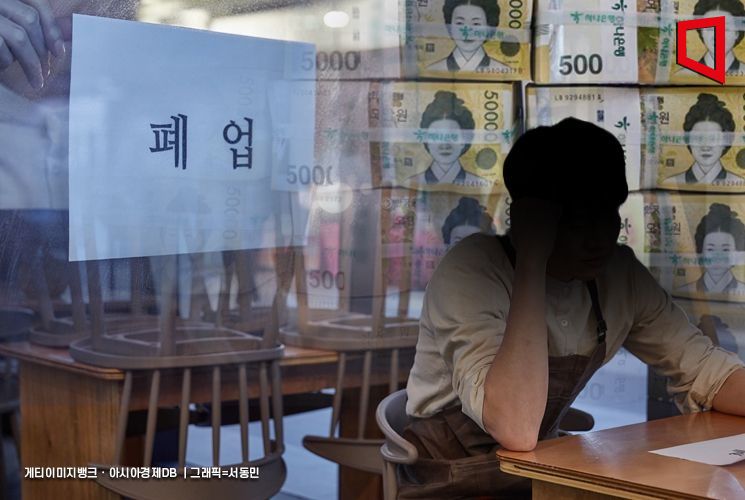
The average debt amount at the time small business owners decided to close their businesses was 102.36 million KRW. The costs incurred for closure also exceeded 20 million KRW.
The Korea Federation of Micro Enterprise (KFME) announced on the 19th the results of the "2025 Survey on Closed Small Business Owners," conducted on 820 small business owners who received closure compensation from the Yellow Umbrella (Small Business and Micro Enterprise Mutual Aid) since 2021.

The survey results showed that the average debt amount at the time of deciding to close was 102.36 million KRW, and the average closure cost was 21.88 million KRW. The detailed average costs of closure were ▲demolition costs 5.18 million KRW ▲restoration costs 3.79 million KRW ▲employee severance pay 5.63 million KRW ▲taxes 4.20 million KRW, etc. Notably, the average debt amount in manufacturing was 144.41 million KRW, more than 1.5 times higher than that of lodging and food service industries, and the average closure cost in manufacturing was 38.59 million KRW, over three times higher than lodging and food service, indicating the need for tailored closure cost support policies considering industry characteristics.
The reasons for closure (multiple responses) were ▲deterioration of profitability and sluggish sales (86.7%) ▲personal reasons such as aptitude and family (28.7%) ▲starting or preparing for a new business (26.0%) ▲unavoidable reasons such as lease expiration and administrative disposition (21.8%). Causes of profitability deterioration and sluggish sales (multiple responses) included ▲decrease in customers due to sluggish domestic demand (52.2%) ▲rising labor costs (49.4%) ▲increased raw material costs due to inflation (46.0%) ▲rising fixed costs such as rent (44.6%). In the lodging and food service industry, the burden of commissions and advertising fees from online platform companies (35.6%) was higher than the average (16.3%). The average operating period from startup to closure was 6.5 years, with 39.9% of closures occurring within less than three years.
The main difficulties during the closure process were ▲preparing for livelihood after closure (31.1%) ▲recovering key money and transferring business (24.3%) ▲repaying loans (22.9%). The proportion of respondents who said the Yellow Umbrella mutual aid fund was helpful during the closure process was 71.1%, and 58.9% of respondents used the fund for living expenses. However, 78.2% of respondents reported not utilizing government support programs (such as the Hope Return Package and New Start Fund) during closure. The reasons given were ▲lack of awareness of government support programs (66.9%) ▲complicated application methods or requirements (21.4%), among others.
The most needed and expandable government policies during closure (multiple responses) were ▲loan repayment deferral and interest reduction (52.6%) ▲closure cost support (51.0%) ▲post-closure career support (46.6%) ▲expansion of self-employed employment insurance and Yellow Umbrella mutual aid (22.8%). Additionally, among respondents who did not start a new business after closure, 59.3% preferred employment if the same income level was expected.
Choo Moon-gap, head of the Economic Policy Headquarters at KFME, said, "The rapid collapse of small business owners, who are both producers and consumers, means that the social costs our economy must bear, such as welfare expenses, will increase accordingly," adding, "If the government strengthens retraining and expands job transition incentives, encouraging closed small business owners to find employment in manufacturing SMEs, it could ease competition among small business owners and alleviate the labor shortage in small manufacturing industries."
© The Asia Business Daily(www.asiae.co.kr). All rights reserved.