"Export Target Set at $14 Billion This Year... Growth is Possible"
Seeking Overseas Cultivation Sites to Respond to Climate Change
Determined to Reform Farmland Regulations and Reduce Rice Paddy Area
Song Mi-ryeong, Minister of Agriculture, Food and Rural Affairs, said on the 20th regarding the launch of the second term of the Donald Trump administration, "It is an uncertain situation," adding, "We have formed a task force (TF) to listen to various opinions and develop response plans based on different scenarios."
Minister Song made these remarks during a regular press briefing held at the Government Complex Sejong on the same day. She explained, "Tomorrow, we plan to listen to any difficulties mainly from food companies and respond if necessary," adding, "We are considering various situations."
However, looking back at the first Trump administration, Minister Song explained that "the agricultural sector was actually not significantly affected." She pointed out, "Due to the special nature of food and the burden of rising U.S. prices when tariffs are raised, the impact on agriculture and food products is expected to be relatively less compared to other sectors."
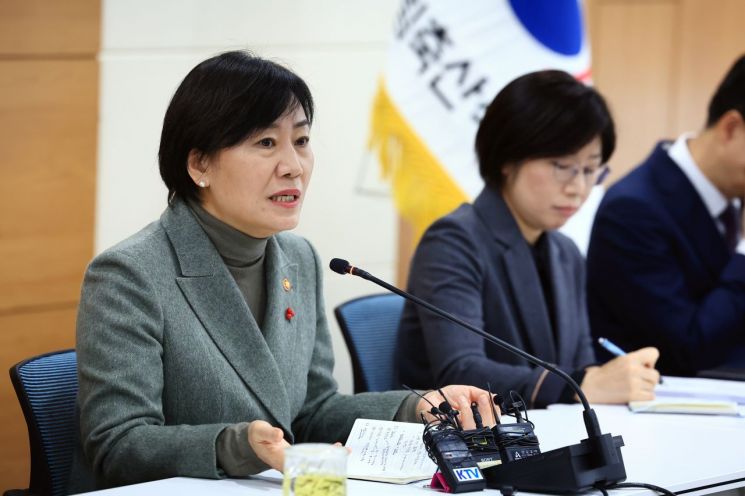 Song Miryeong, Minister of Agriculture, Food and Rural Affairs (left), is speaking at the regular press briefing held at the Government Sejong Complex on the 20th. Provided by the Ministry of Agriculture, Food and Rural Affairs
The Ministry of Agriculture, Food and Rural Affairs has set an export target of $14 billion this year, including K-Food and related industries. Since last year's target ($13.5 billion) was not achieved, this year's target is considered high. Regarding this, Minister Song explained, "K-Food has set a target of $10.5 billion, which is an increase from last year, and the remaining $3.5 billion comes from the plus category (agricultural machinery, fertilizers, etc.), which is the same as last year's target," adding, "Growth is possible."
Minister Song stated that to achieve this, they plan to expand export volumes in various markets beyond the existing main markets of the U.S., China, and Japan, saying, "We are adopting a strategy to secure new export destinations such as India and Latin American markets, which have large populations." She added, "Considering economic growth rates and various situations, this is a challenging goal," and "We will work hard from the beginning of the year to achieve the target."
Regarding this year's work report, Minister Song emphasized, "The most important thing is the five major packages for stabilizing people’s livelihoods," adding, "Among them, the most important is ensuring stable supply and demand of agricultural products." She also said, "We are preparing various measures," explaining, "The key point is that due to the climate crisis over the past two years, supply and demand of some items have been unstable, and we have already started mid- to long-term responses."
The Ministry of Agriculture, Food and Rural Affairs is seeking countermeasures by dividing production into three stages. In the pre-production stage, to secure a scientific forecasting system, they plan to launch an agriculture satellite in the second half of this year. During the production stage, they will identify suitable cultivation areas for each crop adapted to the changed climate. In this process, they will also explore overseas suitable cultivation areas. In the post-production stage, they plan to focus on establishing a system to enhance stockpiling capacity.
Minister Song said, "We are developing overseas agriculture mainly focusing on grains and oils," adding, "We are not considering apples due to quarantine negotiations, but we are looking for suitable cultivation areas for napa cabbage and radish." She also mentioned, "When developing overseas agriculture, we provide long-term, low-interest loans to participating agricultural companies," and "While companies usually farm and distribute locally, we enacted a law last year that requires them to import to Korea if an import order is issued during domestic supply instability."
Minister Song also announced a goal to improve farmland regulations, which have been maintained without change since the 1996 amendment of the Farmland Act. She detailed plans to increase farmland utilization, ease farmland ownership regulations, and expand local autonomy. To respond to the declining demand for rice, she reiterated the goal of reducing rice paddy cultivation area by 80,000 hectares this year.
Minister Song said, "This year, all public officials at the Ministry of Agriculture, Food and Rural Affairs, including myself, will tackle current challenges and prepare for the future with unprecedented determination." She added that efforts for mid- to long-term future responses will not be neglected, stating, "(Agricultural) structural transformation preparations will be something we sow the seeds for."
© The Asia Business Daily(www.asiae.co.kr). All rights reserved.