Seoul City, Public Support Private Rental Housing Project Briefing Session
Seoul City has allowed the supply of ‘Senior Safety Housing’ in natural green areas and Type 1 general residential areas to prepare for the ultra-aged society. This means that the zoning can be upgraded in these areas to supply complex-type housing.
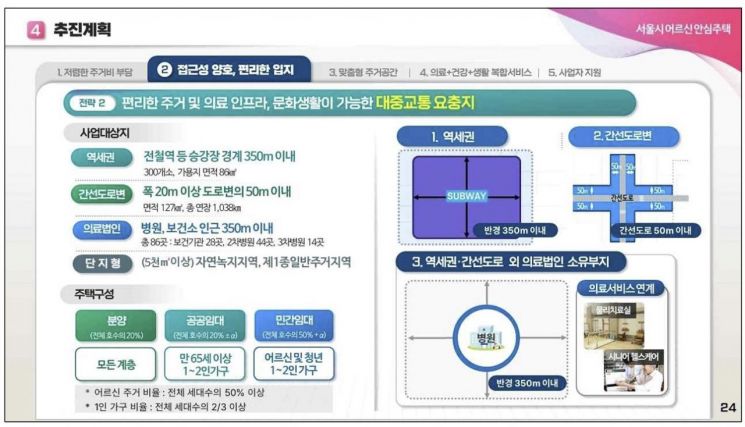
According to the industry on the 21st, Seoul City held a session on the 17th to explain the city’s public-supported private rental housing projects, including ‘Senior Safety Housing,’ to district government officials, project implementers, and representatives from housing-related associations.
Senior Safety Housing is a business model adapted from Youth Safety Housing, which targets young people aged 19 to 39, but modified for the elderly. Unlike youth housing, which is supplied entirely as rental units, 20% of the units are for sale to improve project feasibility. Rental housing includes a minimum ratio of 20% public and 50% private rental units. Rent is cheaper than the surrounding market prices, similar to Youth Safety Housing. Private rentals are supplied at 75-85% of the market price, and public rentals at 30-50%.
To expand supply, the target areas have been broadened. At the beginning of this year, Senior Safety Housing was limited to areas with good community access, such as station areas, main roads, and locations adjacent to health institutions and secondary or tertiary general hospitals. Later, with the establishment of ordinances and operational standards, construction was allowed in natural green areas and Type 1 general residential areas. This was to enable planning of large-scale ‘complex-type Senior Safety Housing’ similar to silver towns. Kim Hoon, head of the Youth Housing Planning Team, said, "Natural green areas can be rezoned to Type 2 general residential areas to carry out projects," adding, "There are nursing facilities near Seoul’s suburbs, and this is intended to meet such demand."
The target residents for Safety Housing are middle-class or lower-middle-class elderly. Unlike senior welfare housing specialized for high-income groups or rental housing supported for low-income groups, it was judged that housing facilities for this group are insufficient. Kim said, "Initially, we planned to obtain the strict BF (Barrier-Free) certification, but we thought the rent would increase too much," adding, "We revised it to comply with barrier-free design guidelines so that essential systems can be included." The community facilities will include only essential ones such as shared dining halls and nutrition centers. Facilities like swimming pools and sports centers, as well as medical centers, will be coordinated to be shared with district residents’ sports centers and others.
The city aimed to approve project plans for more than 3,000 households by next year, but there has been no progress so far. Kim said, "There have been about 50 consultations, but no permit applications have been submitted yet," adding, "We plan to actively encourage projects by shortening the permit process to six months and supporting project cost guarantees and interest rate differences."
Meanwhile, at this session, besides Senior Safety Housing, Seoul-type shared housing for single-person households (rental dormitories) and newlywed Safety Housing were also introduced.
© The Asia Business Daily(www.asiae.co.kr). All rights reserved.