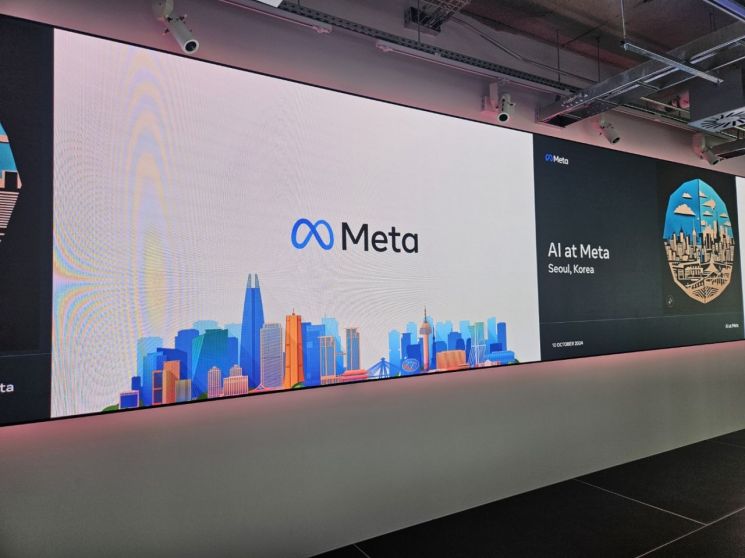
Big tech company Meta announced on the 10th that more than 65,000 derivative models have emerged due to the large language model (LLM) LLaMA, and that it plans to build artificial general intelligence (AGI) in the future.
Manohar Paluri, Vice President of Generative Artificial Intelligence (AI), explained at a media briefing, "LLaMA has grown tenfold since last year, and there are about 65,000 derivative models, which is quite a large number," adding, "We continue to realize our mission to provide innovation that is open, responsible, and affordable."
He further stated, "Thanks to the efforts of participants in the ecosystem based on the models provided by Meta, several success stories are emerging," and explained, "Tech companies are creating innovative use cases, and innovations are appearing in healthcare, education, public services, and other areas where Meta has not directly entered."
Meta said it has conducted a total of four releases related to LLaMA, including the recent 3.2 model, following an open-source approach, and is expanding its influence within the AI community. The LLaMA model has been downloaded more than 400 million times. Vice President Paluri evaluated that the open-source approach accelerates technological innovation as well as contributes to stability and transparency. He said, "Open-source models allow developers to train and fine-tune their own models and help build sustainable systems."
Additionally, Meta explained its plans for building AGI. Paluri said, "Meta's long-term goal is to build AGI and release it as open source so that everyone can benefit from AI," adding, "It can provide great value to society and the economy beyond just corporate growth." AGI refers to AI that has human-like or superior capabilities.
Paluri also introduced MovieGen, which creates videos by inputting prompts (commands). MovieGen is currently under development and can generate audio along with video and editing. Regarding side effects such as deepfakes, Paluri said, "We add watermarks so it can be identified as AI-generated," and added, "The same technology can be used to generate and detect images, so overall, I think it is a positive technology."
Meanwhile, domestic cases using LLaMA were also introduced at the event. Jang Gwang-seon, Senior Researcher at the Korea Institute of Science and Technology Information (KISTI), gave a presentation on KONI, a science and technology information-specialized LLM. He said, "The open-source nature of LLaMA and the ability to build highly secure models with limited resources were considered," adding, "We plan to promote projects aimed at the institution by creating agents specialized in science and technology information using LLaMA and models that automatically generate outcomes."
© The Asia Business Daily(www.asiae.co.kr). All rights reserved.