Starting Next Year, Sequential Annual Investment of 100 Billion KRW for 5 Years
Key Issue: National Assembly's 'Budget Cooperation'
Government Also Plans to Revive Suspended Public Enterprise 'Success-Linked Loans'
The government and Korea National Oil Corporation (KNOC) plan to select one promising deep-sea gas field structure in the East Sea, including 'Daewang Whale,' and commence the first exploratory drilling starting this December. Meanwhile, approximately 12 billion KRW in initial funding has been secured for this year. However, since at least five drilling wells are expected to be drilled in the future, requiring an annual budget of over 100 billion KRW from next year onward, parliamentary cooperation is necessary for the government to provide budget support to KNOC, which is currently in a state of capital erosion.
According to government officials on the 14th, the Ministry of Trade, Industry and Energy and KNOC have prepared about 12 billion KRW as initial funding for the first exploratory drilling. Of this, about 6 billion KRW was secured by utilizing part of the 48.1 billion KRW the government invested in KNOC this year for the East Sea deep-sea gas field drilling project.
The remaining approximately 6 billion KRW will be sourced from KNOC's own funds. Despite KNOC still being in a state of capital erosion due to past large-scale overseas resource development failures, its financial conditions have somewhat improved through steady financial restructuring, achieving consecutive profits over the past two years. Last year, on a consolidated basis, KNOC recorded sales of 3.2671 trillion KRW, operating profit of 846.5 billion KRW, and net profit of 178.8 billion KRW.
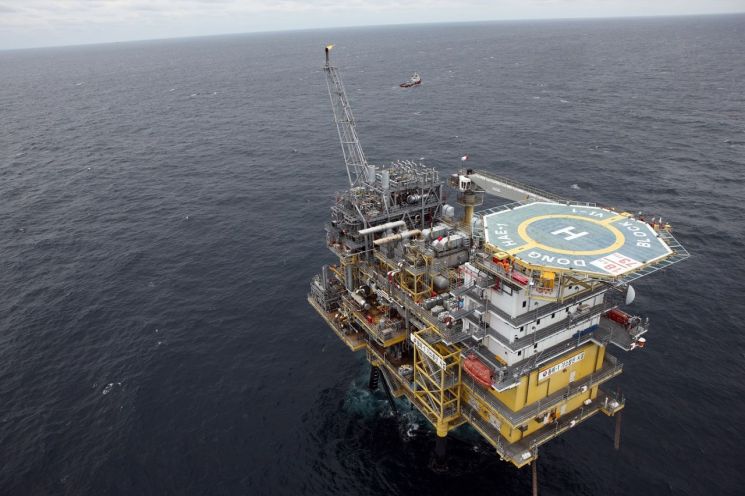
The government plans to invest about 100 billion KRW over four months starting this December to conduct exploratory drilling at one of seven promising structures, having already signed multiple related service contracts, including with Norway's Seadrill and for drillship leasing.
The immediate funding for this year is about 12 billion KRW as initial costs. The remaining nearly 90 billion KRW will be paid next year when the first exploratory drilling is completed, so it must be reflected in next year's budget.
A government official explained, "(For initial payment purposes) a little over 10 billion KRW has been secured," adding, "Most of it is initial payment and contract money, such as payments to Seadrill under contract."
Substantial funding must be injected starting next year. Considering a success rate of about 20%, the government and KNOC expect to drill at least five wells over the next five years. Each well is estimated to cost about 100 billion KRW, totaling approximately 500 billion KRW.
In this regard, on the 13th, the Ministry of Trade, Industry and Energy reported at the People Power Party's caucus meeting plans to utilize a special overseas resource development loan system called 'success-based loans' alongside government investment to support KNOC from next year. Success-based loans are government funds lent to companies undertaking high-risk projects such as overseas resource development. If the project fails, the loan is forgiven; if successful, a special surcharge is collected in addition to principal and interest. Since the large-scale overseas resource development failures during the Lee Myung-bak (MB) administration, the government has only provided success-based loans to private companies excluding public enterprises.
Given the growing necessity of government support for the East Sea deep-sea gas field project, the Ministry plans to discuss with related ministries, including the Ministry of Economy and Finance, to resume success-based loans for the public enterprise KNOC.
However, the opposition party maintains that it is difficult to cooperate on the drilling budget amid insufficient information disclosure, making the budget securing for exploratory drilling from next year onward uncertain at this point. Jin Seong-jun, the Policy Committee Chair of the Democratic Party, stated at a party strategy meeting on the 11th, "Without a thorough investigation, we cannot increase the drilling budget," adding, "Refusing lawmakers' requests for document submission itself seems to acknowledge the suspicions."
Since the government has announced plans to attract investment from global major oil companies with deep-sea oilfield development experience, the financial burden on the government and KNOC may significantly decrease at a certain point in the future.
Attracting investment from global major companies experienced in deep-sea oilfield development can reduce Korea's initial exploration cost burden. However, when development yields results, profits must be shared with those companies according to their investment shares.
© The Asia Business Daily(www.asiae.co.kr). All rights reserved.