"Centuries-Old Ukrainian Literary Works Banned"
"No Access to Medical Services Without Russian Passport"
'Russification' refers to a policy that forces non-Russian nationals or ethnic groups to become Russian or to use the Russian language, culture, and customs. It is a form of cultural assimilation that compels members of former Soviet states under Russian rule, as well as Russia's ethnic minorities, to abandon their own cultures and languages, either voluntarily or involuntarily, in favor of Russian culture and language.
Russification mainly appears in political and cultural spheres. Politically, it involves placing Russian nationals in key administrative positions within state institutions, and culturally, it enforces the use of the Russian language in official business.
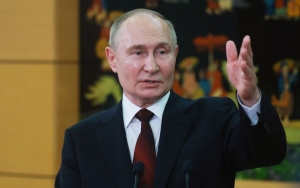
![[News Terms] Russia Begins 'Russification' of Occupied Ukrainian Territories](https://cphoto.asiae.co.kr/listimglink/1/2024022615402175972_1708929620.jpg) Russian President Vladimir Putin (center) is touring a military exhibition after attending an expanded meeting of the Defense Ministry Board with Defense Minister Sergei Shoigu (right) in Moscow last December.
Russian President Vladimir Putin (center) is touring a military exhibition after attending an expanded meeting of the Defense Ministry Board with Defense Minister Sergei Shoigu (right) in Moscow last December. [Photo by AP Moscow/ Yonhap News]
Early examples of Russification include the Kazan Khanate and other Tatar regions conquered by Russia in the 16th century. During this process, the Russian Empire promoted Christian missionary work and mandated Russian as the sole administrative language. After Russia's defeat in the Crimean War and the Polish uprisings in the 19th century, Russification policies became more pronounced, with attempts also made in Finland, Belarus, and Ukraine.
In Ukraine, Russification has been ongoing for centuries. Serhiy Kvit, a Ukrainian literary critic and former Minister of Education, stated, "Russia burned books written in Ukrainian even in the 17th century, and later, during the Russification process, all Ukrainian literary works were outlawed," adding, "This is the same politics that is happening today."
On the 25th (local time), the US magazine Newsweek reported that Russia began issuing its citizenship to residents of Avdiivka in Donetsk Oblast, an eastern battleground it occupied about a week ago.
Earlier, Ukraine withdrew from Avdiivka on the 17th of this month, and Russian forces declared full control of the city the following day. Issuing Russian citizenship to residents of occupied territories is seen as an extension of Russian President Vladimir Putin's historical view that regards Ukraine as former Russian territory.
![[News Terms] Russia Begins 'Russification' of Occupied Ukrainian Territories](https://cphoto.asiae.co.kr/listimglink/1/2024022615391175970_1708929551.jpg) Volodymyr Zelensky, President of Ukraine, is seen clutching his head during a press conference in Kyiv on the 25th (local time) marking the 2nd anniversary of the war. President Zelensky stated that 31,000 of his country's soldiers have died in the two-year war with Russia.
Volodymyr Zelensky, President of Ukraine, is seen clutching his head during a press conference in Kyiv on the 25th (local time) marking the 2nd anniversary of the war. President Zelensky stated that 31,000 of his country's soldiers have died in the two-year war with Russia. [Photo by AFP Kyiv/ Yonhap News]
Russia has focused on 'Russifying' those who have become alienated due to hostile forces by absorbing and indoctrinating them as its own citizens. When it initially occupied southern Kherson Oblast and the Zaporizhzhia region, measures were taken to allow Ukrainians to easily acquire Russian citizenship.
Russification in Avdiivka is also being carried out forcibly. The US think tank Institute for the Study of War (ISW) pointed out, "Russian authorities are forcing residents of the occupied territories to obtain Russian passports by restricting access to essential medical and other services based on whether they hold a Russian passport."
A Ukrainian refugee testified to the European Broadcasting Union (EBU), saying, "Without a Russian passport, pensions are not paid, food is not provided, and medical services cannot be accessed."
In response, Ukrainian authorities are taking measures to protect the 'national identity' of their citizens living in Russian-occupied territories and are preparing countermeasures.
![[News Terms] Russia Begins 'Russification' of Occupied Ukrainian Territories](https://cphoto.asiae.co.kr/listimglink/1/2023080819365234105_1691491012.jpg)
© The Asia Business Daily(www.asiae.co.kr). All rights reserved.