The government’s decision on the 21st to raise the threshold for major shareholders subject to capital gains tax on stock transfers from the current 1 billion KRW to 5 billion KRW was strongly condemned by the Democratic Party’s Planning and Finance Committee members as "rule by enforcement decree."
On the same day, the Democratic Party’s Planning and Finance Committee issued a statement at the National Assembly, strongly opposing the move, saying, "Raising the major shareholder threshold for stock transfer tax is a regression and another form of rule by enforcement decree."
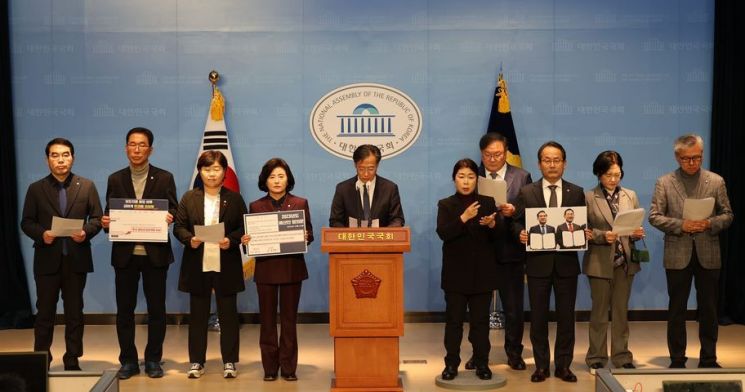
The reason is that the major shareholder threshold, which had been strengthened by the previous government, has been relaxed. They stated, "When the stock transfer tax was introduced in 2000, the major shareholder threshold was 10 billion KRW for KOSPI and KOSDAQ. It was lowered to 5 billion KRW for KOSDAQ in 2005 and 5 billion KRW for KOSPI in 2013, then progressively strengthened to 2.5 billion KRW for KOSPI and 2 billion KRW for KOSDAQ in 2016, 1.5 billion KRW for both KOSPI and KOSDAQ in 2018, and finally to 1 billion KRW in 2020." They added, "This was the previous government’s intention to strengthen taxation on capital income to realize fair taxation. The current raising of the major shareholder threshold for stock transfer tax is a return to 18 years ago."
They also criticized the evasion of the law by revising the enforcement decree against the agreement in the National Assembly. They said, "Is it fairness and common sense that the Yoon Seok-yeol government breaks the promise agreed upon by the ruling and opposition parties in the National Assembly and cunningly revises the enforcement decree?" They added, "The Democratic Party’s Planning and Finance Committee members strongly condemn the Yoon Seok-yeol government’s unilateral and dictatorial revision of the enforcement decree raising the major shareholder threshold for stock transfer tax."
They also pointed out that the relaxation of the major shareholder capital gains tax threshold will lead to a decrease in tax revenue. They said, "In a situation of record-level tax revenue decline, this is a paradoxical act that voluntarily causes further tax revenue reduction." They noted, "If the major shareholder requirement is raised from 1 billion KRW to 5 billion KRW, a significant decrease in tax revenue is expected. Looking only at the determined tax revenue on capital gains from listed stocks in 2020, which was a relatively prosperous period, tax revenue would decrease by more than 700 billion KRW, about 50%."
© The Asia Business Daily(www.asiae.co.kr). All rights reserved.