Large-scale funding support including capital and computing power essential
Only startups chosen by Big Tech have increased chances of success
The generative artificial intelligence (AI) boom has reignited an investment frenzy in the startup industry, but there are concerns that the dependence on funding from big tech companies is increasing, which could actually weaken the growth momentum of startups compared to before. This is because strong financial resources and computing power support from big tech companies have become essential for AI technology development.
As the growth myth of starting from a garage and growing into a big tech company, like Google or Hewlett-Packard (HP) in the past, has disappeared, there are worries that creativity and flexibility may actually decline.
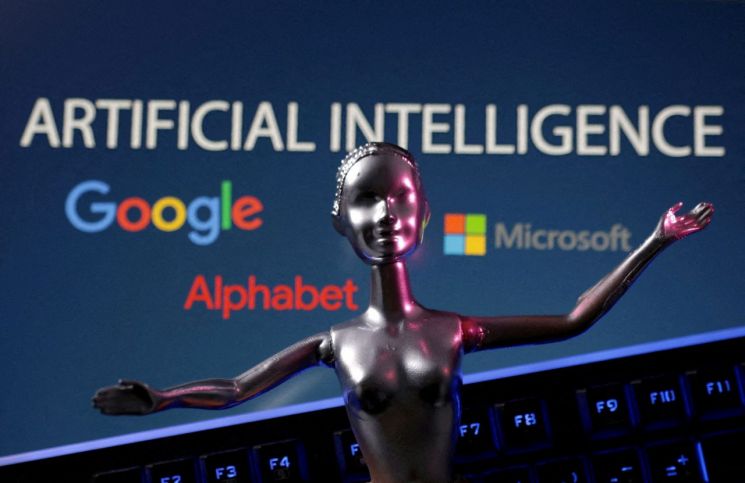
On the 5th (local time), The New York Times (NYT) reported, "In the AI era, small tech companies need big tech company friends," adding, "To create new AI systems, a lot of funding and computing power are required."
Coherent, an AI startup considered a competitor to OpenAI and receiving investment from Google, is a representative example. This company was founded in Toronto, Canada, in 2019 by Aidan Gomez and Nick Frost, who were former Google researchers.
Although it was an ambitious venture, just a few months after founding, the two founders reportedly met with Google to request computing power necessary for developing their own AI technology. While at Google, they could effectively use unlimited computing power, but after starting the startup, they faced the challenge of lacking funds for this.
They were only able to proceed with their business after Sundar Pichai, Google's CEO, personally promised support.
Gomez, Coherent's CEO and co-author of the 2017 academic paper that first concretized the concept of the Transformer model, is a key figure. The Transformer model is a neural network that has become a core element in natural language processing, learning context and meaning by tracking relationships between words in sentences. The company has also received investments from AI experts such as Geoffrey Hinton, a Turing Award winner often called the Nobel Prize of computer science.
Despite Gomez, who concretized core AI technology, founding the company, it appears that help from his former employer Google was ultimately necessary for technology development.
David Katz, partner at Coherent's first investor Radical Ventures, pointed out, "They (big tech companies) control computing power," adding, "They decide who gets that computing power." For AI startups, this means that big tech companies decide whether to provide support from hyperscalers who control the massive data centers needed to build AI systems.
OpenAI also needed investment from Microsoft (MS) to develop ChatGPT, which sparked a global craze. Anthropic, an AI startup founded in 2021 by former OpenAI researchers, received investment by partnering with FTX founder Sam Bankman-Fried. Character.AI, founded by two former Google researchers, and Inflection AI, founded by a former Google executive, also adopted similar approaches to attract investment from large corporations.
The NYT evaluated, "At this moment, when many expect the most important change in the technology industry in decades (the AI technology transformation) to occur, big tech companies have taken the lead in driving it."
© The Asia Business Daily(www.asiae.co.kr). All rights reserved.