Senior Personnel Changes Expected as Early as Late June
Frontline Says "Becoming a Chief Superintendent Is Like Reaching for the Stars"
The government is expected to carry out high-ranking police personnel changes, including the transfer of the Commissioner General, as early as this June. Following the Commissioner General personnel changes, promotions and transfers for the Commissioner and Senior Superintendent General ranks are also expected to follow in succession.
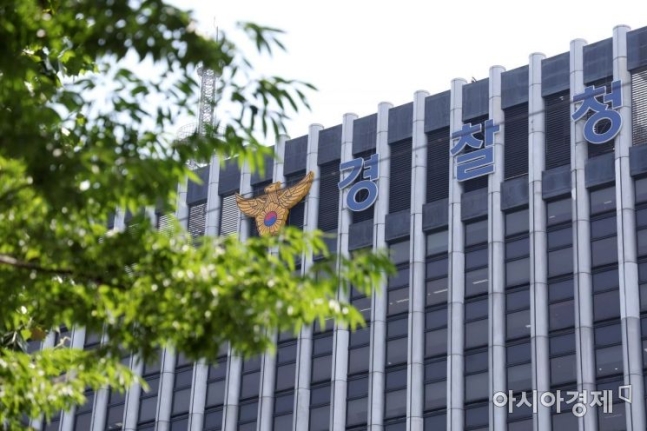
According to the National Police Agency on the 27th, personnel changes involving transfers and promotions of Commissioner Generals, Commissioners, and Senior Superintendent Generals will be carried out between late June and July. A National Police Agency official stated, "It seems that high-ranking police personnel changes will be made as early as late June," adding, "At the latest, the personnel changes are expected to take place within July."
Personnel Decisions Consider Entry Routes, Expertise, and Region... Attention on Connections to the Yoon Administration
The overall flow of police personnel decisions mainly considers entry routes, expertise, and regional balance. A National Police Agency official said, "We understand that the government makes personnel decisions by comprehensively considering entry routes (Korean National Police University, Cadet Candidates, General Recruitment) and expertise."
Graduates of the Korean National Police University are automatically appointed as police officers at the rank of Lieutenant, so their promotions tend to be relatively faster than those from other entry routes. Cadet Candidates are recruited through an examination with a minimum education level of high school graduate. After completing one year of training at the Police Academy, they are also appointed as Lieutenants. Those who enter through general recruitment (constables) mostly rise to ranks between Lieutenant and Senior Superintendent, with some rare cases of promotion to Superintendent General or higher.
Recently, individuals connected to the Yoon Seok-yeol administration have been promoted, and this personnel change is expected to follow a similar trend. Cho Ji-ho, Deputy Commissioner of the National Police Agency, was appointed Commissioner General just six months after being promoted from Senior Superintendent General to Commissioner, earning a reputation for rapid promotion. Kim Soon-ho, the head of the Korean National Police University and the first director of the Police Bureau under the current administration, was also promoted two ranks within a year. This Commissioner General personnel change is expected to be a moderate reshuffle due to variables such as Seoul Police Chief Kim Kwang-ho and the likely transfers of chiefs from Seoul, Busan, and Incheon Police Agencies.
While investigation and intelligence fields have traditionally been considered key positions, recently, individuals with expertise in planning and public relations have been assigned to advance, reflecting the Yoon administration's preference for stable and policy-focused personnel. A senior police official stated, "Since the Yoon administration, there have been cases where Korean National Police University graduates and personnel with investigative expertise have been excluded from personnel decisions."
How regional distribution is handled is also a point of interest. Regional distribution is influenced mainly by two factors: origin and place of service. Among the 22 Senior Superintendent General promotions in January this year, 12 were from the Yeongnam region, 5 from Chungcheong, 2 from Honam, and only 1 each from Seoul and Incheon, leading to criticism of regional bias. Regional allocation considering the autonomous police system is also notable. In the Senior Superintendent General personnel changes earlier this year, the distribution was 8 from the National Police Agency, 7 from Seoul Police Agency, 2 from Busan Police Agency, 2 from Northern Gyeonggi Police Agency, 1 from Southern Gyeonggi Police Agency, 1 from North Chungcheong Police Agency, and 1 from South Gyeongsang Police Agency.
Commissioner General → Commissioner → Senior Superintendent General Personnel Changes... Accelerating Personnel Timetable
As high-ranking personnel changes approach rapidly, the personnel timetable at the front lines has also accelerated. Notable locations include Jongno Police Station, Namdaemun Police Station, and Yeongdeungpo Police Station in Seoul. These police stations are considered key promotion routes as they are located near major national facilities. Although somewhat slowed recently, Gangnam Police Station and especially Yongsan Police Station, whose status has risen following the presidential office's relocation to Yongsan, are also considered major stations. Additionally, Senior Superintendent General-level stations such as Songpa Police Station and Gangseo Police Station are key positions.
Some say this is a story from another world. This is because even attaining the position of Chief Superintendent, the head of a frontline police station, is extremely difficult. As of the end of last year, there were only 634 Chief Superintendents, accounting for just 0.5% of all police officers. A Superintendent working at a frontline station in Seoul said, "Doing good work is basic, but you have to use every connection you have or don't have to even have a chance at becoming a Chief Superintendent." A Chief Superintendent-level officer at a frontline station in Seoul stated, "When the provincial police chief changes, the leadership's tendencies change, so the influence on the front lines is significant," adding, "Especially depending on the expertise of the provincial police chief, the focus of investigations in the province can also change."
Meanwhile, there have been continuous calls for establishing a fair personnel system to guarantee the neutrality and objectivity of police investigations.
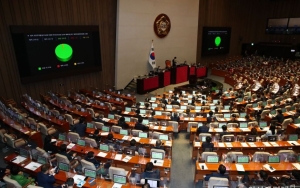
On the 22nd, Lim Ho-seon, a member of the Democratic Party of Korea, introduced a partial amendment bill to the Police Officers Act that specifies the minimum service period for promotions to Senior Superintendent General and above. To prevent personnel decisions based on political alignment, the bill sets a minimum service period of one year for high-ranking police positions such as Commissioner and Senior Superintendent General, and shortens the minimum service period for the Chief Superintendent rank, specified by presidential decree, from four years to three years to resolve the promotion backlog at the Chief Superintendent level.
© The Asia Business Daily(www.asiae.co.kr). All rights reserved.