Container Ship Demand Decline
Shipping Company Maersk's Profits Expected to Drop 80% This Year
Logistics Firms FedEx and UPS Also Face Earnings Slowdown
[Asia Economy Reporter Kwon Haeyoung] Global transportation companies are forecasting bleak earnings this year. It is expected that the impact of a contraction in global trade will be felt. Economic shocks are anticipated in countries with high export dependence, including South Korea.
Container Ships Come to a Halt
According to major foreign media on the 10th, Denmark's Maersk, the world's second-largest shipping company, announced in its earnings report on the 8th (local time) that profits could decline by about 80% this year due to a slowdown in container ship demand. This is due to rising prices and interest rates and a freezing economy, which have led to a contraction in global trade. Maersk projected that global demand for maritime container shipping will decrease by up to 2.5% this year. Logistics company UPS also expects its profits to decline for the first time since 2009.
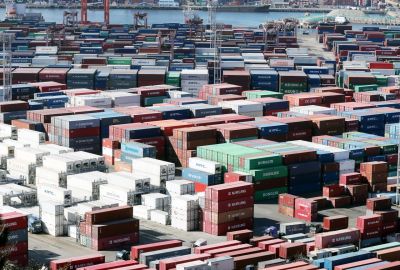
The earnings hit to shipping and logistics companies has already become a reality. Maersk's profit in the fourth quarter of last year was $4.95 billion, down 18.7% from a year earlier. Revenue during the same period fell 3.8% to $17.82 billion. During this period, Maersk's cargo volume dropped 14%, and freight rates fell 3.5%. Other logistics companies also reported poor results. FedEx's net income for the second quarter of fiscal year 2022 (September to November last year) was $788 million, and UPS's profit for the fourth quarter of last year was $3.2 billion, down 24% and 17.9% respectively compared to the same period the previous year. FedEx's average daily cargo volume decreased by 10.2%.
Vincent Clarke, CEO of Maersk, explained, "A completely different picture is unfolding now," adding, "Demand has decreased both in the U.S. and Europe, and this is a rather sharp adjustment." Brian Newman, CFO of UPS, also predicted, "Due to interest rate hikes, inflation, the Ukraine war, and China's COVID-19 disruptions, 2023 will be a challenging year."
In the second half of last year, the global economic downturn slowed the earnings of most companies. Among them, the performance of shipping and logistics companies is particularly noteworthy as it reflects the recent contraction in global trade. The Wall Street Journal (WSJ), a U.S. economic daily, reported, "The world's largest transportation companies are signaling that global trade is declining." Freight rates are also falling due to the slowdown in cargo volume caused by economic deceleration and reduced consumption. The Shanghai Containerized Freight Index (SCFI), a global maritime freight rate indicator, stood at 1006.89 as of the 3rd. Compared to the record high of 5109.60 on January 7 last year, it has dropped to about one-fifth.
China Reopening Variable
Major international organizations also forecast a contraction in trade between countries. The World Trade Organization (WTO) expects the global trade growth rate to decline from 3.5% last year to 1.5% this year. The International Monetary Fund (IMF) predicts that the global import growth rate will fall from 4.7% to 2.4% during the same period. In particular, as the import growth rate of advanced countries shrinks from 6.0% to 2.0%, the export growth rate of emerging countries is expected to decrease from 3.3% to 2.9%. For countries that rely on trade, such contraction in trade leading to export damage and growth slowdown is a foreseen sequence.

Concerns have also been raised that sluggish trade could hamper the global economic recovery. The International Finance Center recently released the 'February Global Risk Watch,' identifying 'trade sluggishness' as a new major global economic risk alongside monetary tightening shocks, recession, and inflation.
However, there are also many expectations that the effect of China's 'reopening' (resumption of economic activities) will appear from the second half of the year, making global economic recovery visible by the end of the year. If the interest rate hike cycles of major countries stop in the first half, there is hope that the recession will be short and shallow.
© The Asia Business Daily(www.asiae.co.kr). All rights reserved.