Combined Observation of Meteorological Satellites and Nanosatellite Constellations
[Asia Economy Reporter Jang Hee-jun] The U.S. Space Force is considering establishing an integrated system that combines military and civilian detection information to enable early response to North Korea's missile threats. The plan is analyzed as an effort to build a system that integrates information detected by military assets with data collected by civilian assets, aiming for early response to North Korean missile threats targeting South Korea, Japan, Guam in the Pacific, and the U.S. mainland.
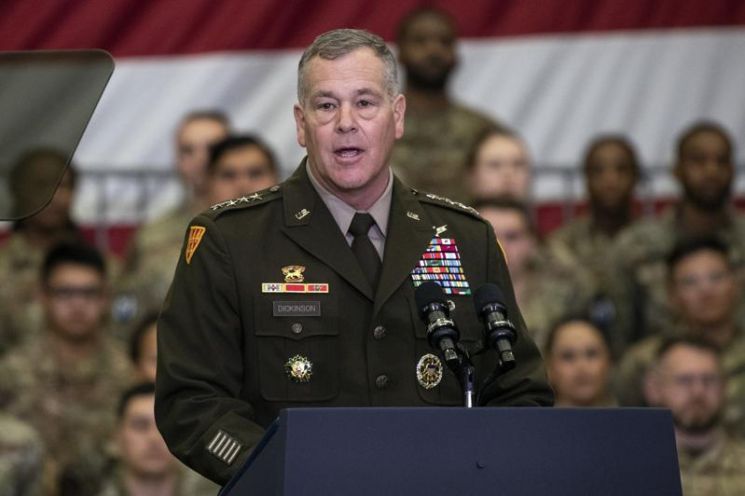
On the 29th (local time), James Dickinson, Commander of the U.S. Space Command, stated at a forum hosted by the Mitchell Institute, affiliated with the U.S. Air Force Association, "We are exploring ways to build an integrated detection architecture that can provide as many alerts as possible regarding all missile activities of North Korea."
This was in response to a question about how the newly established Space Force Component Command under the Indo-Pacific Command would affect the Indo-Pacific Command and U.S. Forces Korea.
Commander Dickinson said, "We are reviewing U.S. assets that were not originally designed for space domain awareness, and also considering how to build a structure that integrates detection sensors within the Department of Defense. Through such a system, we can provide the fastest possible alerts to the United States, its allies, and partners." He also explained that the plan includes considering the integration of civilian systems into this architecture.
Commander Dickinson's remarks suggest the primary mission of the Space Force units deployed to the Indo-Pacific Command and U.S. Forces Korea: to establish a system that integrates and analyzes various detection information, enabling the U.S. and its allies to respond to missile threats in the shortest possible time.
Earlier, on the 23rd, the U.S. military launched the Space Force Command under the Indo-Pacific Command for the first time outside the U.S. mainland, and announced plans to establish Space Force Commands for U.S. Forces Korea and the Central Command within the year. The decision to establish Space Force Component Commands at the Indo-Pacific Command and U.S. Forces Korea ahead of other combatant commands is seen as a recognition of the serious threat posed not only by China, the U.S.'s main competitor, but also by North Korea.
North Korea demonstrated its capability to strike the entire U.S. mainland by launching the intercontinental ballistic missile (ICBM) Hwasong-17 on the 18th, and is continuously advancing its missile capabilities, including the development of hypersonic missiles.
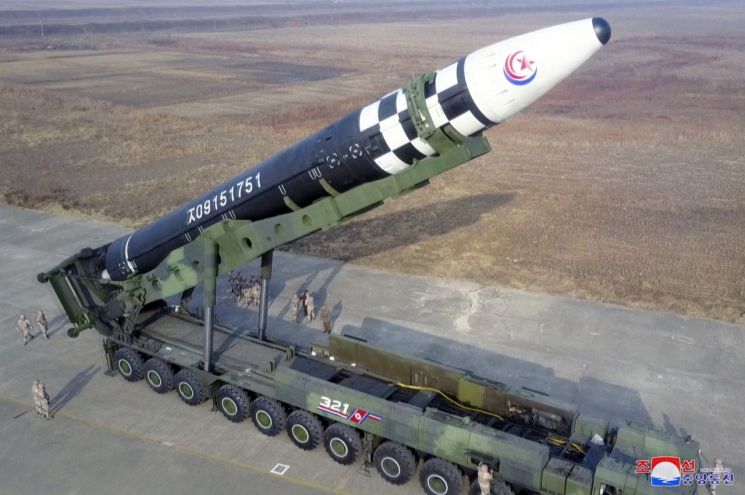 New type intercontinental ballistic missile (ICBM) 'Hwasong-17' launched by North Korea on the 18th [Image source=Yonhap News]
Lee Sang-min, head of the North Korean Military Research Division at the Korea Defense Research Institute, said, "The warning satellites possessed by the Space Force alone cannot provide real-time information on North Korea's missile activities such as mobile launchers (TELs). Dickinson's remarks can be seen as a plan to build a system that integrates and analyzes information from all U.S. assets."
Shin Jong-woo, Secretary General of the Korea Defense Security Forum, explained, "It means building a system that links information from various sensors such as satellites and radars through a 5th generation ultra-high-speed communication network for integrated analysis." He emphasized, "Above all, it aims to significantly increase the detection and response speed compared to the current level to counter North Korea's and China's hypersonic missiles."
Although Commander Dickinson did not specifically list the integrated asset information, meteorological satellite data and civilian micro-satellite constellation information are mentioned as potential integration targets. Ryu Seong-yeop, senior research fellow at the 21st Century Military Research Institute, said, "Utilizing civilian micro-satellite constellation technology can be applied to detect missile launchers moving on the ground or missiles in flight after launch."
There is also an analysis that the newly established Space Force's integration of assets and capabilities across the military services for missile response is a natural process to enhance joint operational effectiveness.
A military source evaluated, "Although the Space Force and Space Command have been newly established and share missile response capabilities, it seems that emphasizing the integration of detection information is necessary to promote jointness by integrating the roles of each military branch to conduct proper operations."
Meanwhile, Commander Dickinson also expressed caution regarding China's space activities at the Space Force Component Command inauguration ceremony under the Indo-Pacific Command held on the 23rd of this month. He said, "China's space activities and capabilities are advancing. I would say they have not yet beaten the U.S., but they are closing the gap with the United States."
John Aquilino, Commander of the Indo-Pacific Command, also emphasized, "It is no coincidence that the Space Force Component Command was first established in the Indo-Pacific. The Indo-Pacific is the most important theater where four of the five major national security threats?China, Russia, North Korea, and violent extremists?are present."
© The Asia Business Daily(www.asiae.co.kr). All rights reserved.