Real Estate R114 Seoul Apartment Sale Prices Stable After 6 Weeks
10 Autonomous Districts Stable, 8 Decline
Gangnam, Previously Leading Increase, Also Stable
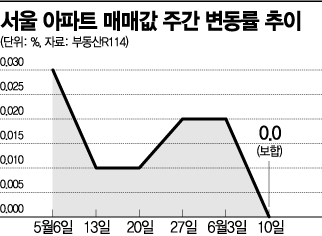
[Asia Economy Reporter Kim Hyemin] The decline in apartment sale prices is spreading throughout Seoul. Apartments in the Gangnam 3 districts, which had driven the rise in real estate prices, have also dropped by hundreds of millions of won. Recently, as transactions have continued mainly through urgent sales coinciding with the property tax assessment date, the downward trend is accelerating from the outskirts of Seoul to the city center.
According to Real Estate R114 on the 13th, last week, the apartment sale prices in Seoul remained flat (0.00%). Both redevelopment apartments and general apartments stopped rising, turning flat after six weeks. The price change rate in Seoul had continued to rise at around 0.1~0.3% for about a month since it paused once on April 29.
As the upward trend halted, the number of autonomous districts turning flat or declining is increasing. Last week, among the 25 autonomous districts in Seoul, 10 were flat and 8 declined. Compared to a month ago, one more district turned flat and three more declined. Gangnam-gu, which led the price increase, turned flat, and Seocho-gu, which recorded a 0.11% increase the previous week, also saw its growth shrink to 0.03%. Gangdong-gu, classified as one of the Gangnam 4 districts, declined by 0.08% compared to the previous week.
Central Seoul areas such as Mapo, Seongdong, Dongdaemun, and Jung-gu also either remained flat, declined, or saw reduced growth rates. According to the Ministry of Land, Infrastructure and Transport's real transaction price disclosure system, a 59㎡ unit (3rd floor) in Sinchon Gran Xi, Mapo-gu, was traded for 1.42 billion won on the 18th of last month. Compared to a 59㎡ unit on the 8th floor traded for 1.57 billion won in February, the price dropped by 150 million won in three months. Similarly, a 59㎡ unit in Hangdang-dong, Seongsong-gu, Seoul Forest Riverview Xi was directly traded last month for 1.12 billion won, down about 500 million won in four months.
The combined effect of interest rate hikes, recognition of peak housing prices, and expectations of deregulation has led to a continued absence of transactions, spreading the downward pressure on housing prices from the outskirts to the city center of Seoul. According to the Seoul Real Estate Information Plaza, apartment sale transactions in Seoul have remained in the 1,000 range for seven consecutive months since November last year. Although there was a forecast that the number of urgent sale listings would decrease after the property tax assessment date on the 1st of this month, the number of listings currently stands at around 62,000 to 63,000 due to weak transaction support.
Lim Byungcheol, chief researcher at Real Estate R114, said, "Although there is a possibility that demand for home purchases will increase in the future due to the government's improvement of the loan environment for actual buyers, the burden of loan interest has increased due to the base interest rate hike," adding, "If the third stage of the DSR (debt service ratio) regulation, which expands the regulation to loans over 100 million won per borrower, is introduced from next month, buying demand may shrink further."
© The Asia Business Daily(www.asiae.co.kr). All rights reserved.