‘Public Procurement Fair Price Contract for SMEs’ Forum Held
Survey Results Announced for 500 SMEs
91% of Companies Experienced Material Cost Increase Last Year... Average Rise of 25.7%
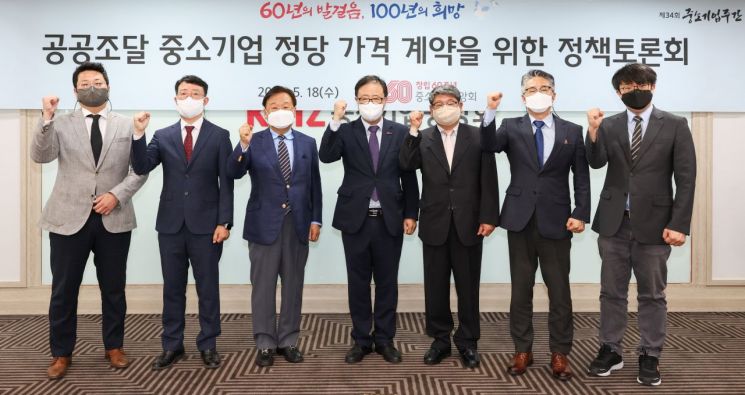 Professor Kim Ik-seong of Dongduk Women's University (third from the left), Jung Yoon-mo, Executive Vice President of the Korea Federation of SMEs, and Hong Sung-kyu, Chairman of the Korea Electric Wire Industry Cooperative, are posing for a commemorative photo at the "Discussion Forum for Fair Pricing Contracts for Public Procurement SMEs" held on the 18th at the Korea Federation of SMEs in Yeouido, Seoul. Photo by Korea Federation of SMEs
[Asia Economy Reporter Kwak Min-jae] Eight out of ten small and medium-sized enterprises (SMEs) were found to deliver products without price changes despite rising raw material and international oil prices.
The Korea Federation of SMEs held a "Discussion Forum for Fair Price Contracts for Public Procurement SMEs" on the 18th at the Federation of SMEs in Yeouido, Seoul, and announced the results of a survey conducted on 500 SMEs related to public procurement.
At the event, Yoo Jin-ho, Head of the Sales Policy Department at the Federation of SMEs, stated that 91% of companies responded that material costs increased last year compared to 2020, with an average increase rate of 25.7%. Due to the Ukraine crisis, raw material and international oil prices rose, and 85.2% of companies reported increased material costs compared to early this year. The average increase rate was 18.0%.
However, 77.9% of companies delivered products without price changes despite the continuous rise in material costs. Only 17.8% responded that public procurement delivery prices increased last year.
SMEs responded to improvement measures for receiving fair contract amounts in public procurement contracts in the following order: "Activation of contract amount adjustment due to price fluctuations" (57.8%), "Proper estimation of expected prices" (27.8%), "Improvement of bidding system" (8.0%), and "Change in perception of contract managers" (3.6%).
Following this, Kim Dae-sik, Senior Research Fellow, who presented on "Review of Improvement in the Evaluation Method of the Current Goods Purchase Qualification Examination System," pointed out the gap between contract amounts close to the minimum bid rate under the contract performance capability evaluation criteria of the qualification examination system and the appropriate profits of SMEs.
Analyzing the current status of qualification examinations, he noted that the proportion of SMEs in purchase bidding is very high at 97.8%, but under the current system, it is difficult to secure appropriate manufacturing costs, arguing that adjustment of the minimum bid rate considering economic and social conditions is necessary.
In the comprehensive discussion led by Professor Kim Ik-sung of Dongduk Women's University, participants including Hong Sung-kyu, Chairman (Korea Electric Wire Industry Cooperative), Kim Jae-hyun, Research Director (Fighterch Research Institute), Professor Jang Myung-gyun (Baekseok Culture University), and Yoo Hyung-sik, Executive Director of Dongwon Plastic, shared the realities of SME deliveries in the public procurement market and discussed various policy alternatives for fair price contracts.
Chairman Hong said, "Although the National Contract Act stipulates that contract amounts can be adjusted due to price increases, public institutions often delay by requesting various documents, and cases where delivery prices do not reflect raw material price increases are frequent," adding, "Active government efforts, including effective adjustment measures, are necessary."
Kim Jae-hyun, Research Director at Fighterch Research Institute, said, "Public procurement is not merely for purchasing goods in the public sector but has the character of a system to nurture companies," and emphasized the need to improve the system so that companies participating in the public procurement market can receive appropriate prices and grow.
Jung Yoon-mo, Executive Vice President of the Korea Federation of SMEs, stated, "The public procurement market amounts to 184 trillion won annually, greatly contributing to expanding sales channels and growth of SMEs, but there are difficulties in guaranteeing appropriate profits for SMEs due to excessive competition among participating companies, lowest-price inducement, and rigid system operation," and added, "A paradigm shift in procurement policy from a low-price focus to a quality focus is necessary."
© The Asia Business Daily(www.asiae.co.kr). All rights reserved.