Discussion on '4-Day Workweek' Begins in Presidential Election
Sim Sang-jung Pledges It, Lee Jae-myung and Lee Nak-yeon Respond Positively
Considerations Include Wage Cuts
Experts Say "Europe Has 35-Hour Workweek... Time to Discuss Working Hours and Health Rights"
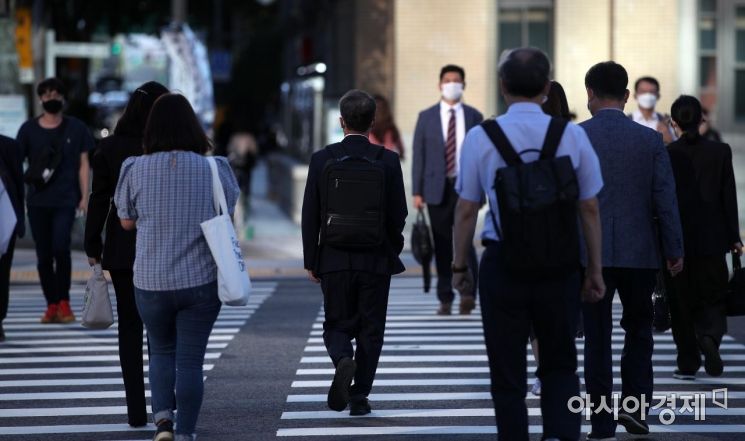 After the Chuseok holiday, on the first working day, the 23rd, citizens returning to their daily lives are hurrying on their way to work on the streets of Gwanghwamun, Seoul. Photo by Hyunmin Kim kimhyun81@
[Asia Economy Reporter Park Hyun-joo] "Let's go with Mon-Tue-Wed-Thu off-off-off," "They accurately understood the needs of workers," "I agree as long as the salary is not cut."
As discussions on the introduction of a four-day workweek have intensified in the presidential election climate, office workers' expectations are growing. They are showing support for candidates who pledge a four-day workweek on social networking services (SNS) such as Twitter.
It is well known that South Korea's working hours are among the longest in the world. As of last year, the annual working hours were 1,908 hours, ranking third among OECD countries after Mexico (2,124 hours) and Costa Rica (1,913 hours). The average working hours among OECD member countries is 1,687 hours.
Consequently, discussions on the four-day workweek have emerged to guarantee workers' health rights and the right to rest. The Korean Health and Medical Industry Labor Union, which announced a general strike in September this year and negotiated with the government, also urged improvements to shift work systems and guarantees for a four-day workweek.
Recently, the four-day workweek has also been proposed as a new solution to the climate crisis. On May 30, the UK environmental group 'Platform London' released a report titled "Stop the Clock: The Environmental Benefits of A Short Working Week," claiming that if the UK switches to a four-day workweek, it could reduce greenhouse gas emissions by 127 million tons annually by 2025. This corresponds to 21.3% of the UK's total greenhouse gas emissions.
◆ Sim Sang-jung: "We must reduce working hours like advanced countries"... Lee Jae-myung and Lee Nak-yeon also 'positive'
The discussion on the four-day workweek was initiated by Assemblyman Cho Jung-hoon of the Transition Era, who ran in the Seoul mayoral by-election last April, and Chungnam Governor Yang Seung-jo, who declared his presidential candidacy. In addition, Justice Party presidential candidate Sim Sang-jung ignited the discussion by making a new labor law, which includes the four-day workweek and a gender-equal wage disclosure system, her first pledge.
On the 6th, Assemblyman Sim held a press conference at the National Assembly, stating, "Since the agreement on a 40-hour workweek in 2003, working hours have not been reduced for 18 years," and added, "The European Union set a 35-hour workweek guideline 30 years ago in 1993 and has started experimenting with a four-day workweek. We must reduce working hours like advanced countries. Above all, it is urgently needed to share jobs amid high unemployment."
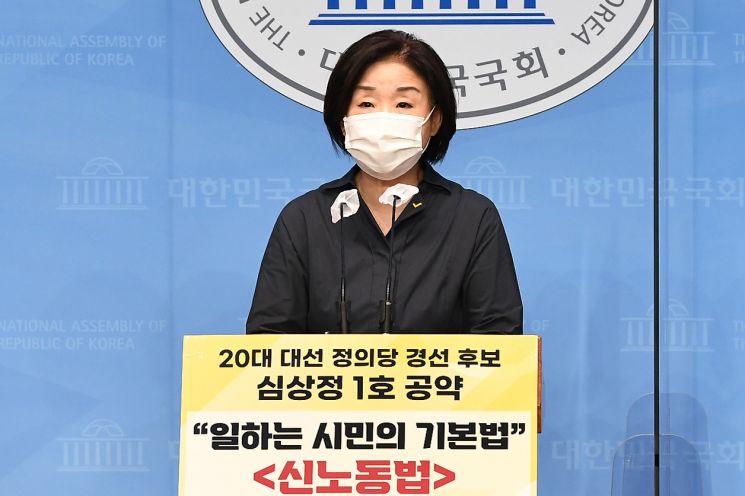 Sim Sang-jung, a Justice Party lawmaker who declared her candidacy for the presidential election, is holding a press conference to announce the 'New Labor Law' pledge at the National Assembly Communication Office in Seoul on the 6th. [Image source=Yonhap News]
Ruling party presidential candidates also responded positively. Gyeonggi Province Governor Lee Jae-myung said at a press briefing on the 22nd of last month, "Korea has the longest working hours, and even the 52-hour workweek is actually long," adding, "We need to reduce working hours in the long term, including a four-day workweek." He emphasized, "Globally, many places work 37 hours a week, not even 40 hours. Working hours must be reduced as a trend to increase jobs."
Candidate Lee Nak-yeon also said at the second party presidential primary debate on July 5, "Some public enterprises actually operate a 4.5-day workweek or a biweekly four-day workweek, extending retirement by two years and employing young people, achieving a twofold effect," and added, "I agree with gradually preparing and introducing it."
◆ Eight out of ten office workers positive about the four-day workweek... Experts: "High response from MZ generation... Currently in the process of discussing the system"
There is also strong public consensus on the four-day workweek. According to a survey conducted by the job platform 'Saramin' on the 27th of last month targeting 4,155 adults, 83.6% responded positively to the four-day workweek. The main reasons were "guaranteeing the right to rest and establishing a work-life balance culture" (72.4%, multiple responses) and "improving work efficiency through sufficient recharging" (51.7%). Following these were △ health management (32.1%) △ domestic demand stimulation and economic growth due to increased holidays (21.2%) △ childcare (20.1%).
Reactions on SNS such as Twitter are also heated regarding the four-day workweek. Netizens commented, "We should elect candidates who pledge a four-day workweek," "The introduction of a four-day workweek is urgent," and "When the five-day workweek was introduced, people said the country would collapse, but it didn't. Let's go for the four-day workweek." On the other hand, opposing opinions such as "The four-day workweek is an unrealistic and unsuitable bait pledge to lure voters," and "Small and medium-sized enterprises will be heavily impacted" were also expressed.
Concerns have also been raised that wages may be cut as working hours decrease if the four-day workweek is introduced. Among respondents who were negative about the four-day workweek (682 people) in the earlier 'Saramin' survey, 60.4% (multiple responses) worried about the possibility of wage cuts. In particular, it was pointed out that low-wage workers, who often calculate wages hourly, would be severely affected if working hours are reduced.
Meanwhile, experts believe that it is time for Korean society to discuss the four-day workweek. Kim Jong-jin, senior research fellow at the Korea Labor and Society Institute, said, "Countries like Spain and Iceland are already conducting experiments on the four-day workweek, and most European countries implement a 35-hour workweek," adding, "Since the MZ generation, which will be the main productive population in the future, shows high support for the four-day workweek, it is now time for Korean society to discuss issues related to overwork, work-life balance, and health rights."
Regarding blind spots such as wage cuts and impacts on small and medium-sized enterprises raised by some, he explained, "The four-day workweek will not be implemented immediately from next year. Except for candidate Sim, no major ruling or opposition candidates have pledged it. (Working hour reduction) can be discussed through various systems such as the four-day workweek, 32-hour workweek, and flexible work systems, but there has been no discussion yet on which system to operate." He added, "Currently, it is a process of discussing how to design and supplement the system, so it is premature to make conclusions about the problems."
© The Asia Business Daily(www.asiae.co.kr). All rights reserved.