[Asia Economy Reporter Kim Bong-su] A Korean research team has developed a wearable rechargeable battery that maintains its performance even after 1000 uses.
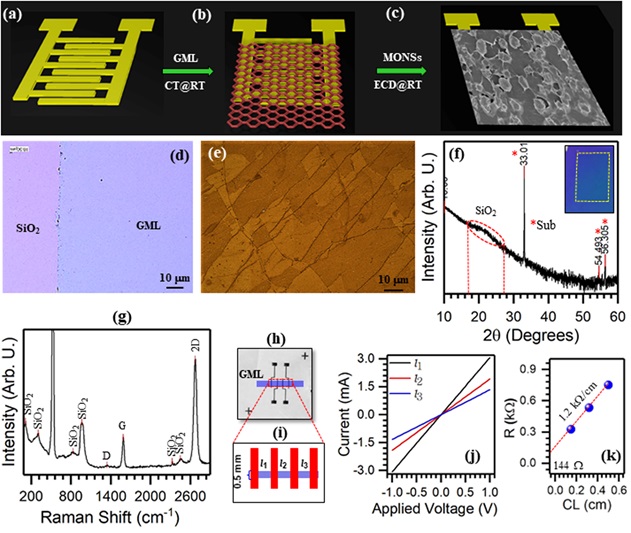
The research team led by Professor Lee Sung-won of the Department of New Materials Science at Daegu Gyeongbuk Institute of Science and Technology (DGIST) announced on the 22nd that they succeeded in developing a thin, flexible, and mechanically stable energy storage device using monolayer graphene and metal oxide heterojunction materials. The developed energy storage device can be used as an auxiliary power source for skin-attached wearable devices.
Recently, as telemedicine has gained attention, there has been growing interest in the development of wearable devices and sensors. However, the miniaturization and flexibilization of supercapacitors, which are energy storage devices necessary to operate wearable devices and sensors, are still in the early stages. When bent enough to deform its shape, it is difficult to secure physical stability, limiting practical use. As an alternative, inexpensive film-type energy storage devices are actively being researched, among which graphene is utilized through various studies due to its excellent electrical properties and large surface area.
The research team fabricated supercapacitors in an ultrathin form less than 0.1 mm thick, achieving mechanical flexibility sufficient to be folded and used. In particular, even when folded and used, it guarantees the same electrical characteristics as when unfolded, enabling stable energy supply without changes in characteristics during free movement when attached to the skin as an energy source for wearable products.
It was manufactured by growing and bonding metal oxides on monolayer graphene, representing a typical case of utilizing monolayer graphene, which had not been widely used in industrial fields. The research also documented complex changes occurring when metal oxides are bonded with other materials, which can serve as guidelines in the future. The total thickness is 30 μm (micrometers), with a storage capacity per unit area of 7.76 mF/cm2, and it guarantees almost the same storage capacity even after 1000 charge and discharge cycles.
The research team stated, "Although supercapacitors have many advantages, we plan to continue additional research to solve the currently somewhat lower total energy storage capacity compared to other commercial batteries."
This research result was published online on June 24 in the international energy journal ‘Nano Energy’.
© The Asia Business Daily(www.asiae.co.kr). All rights reserved.