[Asia Economy Reporter Yoo In-ho] Kim Jong-un, General Secretary of the Workers' Party of Korea, has drawn attention by officially acknowledging the food shortage in a public setting.
As it has been confirmed that North Korea's food situation has worsened, there is a possibility that our government and the U.S. administration may initiate dialogue using humanitarian aid such as food support as an opportunity.
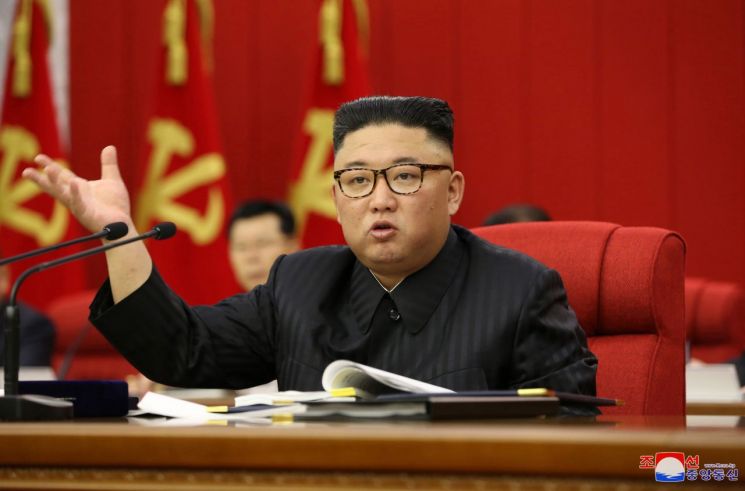
According to the Korean Central News Agency on the 16th, General Secretary Kim said at the Party plenary meeting held the previous day, "Due to the failure to meet the grain production plan caused by last year's typhoon damage in the agricultural sector, the food situation of the people is becoming tense."
According to the North Korean dictionary, 'tense' means 'a state or condition where it becomes difficult to smoothly carry out tasks or such a state.'It is quite unusual that General Secretary Kim acknowledged the food shortage in a public meeting and North Korean media reported it as is. This strongly indicates that the current food situation is not good.
Last year's typhoon and monsoon damage were concentrated in Hwanghae-nambuk Province, a major grain production area, and with the border closed due to COVID-19, importing agricultural materials or receiving food aid has become more difficult than before.
General Secretary Kim emphasized, "At this plenary meeting, active measures to resolve this must be presented," and "Farming well is the most important and top priority combat task that our Party and state must solve at this time."
In fact, indicators of North Korea's food production last year released by the UN Food and Agriculture Organization (FAO) and the Rural Development Administration all show a 'decrease in production.'
FAO predicted the estimated food production from November last year to October this year to be a total of 5,561,000 tons. Specifically for rice, it estimated 2,113,000 tons, and after milling, about 1,395,000 tons.
FAO estimated the food shortage at 858,000 tons and warned that if this is not resolved through imports or aid, the period from August to October this year will be a 'harsh time.'
The Rural Development Administration estimated North Korea's rice production last year to be even lower. A report released in December last year showed rice production at 2,020,000 tons, about 9.8% less compared to 2019.
Looking at the trend of rice prices in North Korea investigated by the North Korea specialist media Daily NK, rice prices have been sharply rising recently.
According to the media, as of the 8th, the price per kilogram of rice by region was 5,000 won in Pyongyang, 4,900 won in Sinuiju, and 4,800 won in Hyesan.
In early March, rice prices were 3,700 won in Pyongyang, 3,900 won in Sinuiju, and 4,050 won in Hyesan, so rice prices have risen by more than 1,000 won per kilogram in just three months.
The Korea Development Institute (KDI) North Korean Economic Review report forecasts North Korea's food shortage this year to be between 700,000 and 1,000,000 tons, analyzing that "such a shortage is beyond the range that North Korea can solve on its own."
In diplomatic circles, there is an analysis that General Secretary Kim must prioritize resolving the food problem quickly over diplomatic issues. If the immediate food shortage is not resolved, the implementation of the economic development line based on self-reliance announced at the 8th Party Congress in January will be impossible from the start.
If the food shortage is left as is, there is a risk that the 'Arduous March' situation of the mid-1990s, when many people starved to death, could be repeated, leading to growing public discontent and eventually to regime instability.
© The Asia Business Daily(www.asiae.co.kr). All rights reserved.