Third-Party Delivery Extended Until Year-End
Domestic Sales Indefinitely
免 Industry "Grateful for Government's Flexible Administrative Support"
Air Routes Recovery Slow... September International Passengers ↓
[Asia Economy Reporter Cha Min-young] The government’s decision to extend the period for domestic sales of long-term duty-free inventory and support for third-party returns has brought a sigh of relief to the duty-free industry, which is facing management difficulties. Although the extension deadline for the third-party return support, which accounts for a large portion of sales, is fixed at the end of the year, there is a consensus that the immediate crisis has been averted.
On the 27th, the Korea Customs Service announced that it will indefinitely extend the domestic sales of duty-free inventory, which had been temporarily operated for six months from the end of April to the 28th of this month. In addition, the third-party return support policy will be maintained until the end of this year. As an alternative to third-party returns, the Customs Service plans to review within the year a method where foreign buyers registered in advance with customs for duty-free goods management can send duty-free items at designated delivery points before departure.
The Korea Customs Service made this decision considering the ongoing sales decline in the duty-free industry due to the impact of the novel coronavirus disease (COVID-19). A Customs Service official said, "We ask for active cooperation from the duty-free industry, distribution sector, and suppliers so that the extension of the domestic sales period for duty-free goods can lead to employment stability for duty-free shops and their partner companies."
The domestic duty-free industry expressed gratitude for the government’s bold decision, as the immediate crisis has been resolved. Initially, the industry had been disposing of unsold inventory such as leather goods, eyewear, watches, and jewelry that had not been sold for over six months through domestic sales of duty-free inventory over the past six months. This was because if inventory accumulates, logistics warehouse usage and management costs increase exponentially.
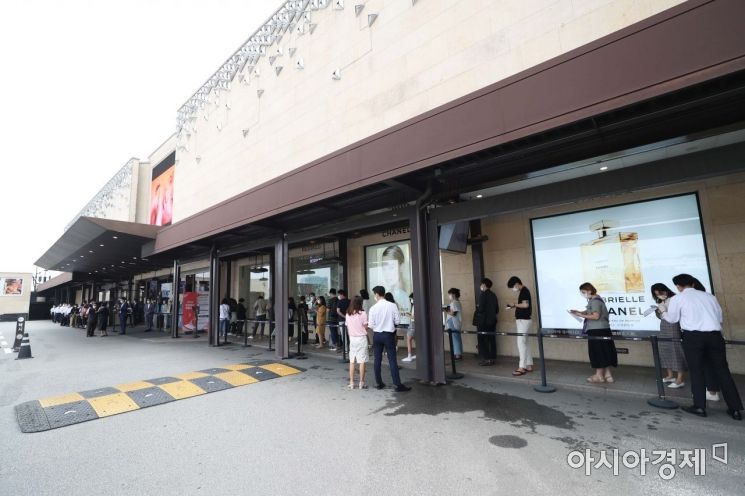 On the 27th, the government decided to extend the period for domestic sales and third-party return support policies for long-term duty-free inventory, bringing a sigh of relief to the duty-free industry. The photo shows the queue waiting to purchase duty-free inventory at Shilla Duty Free on July 21. Photo by Shin Reporter
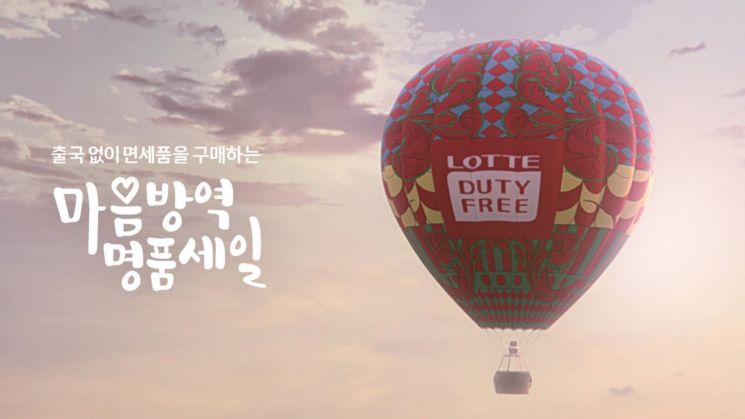
Although various side effects such as domestic sales confusion were initially feared, no significant problems occurred during the six-month implementation period. The duty-free industry also strengthened domestic sales by establishing separate non-face-to-face (untact) platforms in addition to offline sales spaces. Lotte Duty Free has been conducting domestic sales through events like the "Mind Quarantine Luxury Sale" on its integrated mall 'Lotte On.' Shilla Duty Free also showcased products through the travel product brokerage platform app 'Shilla Trip.' Shinsegae Duty Free operates a dedicated online site and mobile application called 'SSG Special' for selling duty-free inventory.
In particular, the extension of the third-party overseas return support policy, which practically accounts for most duty-free sales, holds greater significance. According to the office of Jeong Il-young, a member of the Democratic Party of Korea, the sales revenue generated by duty-free shops through third-party overseas returns reached a total of $465.94 million (approximately 534 billion KRW) as of September 25. This measure was introduced as it became difficult for Chinese corporate-style daigou shoppers to visit Korea due to mandatory self-quarantine.
A representative of a major duty-free shop said, "The industry is going through a very difficult time, and we appreciate and welcome the government’s flexible administrative support that understands our difficulties. Although there is some regret regarding the deadline for third-party returns, we expect new policies to emerge depending on the COVID-19 situation." Another duty-free shop official expressed regret, saying, "However, it would have been better if there had been sufficient explanation about the basis for setting the specific deadline at the end of the year, which is the standard for the third-party return policy."
The recovery of air routes remains distant. In September, the number of international passengers using Incheon International Airport decreased by 96.4% year-on-year to 197,000. After hitting a low of 138,000 in May, international passenger numbers had been steadily increasing for three months, reaching about 230,000 in August, but the upward trend stalled last month. Concerns have grown in October as signs of COVID-19 resurgence have intensified recently, especially in Europe and North America.
© The Asia Business Daily(www.asiae.co.kr). All rights reserved.