Protecting Solar Cells from Water and UV Rays
Converting UV Rays to Visible Light to Increase Power Efficiency
Securing Price Competitiveness and Versatility with Spray Coating Method
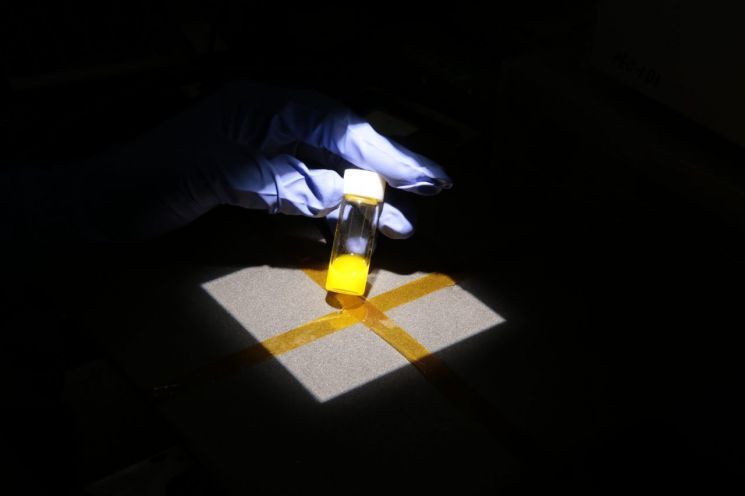
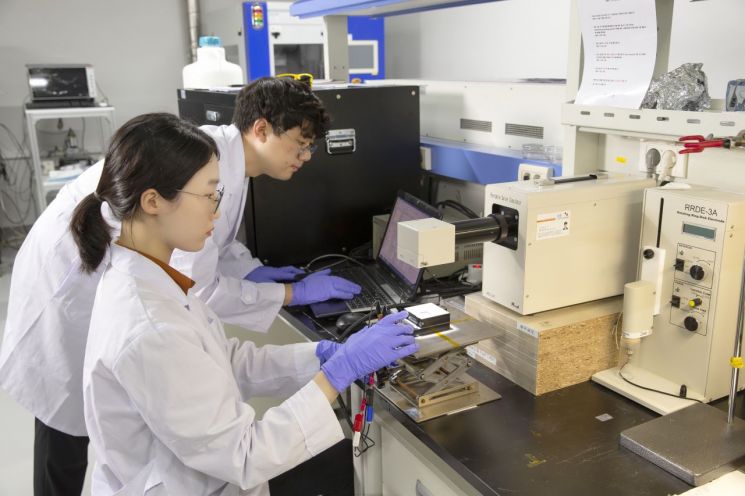
[Asia Economy Reporter Hwang Junho] Domestic researchers have developed a technology that protects perovskite solar cells, which are vulnerable to moisture, from water and blocks ultraviolet rays that cause cell 'aging,' converting them into useful visible light. This technology can be applied by coating the finished cells, making rapid commercialization expected. Professors Kwon Taehyuk, Seo Gwanyong, and Jang Seongyeon of Ulsan National Institute of Science and Technology announced on the 22nd that they developed perovskite electric coating materials and coating methods with various functions. The related research results are scheduled to be published on the 23rd (local time) in Advanced Energy Materials, an international journal in the energy field.
Protecting Solar Cells with Waterproof Spray
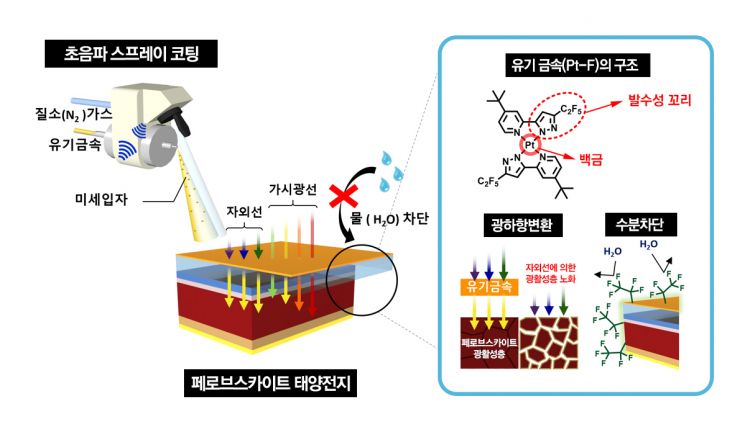
The research team developed a technology to solve the moisture vulnerability of perovskite solar cells and improve cell efficiency. They applied an organometallic compound with enhanced water-repellent properties (hydrophobicity) to the cells using an 'ultrasonic spray method.' The organometallic compound developed by the team converts ultraviolet rays absorbed by the perovskite into visible light. As the amount of visible light increases, the power absorbed by the cell also increases.
Hwang Eunhye, a first author and chemistry researcher, said, "The organometallic compound has a structure where organic molecules are attached like tails (ligands) around the metal platinum ion, and we used a substance with strong hydrophobic functional groups on these tails." Kim Hyeongwoo, a co-first author and energy engineering researcher, explained, "We designed the organometallic compound to selectively absorb ultraviolet rays and re-emit them as visible light based on density functional theory."
Maintains Initial Efficiency for Nearly 900 Hours Even at 50-60% Humidity
The cells coated with the organometallic compound maintained their initial efficiency for nearly 900 hours even under high humidity of 50-60%. The cell efficiency also improved due to the photoluminescence conversion. In contrast, cells without this coating saw their efficiency halved due to ultraviolet rays within 300 hours, while coated cells maintained their initial efficiency during the same period.
Professor Seo Gwanyong emphasized, "This research has a significant impact as it solves the chronic instability problem of perovskite solar cells while improving their efficiency."
The research team also developed an economical method to easily coat this organometallic compound. It is a method of applying a composite solution in fine particle form very thinly using compressed nitrogen gas. Unlike existing processes, it can coat both the top and sides of the substrate simultaneously. Professor Jang Seongyeon said, "It has economic feasibility (about US$2.0/m2) with minimal processing."
Professor Kwon Taehyuk explained, "The significance lies in creating a multifunctional protective film using a single material (organometallic) and a single process," adding, "It is a valuable study as a 'platform' technology applicable not only to perovskite but also to various solar cells."
© The Asia Business Daily(www.asiae.co.kr). All rights reserved.