Trump: "Unlimited Ammunition Reserves"
"Khamenei's Son Likely as Next Leader"
Push for Prolonged War Raises Concerns Over Escalating U.S. Fiscal Losses
![Trump: "We Can Fight Forever"... Is the U.S.-Iran Conflict Entering a Prolonged War? (Comprehensive) [U.S.-Iran War]](https://cphoto.asiae.co.kr/listimglink/1/2026030410364660928_1772588205.jpg)
There are growing projections that the war between the United States and Iran could evolve into a prolonged conflict. After U.S. President Donald Trump stated that a long-term war is feasible, Iran also expressed a strong determination to resist.
However, there are mounting concerns both inside and outside the United States regarding the shifting dynamics of the conflict. As fears of massive fiscal losses grow, voices within "MAGA"-President Trump's core support base-are increasingly opposing a prolonged war. Experts also point out that, with midterm elections approaching, the political burden is significant, and that it would be extremely difficult to conduct ground operations with the number of troops currently deployed.
Trump: "We Can Fight This War Forever"... Signals Possibility of Prolonged Conflict
![Trump: "We Can Fight Forever"... Is the U.S.-Iran Conflict Entering a Prolonged War? (Comprehensive) [U.S.-Iran War]](https://cphoto.asiae.co.kr/listimglink/1/2026030410365860930_1772588218.jpg)
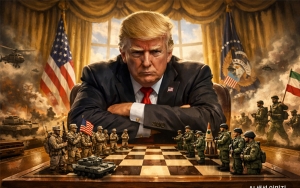
On March 3 (local time), President Trump responded on his social media platform, Truth Social, to a Wall Street Journal (WSJ) article published the previous day, which claimed that a lack of ammunition stockpiles would make a long-term war difficult. He said, "The WSJ article is wrong and it is a disgrace." He continued, "We have never had such large or high-quality reserves of intermediate and advanced munitions. We can, in fact, supply these weapons almost without limit," adding, "With these stockpiles alone, we could fight this war forever, and do so very successfully." He stressed that, if necessary, a prolonged war with Iran would be entirely possible.
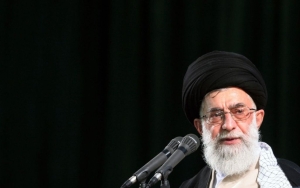
Iran, too, remains resolute in its will to resist over the long term. Domestically, it is reported that Mojtaba Khamenei, the second son of Supreme Leader Ali Khamenei, who was killed in a U.S. airstrike, is being strongly considered as his successor. The New York Times (NYT), citing three Iranian officials, reported that there are calls within the Assembly of Experts-the constitutional body that elects the Supreme Leader-to nominate Mojtaba Khamenei as the next leader, particularly among hardliners in the Islamic Revolutionary Guard Corps (IRGC).
Vali Nasr, an Iran and Shia Islam expert at Johns Hopkins University, told the NYT, "If Mojtaba Khamenei is chosen, the regime will, in effect, be even more dominated by the hardline Revolutionary Guard than it is now."
The Iranian military also asserted that it is capable of long-term defense. According to Iranian state media IRNA, Reza Talaei Nick, spokesperson for the Iranian Ministry of Defense, said at a press conference, "In this imposed war, we have the ability to resist longer and maintain offensive defense beyond what the enemy has planned," and added, "We do not intend to use all our advanced weapons and equipment within the first few days."
Concerns Over Expanding U.S. Fiscal Losses... Large-Scale Ground Forces Also Needed
![Trump: "We Can Fight Forever"... Is the U.S.-Iran Conflict Entering a Prolonged War? (Comprehensive) [U.S.-Iran War]](https://cphoto.asiae.co.kr/listimglink/1/2026030310554159180_1772502941.jpg)
There are concerns in and outside the United States that a drawn-out conflict could lead to enormous fiscal losses. Kent Smetters, lead researcher at the Penn Wharton Budget Model (PWBM) of the University of Pennsylvania's Wharton School, said in an interview with Fortune that "the total economic cost of U.S. and Israeli military operations against Iran could reach up to $210 billion (approximately KRW 310 trillion)," adding, "Direct military expenditure alone is estimated at a minimum of $4 billion to a maximum of $9.5 billion." He further warned, "If the war lasts more than two months, costs will rise sharply."
Bloomberg News also pointed out, "Iran's Shahed drones cost around $20,000 each, but the missiles used by the U.S. to intercept them cost up to $4 million each," and noted, "The longer the war drags on, the more disadvantageous it becomes for the United States and the more favorable it is for Iran."
There are also criticisms that the current U.S. military presence is insufficient. Currently, the number of U.S. troops mobilized for operations in Iran stands at around 45,000 to 50,000. With this level of force, only limited airstrikes are possible, and actual ground operations for a prolonged war would be difficult to sustain.
Mark Cancian, senior adviser, and Chris Park, research associate at the Center for Strategic and International Studies (CSIS), stated in a recent report, "While the U.S. forces currently deployed in the Middle East are sufficient for punitive airstrikes, they lack the Marine Corps, special operations forces, and logistical capability required to conduct large-scale ground operations like those seen in the 1991 Gulf War or the 2003 Iraq War." In fact, the U.S. deployed 450,000 ground troops in the Gulf War in 1991 and mobilized 150,000 ground troops during the Iraq War in 2003.
MAGA Supporters Also Oppose Prolonged War... Political Burden Ahead of Midterms
![Trump: "We Can Fight Forever"... Is the U.S.-Iran Conflict Entering a Prolonged War? (Comprehensive) [U.S.-Iran War]](https://cphoto.asiae.co.kr/listimglink/1/2026030410471760957_1772588838.jpg)
Within "MAGA," opposition to a prolonged conflict is also growing. They argue that it runs counter to the isolationist principles that were among President Trump's campaign pledges.
Tucker Carlson, a conservative commentator and prominent MAGA supporter, appeared on ABC on March 1 (local time), immediately after the U.S. airstrike, and criticized the operation as "disgusting and evil." Megyn Kelly, a conservative journalist and former Fox News anchor, also expressed her disapproval on social media, stating, "This war does not align with America First," and added, "I don't think the soldiers who died during the operation died for America. I think they died for Iran or Israel."
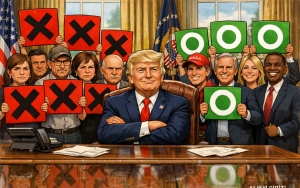
Axios, a U.S. political media outlet, reported, "The MAGA base appears divided over this war, and a significant number of people remain opposed to foreign conflicts." The outlet added, "If this war ends quickly and decisively, even those who opposed it may soon forget, but if it drags on, it could provoke outrage among many MAGA supporters."
© The Asia Business Daily(www.asiae.co.kr). All rights reserved.